


Clinicopathologic Characteristics and Outcomes of Lupus Nephritis With Antineutrophil Cytoplasmic Antibody: A Retrospective Study
- PMID: 26825903
- PMCID: PMC5291573
- DOI: 10.1097/MD.0000000000002580
Clinicopathologic Characteristics and Outcomes of Lupus Nephritis With Antineutrophil Cytoplasmic Antibody: A Retrospective Study
Abstract
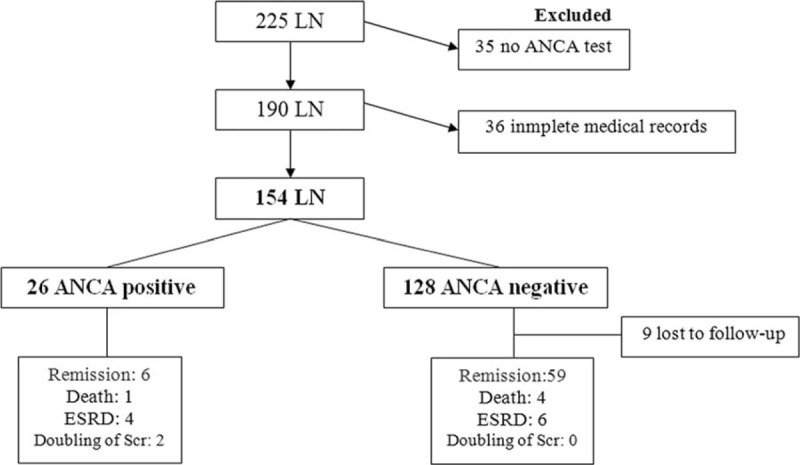
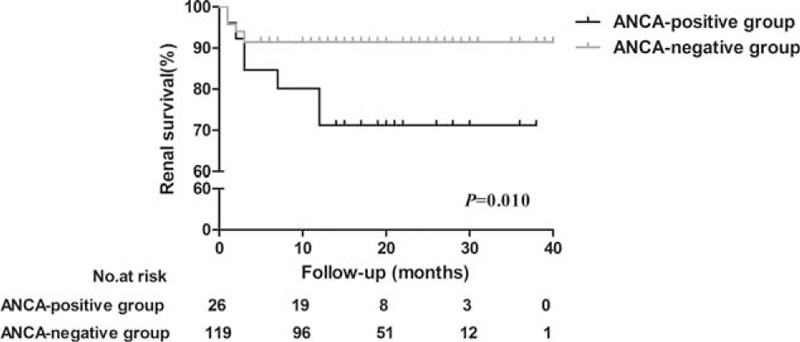
Few studies have analyzed the clinicopathologic characteristics and outcomes of lupus nephritis (LN) patients with antineutrophil cytoplasmic antibody (ANCA). The clinical and renal histopathologic data of 154 patients with biopsy-proven LN from 2011 to 2013 were analyzed retrospectively. The patients were followed up for a median period of 16.8 ± 9.4 months, and their outcomes were analyzed. Multivariate Cox analysis was used to evaluate the independent factors for poor outcomes. Among the 154 LN patients, 26 (16.88%) were seropositive for ANCA. The incidences of alopecia, oral ulcer, photosensitivity and skin lesion, and psychosomatic manifestations in the ANCA-positive group were significantly higher than in the ANCA-negative group (P = 0.007, 0.02, 0.02, and 0.03, respectively). Compared with the ANCA-negative group, the ANCA-positive group had significantly lower levels of complement C3 (P = 0.03). Additionally, the positive rate of antinucleosome antibodies, antihistone antibodies, antimitochondrial antibody M2, and anticardiolipin antibodies were higher significantly in the ANCA-positive patients than in the ANCA-negative patients (P = 0.001, 0.001, 0.03, 0.005, respectively). The ANCA-positive group had a notably higher chronic index than the ANCA-negative group (P = 0.01). During the follow-up, the complete remission rate in the ANCA-negative group was higher than that in the ANCA-positive group (P = 0.01). The cumulative renal survival rate in the ANCA-positive group was significantly lower than in the ANCA-negative group (log-rank = 6.59, P = 0.01). Multivariate Cox analysis revealed that the reduced estimated glomerular filtration rate (HR, 1.02; 95% confidence interval, 1.01 to 1.03; P = 0.005), NLR (HR, 1.20; 95% confidence interval, 1.02 to 1.40; P = 0.03), and ANCA (HR, 3.37; 95% confidence interval, 1.12 to 10.09; P = 0.03) were independent risk factors for patients' renal survival after adjusting for age, sex, crescent formation, and glomerulosclerosis. The study found ANCA in LN patients is not rare, and patients with ANCA present with more severe clinicopathologic injuries. Thus, ANCA is an independent risk factor for poor renal outcomes in LN patients.
Conflict of interest statement
The authors have no conflicts of interest to disclose.
Figures
References
-
- Borchers AT, Leibushor N, Naguwa SM, et al. Lupus nephritis: a critical review. Autoimmun Rev 2012; 12:174–194. - PubMed
-
- Furuta S, Jayne DRW. Antineutrophil cytoplasm antibody-associated vasculitis: recent developments. Kidney Int 2013; 84:244–249. - PubMed
-
- Chen M, Zhao M, Zhang Y, et al. Antineutrophil cytoplasmic autoantibodies in patients with systemic lupus erythematosus recognize a novel 69 kDa target antigen of neutrophil granules. Nephrology 2005; 10:491–495. - PubMed
-
- Savige JA, Davies DJ, Gatenby PA. Anti-neutrophil cytoplasmic antibodies (ANCA): their detection and significance: report from workshops. Pathology 1994; 26:186–193. - PubMed
Publication types
MeSH terms
Substances
LinkOut - more resources
Full Text Sources
Other Literature Sources
Miscellaneous
