


A Large Cohort Study on the Clinical Value of Simultaneous Amplification and Testing for the Diagnosis of Pulmonary Tuberculosis
- PMID: 26825909
- PMCID: PMC5291579
- DOI: 10.1097/MD.0000000000002597
A Large Cohort Study on the Clinical Value of Simultaneous Amplification and Testing for the Diagnosis of Pulmonary Tuberculosis
Abstract
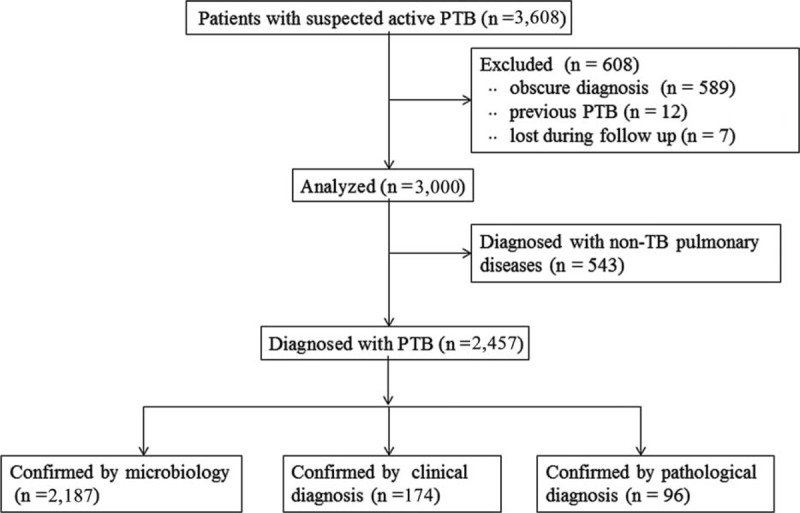
The AmpSure simultaneous amplification and testing method for the detection of Mycobacterium tuberculosis (SAT-TB assay) was designed to diagnose rapidly pulmonary tuberculosis (PTB). Unfortunately, the diagnostic advantage is unclear from previous small sample studies. In the current inquiry, a large sample size was used to reevaluate the clinical accuracy of the SAT-TB assay using sputum specimens. A total of 3608 patients with suspected PTB were enrolled prospectively for diagnosis from sputum specimens using the SAT-TB assay. Of these, 2457 had a definite diagnosis of PTB confirmed by positive microbiology, or pathologic findings of TB in the lung, or clinical diagnosis of active PTB following anti-TB treatment with a favorable response. The sensitivity, specificity and accuracy of the SAT-TB assay were 75.8%, 100%, and 80.2%, respectively. The sensitivity of SAT-TB was significantly higher than that of the sputum smear (23.8%) (X(2) = 1327.437; P = 0.000), wheresa significantly lower than that of sputum culture (89.0%) (X(2) = 148.197; P = 0.000). The specificity of SAT-TB was significantly higher than that of sputum smears (96.3%) (X(2) = 20.375, P = 0.000), whereas no significant difference was found compared with sputum cultures (99.6%) (X(2) = 2.004, P = 0.500). Positive results in the SAT-TB assay using sputum specimens indicates that active PTB is present and anti-TB treatment is strongly recommended regardless of smear and culture test results. Simultaneous amplification and testing method for detection of Mycobacterium tuberculosis is an accurate, cheap, and rapid method for PTB diagnosis.
Conflict of interest statement
The authors report no conflicts of interest.
References
-
- WHO Global tuberculosis report 2014. 2014; Geneva, Switzerland: World Health Organization/HTM/TB/2014.08, Available at. http://www.who.int/tb/publica tions/global_report/en. Accessed date December 1, 2014.
-
- McNerney R, Cunningham J, Hepple P, et al. New tuberculosis diagnostics and rollout. Int J Infect Dis 2015; 32:81–86. - PubMed
-
- WHO The Global Plan to Stop TB 2011–2015. Geneva, Switzerland: World Health Organization; 2010.
-
- Wang L, Zhang H, Ruan Y, et al. Tuberculosis prevalence in China, 1990–2010: a longitudinal analysis of national survey data. Lancet 2014; 383:2057–2064. - PubMed
-
- Ismail NA, Omar SV, Lewis JJ, et al. Performance of a novel algorithm using automated digital microscopy for diagnosing tuberculosis. Am J Respir Crit Care Med 2015; 191:1443–1449. - PubMed
Publication types
MeSH terms
Substances
LinkOut - more resources
Full Text Sources
Other Literature Sources
Research Materials
