


Building a Natural Language Processing Tool to Identify Patients With High Clinical Suspicion for Kawasaki Disease from Emergency Department Notes
- PMID: 26826020
- PMCID: PMC5031359
- DOI: 10.1111/acem.12925
Building a Natural Language Processing Tool to Identify Patients With High Clinical Suspicion for Kawasaki Disease from Emergency Department Notes
Abstract
Objective: Delayed diagnosis of Kawasaki disease (KD) may lead to serious cardiac complications. We sought to create and test the performance of a natural language processing (NLP) tool, the KD-NLP, in the identification of emergency department (ED) patients for whom the diagnosis of KD should be considered.
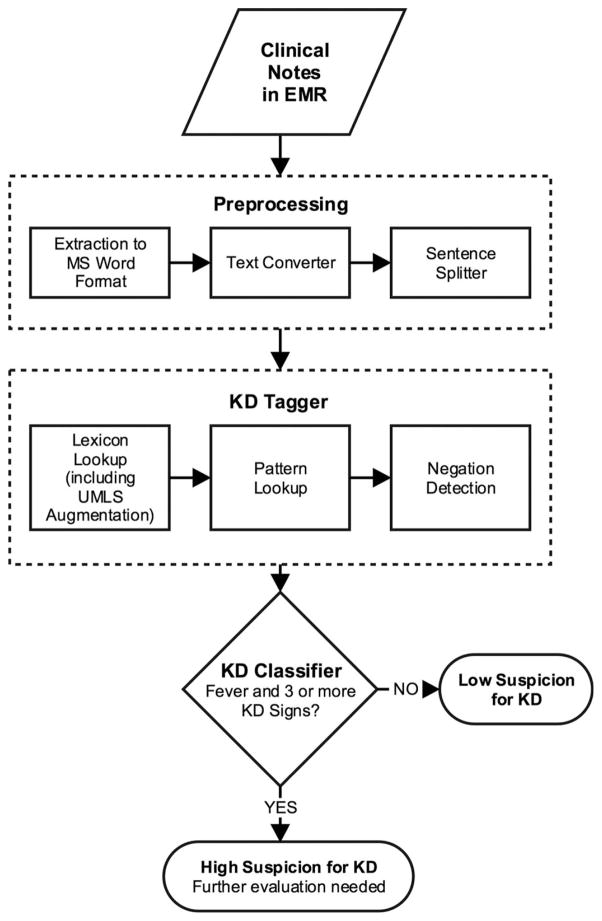
Methods: We developed an NLP tool that recognizes the KD diagnostic criteria based on standard clinical terms and medical word usage using 22 pediatric ED notes augmented by Unified Medical Language System vocabulary. With high suspicion for KD defined as fever and three or more KD clinical signs, KD-NLP was applied to 253 ED notes from children ultimately diagnosed with either KD or another febrile illness. We evaluated KD-NLP performance against ED notes manually reviewed by clinicians and compared the results to a simple keyword search.
Results: KD-NLP identified high-suspicion patients with a sensitivity of 93.6% and specificity of 77.5% compared to notes manually reviewed by clinicians. The tool outperformed a simple keyword search (sensitivity = 41.0%; specificity = 76.3%).
Conclusions: KD-NLP showed comparable performance to clinician manual chart review for identification of pediatric ED patients with a high suspicion for KD. This tool could be incorporated into the ED electronic health record system to alert providers to consider the diagnosis of KD. KD-NLP could serve as a model for decision support for other conditions in the ED.
© 2016 by the Society for Academic Emergency Medicine.
Conflict of interest statement
The authors have no potential confiicts to disclose. Supervising Editor: Damon Kuehl, MD.
Figures
References
-
- Newburger JW, Takahashi M, Gerber MA, et al. Diagnosis, treatment, and long-term management of Kawasaki disease: a statement for health professionals from the Committee on Rheumatic Fever, Endocarditis and Kawasaki Disease, Council on Cardiovascular Disease in the Young, American Heart Association. Circulation. 2004;110:2747–71. - PubMed
-
- Newburger JW, Takahashi M, Burns JC, et al. The treatment of Kawasaki syndrome with intravenous gamma globulin. N Engl J Med. 1986;315:341–7. - PubMed
-
- Newburger JW, Takahashi M, Beiser AS, et al. A single intravenous infusion of gamma globulin as compared with four infusions in the treatment of acute Kawasaki syndrome. N Engl J Med. 1991;324:1633–9. - PubMed
-
- Anderson MS, Todd JK, Glodé MP. Delayed diagnosis of Kawasaki syndrome: an analysis of the problem. Pediatrics. 2005;115:e428–33. - PubMed
Publication types
MeSH terms
Grants and funding
LinkOut - more resources
Full Text Sources
Other Literature Sources
Medical
