


Virtual online consultations: advantages and limitations (VOCAL) study
- PMID: 26826147
- PMCID: PMC4735312
- DOI: 10.1136/bmjopen-2015-009388
Virtual online consultations: advantages and limitations (VOCAL) study
Abstract
Introduction: Remote video consultations between clinician and patient are technically possible and increasingly acceptable. They are being introduced in some settings alongside (and occasionally replacing) face-to-face or telephone consultations.
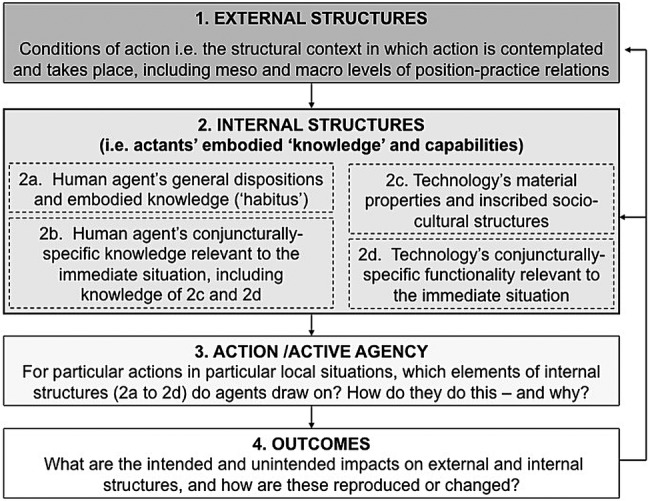
Methods: To explore the advantages and limitations of video consultations, we will conduct in-depth qualitative studies of real consultations (microlevel) embedded in an organisational case study (mesolevel), taking account of national context (macrolevel). The study is based in 2 contrasting clinical settings (diabetes and cancer) in a National Health Service (NHS) acute trust in London, UK. Main data sources are: microlevel--audio, video and screen capture to produce rich multimodal data on 45 remote consultations; mesolevel--interviews, ethnographic observations and analysis of documents within the trust; macrolevel--key informant interviews of national-level stakeholders and document analysis. Data will be analysed and synthesised using a sociotechnical framework developed from structuration theory.
Ethics approval: City Road and Hampstead NHS Research Ethics Committee, 9 December 2014, reference 14/LO/1883.
Planned outputs: We plan outputs for 5 main audiences: (1) academics: research publications and conference presentations; (2) service providers: standard operating procedures, provisional operational guidance and key safety issues; (3) professional bodies and defence societies: summary of relevant findings to inform guidance to members; (4) policymakers: summary of key findings; (5) patients and carers: 'what to expect in your virtual consultation'.
Discussion: The research literature on video consultations is sparse. Such consultations offer potential advantages to patients (who are spared the cost and inconvenience of travel) and the healthcare system (eg, they may be more cost-effective), but fears have been expressed that they may be clinically risky and/or less acceptable to patients or staff, and they bring significant technical, logistical and regulatory challenges. We anticipate that this study will contribute to a balanced assessment of when, how and in what circumstances this model might be introduced.
Published by the BMJ Publishing Group Limited. For permission to use (where not already granted under a licence) please go to http://www.bmj.com/company/products-services/rights-and-licensing/
Figures
References
-
- National Information Board (UK). Personalised health and care 2020: using data and technology to transform outcomes for patients and citizens. London: Stationery Office, 2014. https://www.gov.uk/government/uploads/system/uploads/attachment_data/fil... (accessed 8.6.2015).
-
- Horvath AO, Greenberg LS. Development and validation of the Working Alliance Inventory. J Couns Psychol 1989;36:223 10.1037/0022-0167.36.2.223 - DOI
MeSH terms
Grants and funding
LinkOut - more resources
Full Text Sources
Other Literature Sources
Medical
