


Pioneer transcription factors, chromatin dynamics, and cell fate control
- PMID: 26826681
- PMCID: PMC4914445
- DOI: 10.1016/j.gde.2015.12.003
Pioneer transcription factors, chromatin dynamics, and cell fate control
Abstract
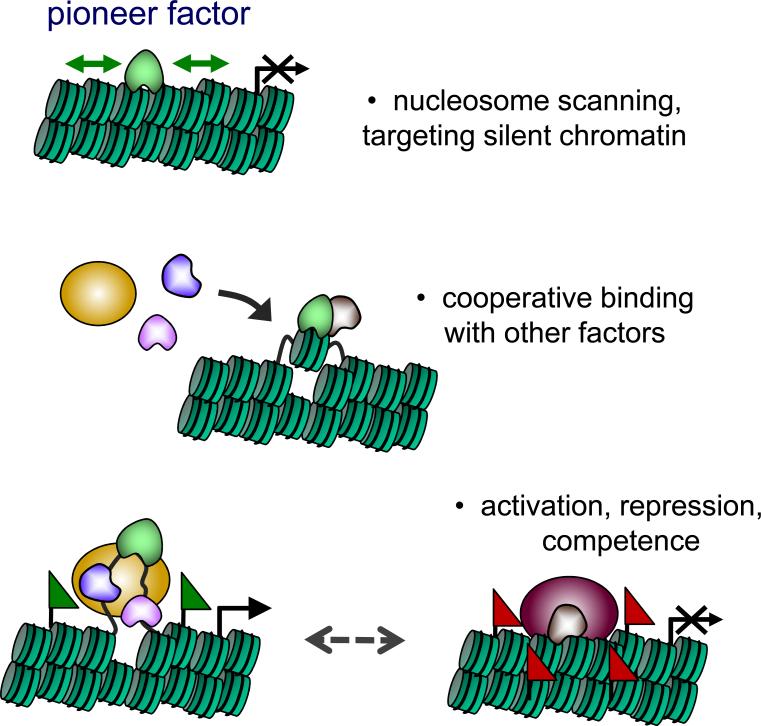
Among the diverse transcription factors that are necessary to elicit changes in cell fate, both in embryonic development and in cellular reprogramming, a subset of factors are capable of binding to their target sequences on nucleosomal DNA and initiating regulatory events in silent chromatin. Such 'pioneer transcription factors' initiate cooperative interactions with other regulatory proteins to elicit changes in local chromatin structure. As a consequence of pioneer factor binding, the local chromatin can either become open and competent for activation, closed and repressed, or transcriptionally active. Understanding how pioneer factors initiate chromatin dynamics and how such can be blocked at heterochromatic sites provides insights into controlling cell fate transitions at will.
Copyright © 2015 Elsevier Ltd. All rights reserved.
Figures
References
-
- Bossard P, Zaret KS. Repressive and restrictive mesodermal interactions with gut endoderm: possible relation to Meckel's Diverticulum. Development. 2000;127:4915–4923. - PubMed
-
- Budry L, Balsalobre A, Gauthier Y, Khetchoumian K, L'Honore A, Vallette S, Brue T, Figarella-Branger D, Meij B, Drouin J. The selector gene Pax7 dictates alternate pituitary cell fates through its pioneer action on chromatin remodeling. Genes Dev. 2012;26:2299–2310. [This paper demonstrates how Pax7 enables other factors to engage chromatin while inducing trans-differentiation.] - PMC - PubMed
Publication types
MeSH terms
Substances
Grants and funding
LinkOut - more resources
Full Text Sources
Other Literature Sources
Research Materials
