. 2017 May 1;81(9):797-806.
doi: 10.1016/j.biopsych.2015.11.019. Epub 2015 Dec 2.

Addiction-like Synaptic Impairments in Diet-Induced Obesity

Affiliations

Addiction-like Synaptic Impairments in Diet-Induced Obesity

Robyn Mary Brown et al. Biol Psychiatry. .

Abstract

Background: There is increasing evidence that the pathological overeating underlying some forms of obesity is compulsive in nature and therefore contains elements of an addictive disorder. However, direct physiological evidence linking obesity to synaptic plasticity akin to that occurring in addiction is lacking. We sought to establish whether the propensity to diet-induced obesity (DIO) is associated with addictive-like behavior, as well as synaptic impairments in the nucleus accumbens core considered hallmarks of addiction.

Methods: Sprague Dawley rats were allowed free access to a palatable diet for 8 weeks then separated by weight gain into DIO-prone and DIO-resistant subgroups. Access to palatable food was then restricted to daily operant self-administration sessions using fixed ratio 1, 3, and 5 and progressive ratio schedules. Subsequently, nucleus accumbens brain slices were prepared, and we tested for changes in the ratio between α-amino-3-hydroxy-5-methyl-4-isoxazole propionic acid (AMPA) and N-methyl-D-aspartate currents and the ability to exhibit long-term depression.

Results: We found that propensity to develop DIO is linked to deficits in the ability to induce long-term depression in the nucleus accumbens, as well as increased potentiation at these synapses as measured by AMPA/N-methyl-D-aspartate currents. Consistent with these impairments, we observed addictive-like behavior in DIO-prone rats, including 1) heightened motivation for palatable food; 2) excessive intake; and 3) increased food seeking when food was unavailable.

Conclusions: Our results show overlap between the propensity for DIO and the synaptic changes associated with facets of addictive behavior, supporting partial coincident neurological underpinnings for compulsive overeating and drug addiction.

Keywords: Food addiction; Glutamate; Long-term depression; Nucleus accumbens; Obesity; Synaptic plasticity.


Figures

Figure 1
Figure 1
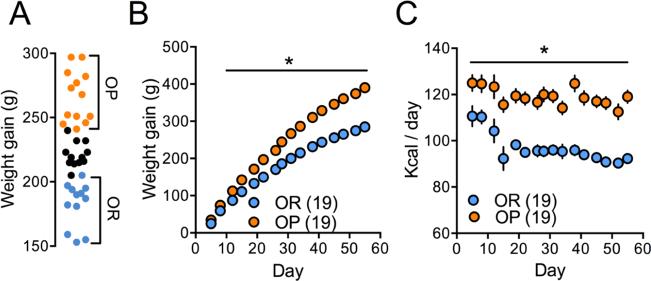
Free access to palatable food diet causes obesity in some rats but not in others. (A) Weight gain spread of a representative group of rats following 8 weeks of ad libitum palatable food diet in their home cages. Top third – diet-induced obese (OP) rats. Bottom third – diet-induced obesity resistant (OR) rats. (B) OP rats gained more weight than OR rats (two-way ANOVA, F(1,36)=96.64, p<0.0001 for weight gain main effect) during the 8 week diet period. (C) OP rats consumed more calories than OR rats (two-way ANOVA, F(1,36)=69.69 for Kcal consumed main effect) during the 8 week diet period. * - p<0.05. Data represents mean±SEM.
Figure 2
Figure 2
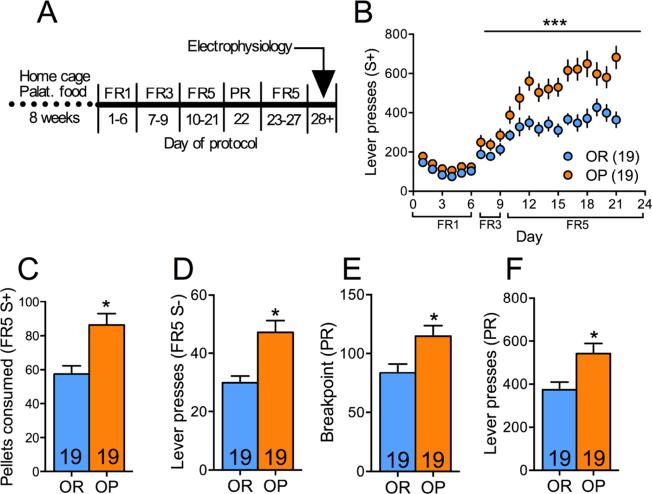
OP rats show increased addictive-like behavior as compared to OR rats. (A) Experimental protocol. FR – fixed ratio. (B) Timecourse of lever pressing during the S+ periods over the operant protocol schedule. *** - p=0.0003 (2-way ANOVA, F(1,36)=15.70 for main effect of weight gain). (C-F) OP rats showed increased pellet consumption during the FR5 S+ period (unpaired t-test, t(36)=3.49, p=0.0013) and higher lever pressing during the FR5 S− period (unpaired t-test, t(36)=3.755, p=0.0006), higher breakpoint (BP, Mann-Whitney test, U=90, p=0.0063) as well as lever presses (unpaired t-test, t(36)=2.87, p=0.007) during a progressive ratio (PR) task. Numbers in bars – rats. * - p<0.05. Data represents mean±SEM.
Figure 3
Figure 3
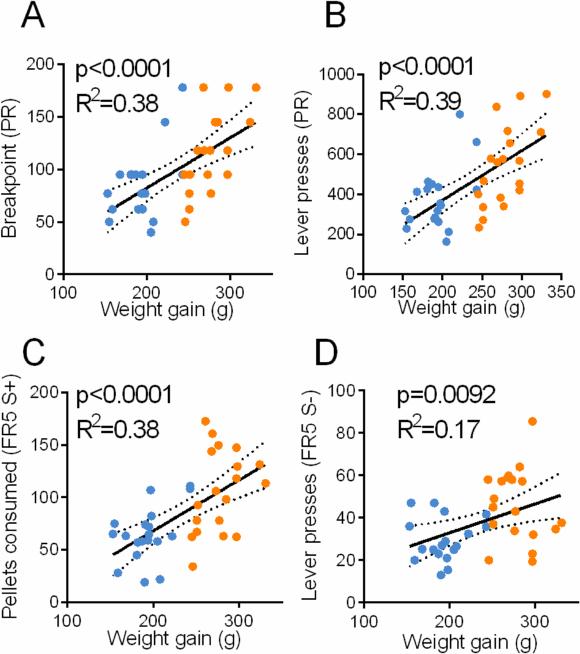
Behavior is positively correlated with previous weight gain. (A-B) breakpoint (F(1,36)=21.77) and lever presses (F(1.36)=23.18) in PR test. (C-D) Pellets consumed in FR5 S+ (F(1,36)=22.17) and lever presses during FR5 S−(F(1,36)=7.587) are positively correlated with weight gain. Dashed line represents 95% confidence. Blue – OR. Orange – OP.
Figure 4
Figure 4
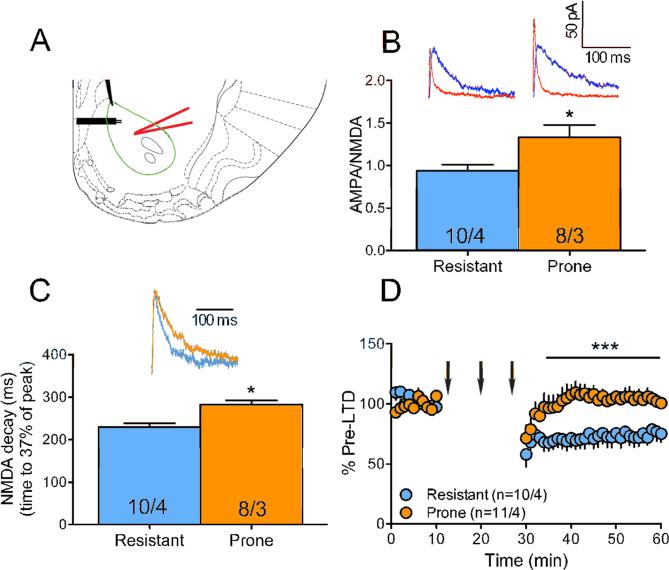
OP rats, but not OR rats, show “addiction-like” electrophysiological measures. (A) Schematic drawing of the recording setup. In a coronal section of the NAcore (green line) a medium spiny neuron located dorsomedial to the anterior commissure was patched by a glass pipette (red) and EPSCs were evoked by a stimulating electrode (black) positioned ~300 μm dorsomedial to the recorded neuron. Coronal slice diagram modified from (68). (B) OP rats show higher AMPA/NMDA (unpaired t-test, t(16)=2.59, p=0.02, red trace = AMPA, blue = NMDA) than OR rats. (C) OP rats show longer NMDA current decay (unpaired t-test, t(16)=3.96, p=0.001) than OR rats. Insets: representative traces. (D) OP rats show lack of LTD (two-way ANOVA, F(1,674)=159.0 for rat type main effect). Arrows indicate LTD protocol – three 3-min trains of 5 Hz. Numbers in bars and legend represent number of cells / number of rats. * p<0.05 using unpaired two-tailed student's t-test. *** p<0.0001 using Two-way ANOVA for main effect of group.
Figure 5
Figure 5
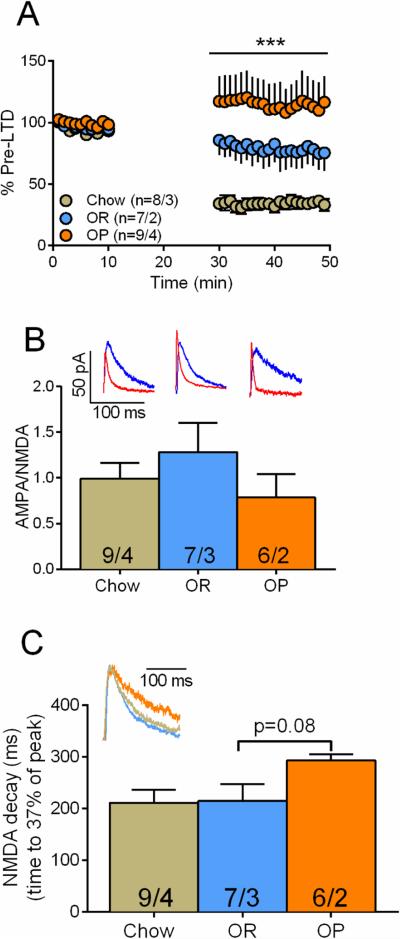
OP rats, but not OR rats or chow rats show some evidence of “addiction-like” electrophysiological measures after the homecage diet alone (no behavior) (A) Schematic drawing of the recording setup. In a coronal section of the NAcore (green line) a medium spiny neuron located dorsomedial to the anterior commissure was patched by a glass pipette (red) and EPSCs were evoked by a stimulating electrode (black) positioned ~300 μm dorsomedial to the recorded neuron. Coronal slice diagram modified from (68). (B) OP rats show lack of LTD and chow rat LTD is significantly greater than OR rat LTD (two-way ANOVA, F(2,833)=129.80 for rat type main effect). Arrows indicate LTD protocol – three 3-min trains of 5 Hz. (C) No difference between AMPDA/NMDA according to diet or weight gain on diet. (D) OP rats show a trend for longer NMDA current decay than OR and chow rats (one-way ANOVA, F(2, 19)=2.850). Insets: representative traces. Numbers in bars and legend represent number of cells / number of rats. *** p<0.0001 using Two-way ANOVA for main effect of group.
Figure 6
Figure 6
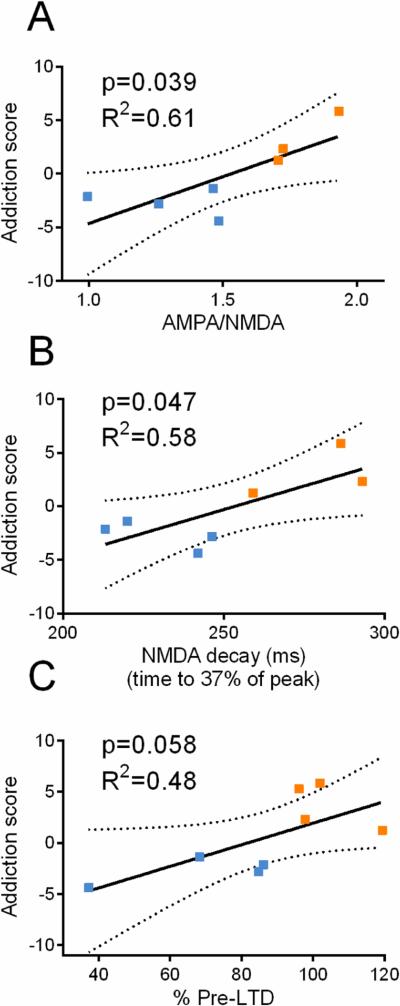
Addiction synaptic hallmarks are positively correlated with addictive-like behavior. (A-C) AMPA/NMDA (F(1,5)=7.772), NMDA decay (F(1,5)=6.899), and lack of LTD (F(1,6)=5.486) positively correlate with operant behavior. Operant behavior is presented by an ‘addiction score’ calculated for each rat (see Supplemental Methods). Dashed line represents 95% confidence. Blue – OR. Orange – OP.

Comment in

References

    1. NIDDK . Network WW-cI. NIDDK; 2005. Overweight and Obesity Statistics.
    1. DiLeone RJ, Taylor JR, Picciotto MR. The drive to eat: comparisons and distinctions between mechanisms of food reward and drug addiction. Nat Neurosci. 2012;15:1330–1335. - PMC - PubMed
    1. Volkow ND, Wang GJ, Fowler JS, Telang F. Overlapping neuronal circuits in addiction and obesity: evidence of systems pathology. Philos Trans R Soc Lond B Biol Sci. 2008;363:3191–3200. - PMC - PubMed
    1. Volkow ND, Wang GJ, Fowler JS, Tomasi D, Baler R. Food and drug reward: overlapping circuits in human obesity and addiction. Curr Top Behav Neurosci. 2012;11:1–24. - PubMed
    1. Volkow ND, Wang GJ, Tomasi D, Baler RD. Obesity and addiction: neurobiological overlaps. Obes Rev. 2013;14:2–18. - PMC - PubMed

Publication types