


Methylation Markers for the Identification of Body Fluids and Tissues from Forensic Trace Evidence
- PMID: 26829227
- PMCID: PMC4734623
- DOI: 10.1371/journal.pone.0147973
Methylation Markers for the Identification of Body Fluids and Tissues from Forensic Trace Evidence
Erratum in
-
Correction: Methylation Markers for the Identification of Body Fluids and Tissues from Forensic Trace Evidence.PLoS One. 2016 May 24;11(5):e0156472. doi: 10.1371/journal.pone.0156472. eCollection 2016. PLoS One. 2016. PMID: 27219355 Free PMC article.
Abstract
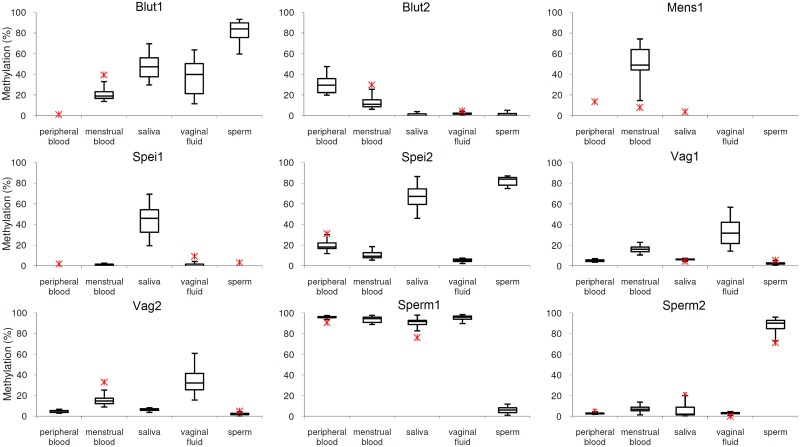
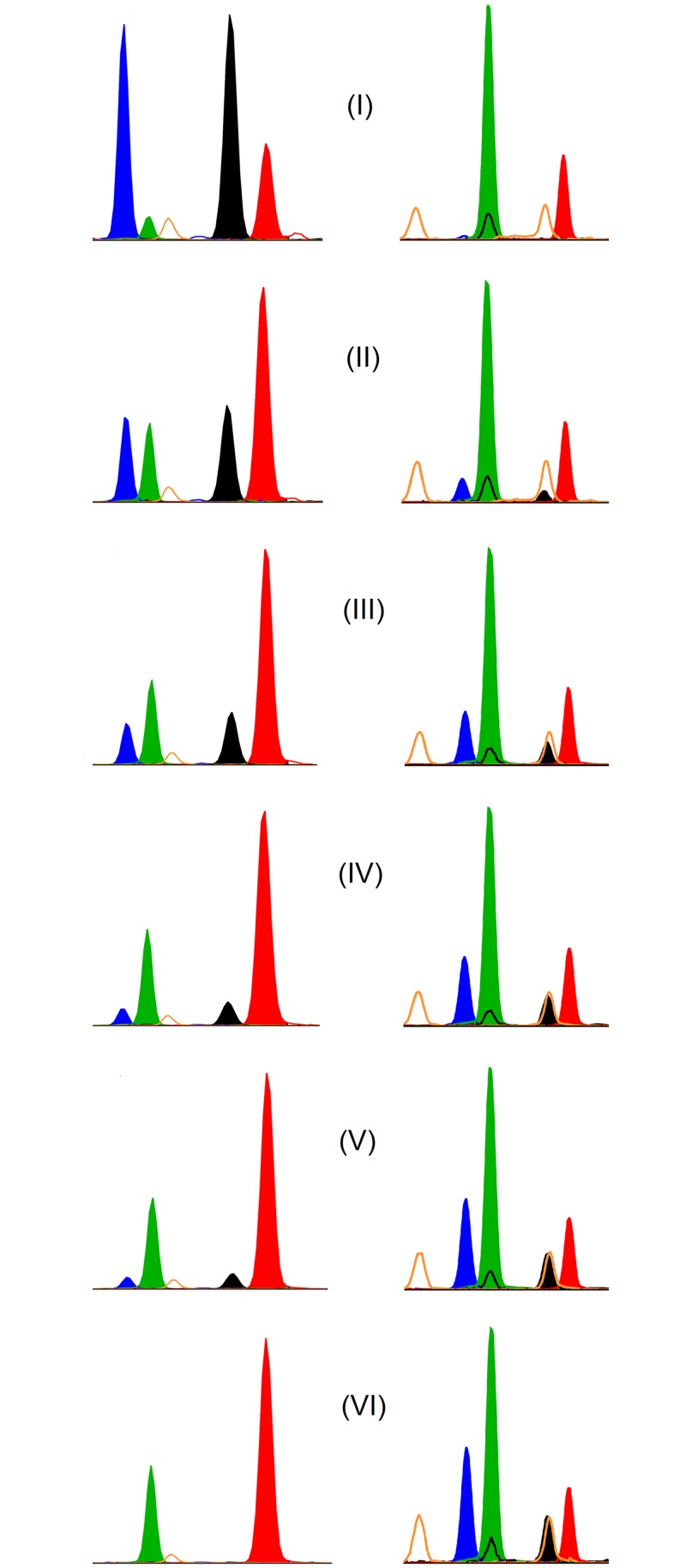
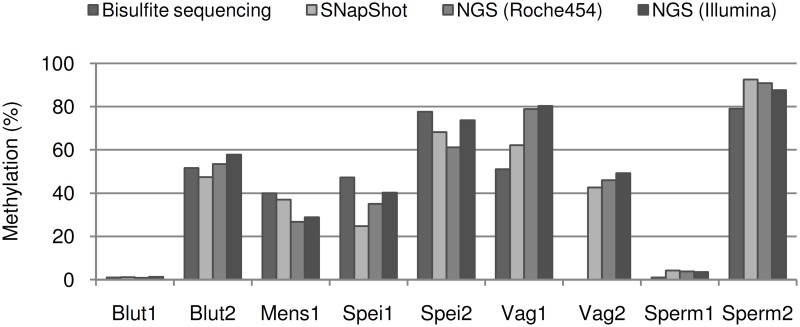
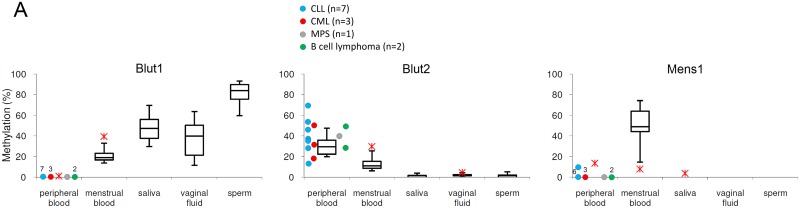
The identification of body fluids is an essential tool for clarifying the course of events at a criminal site. The analytical problem is the fact that the biological material has been very often exposed to detrimental exogenous influences. Thereby, the molecular substrates used for the identification of the traces may become degraded. So far, most protocols utilize cell specific proteins or RNAs. Instead of measuring these more sensitive compounds this paper describes the application of the differential DNA-methylation. As a result of two genome wide screenings with the Illumina HumanMethylation BeadChips 27 and 450k we identified 150 candidate loci revealing differential methylation with regard to the body fluids venous blood, menstrual blood, vaginal fluid, saliva and sperm. Among them we selected 9 loci as the most promising markers. For the final determination of the methylation degree we applied the SNuPE-method. Because the degree of methylation might be modified by various endogenous and exogenous factors, we tested each marker with approximately 100 samples of each target fluid in a validation study. The stability of the detection procedure is proved in various simulated forensic surroundings according to standardized conditions. We studied the potential influence of 12 relatively common tumors on the methylation of the 9 markers. For this purpose the target fluids of 34 patients have been analysed. Only the cervix carcinoma might have an remarkable effect because impairing the signal of both vaginal markers. Using the Illumina MiSeq device we tested the potential influence of cis acting sequence variants on the methylation degree of the 9 markers in the specific body fluid DNA of 50 individuals. For 4 marker loci we observed such an influence either by sole SNPs or haplotypes. The identification of each target fluid is possible in arbitrary mixtures with the remaining four body fluids. The sensitivity of the individual body fluid tests is in the same range as for the forensic STR-analysis. It is the first forensic body fluid protocol which considers the exogenic and endogenic parameters potentially interfering with the true results.
Conflict of interest statement
Figures

References
-
- Santucci KA, Nelson DG, McQuillen KK, Duffy SJ, Linakis JG. Wood's lamp utility in the identification of semen. Pediatrics. 1999. December;104(6):1342–4. - PubMed
-
- James SH, Nordby JJ. Identification of bi-ological fluids and stains; Forensic science: an introduction to scientific and investigative techniques. 2nd ed Boca Raton: CRC Press, USA; 2003.
-
- Allen SM. An enzyme linked immunosorbent assay (ELISA) for detection of seminal fluid using a monoclonal antibody to prostatic acid phosphatase. J Immunoassay. 1995. August;16(3):297–308. - PubMed
-
- Sato I, Barni F, Yoshiike M, Rapone C, Berti A, Nakaki S, et al. Applicability of Nanotrap Sg as a semen detection kit before male-specific DNA profiling in sexual assaults. Int J Legal Med. 2007. July;121(4):315–9. - PubMed
Publication types
MeSH terms
Substances
LinkOut - more resources
Full Text Sources
Other Literature Sources
Research Materials
