


Updated long-term survival for patients with metastatic colorectal cancer treated with liver resection followed by hepatic arterial infusion and systemic chemotherapy
- PMID: 26830685
- PMCID: PMC5076474
- DOI: 10.1002/jso.24189
Updated long-term survival for patients with metastatic colorectal cancer treated with liver resection followed by hepatic arterial infusion and systemic chemotherapy
Abstract
Background and objectives: Patients who undergo liver resection for metastatic colorectal cancer (mCRC) have reported 5-year survivals ranging from 25% to 50%. The current study updated long-term survival for patients with resected liver metastases treated with adjuvant hepatic arterial infusion (HAI) and systemic (SYS) chemotherapy.
Methods: Updated survival and recurrence free survival for patients treated on four consecutive adjuvant protocols with HAI and SYS from 1991 to 2009. Patients were divided into two groups: those treated on protocols before 2003 and after 2003. Median follow-up for all patients was 11 years.
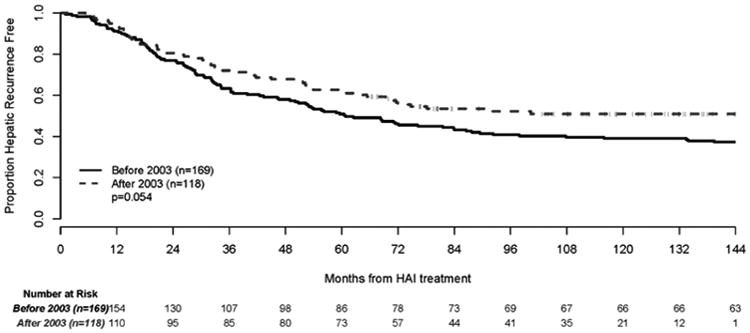
Results: All 287 patients enrolled in four prospective protocols after liver resection are included. Patients treated before 2003 had a median follow-up of 15 years, 5 and 10-year survivals of 56% [95%CI: 49-64%] and 40% [95%CI: 32-47%], respectively, and median survival of 71 months. Patients treated after 2003 had a median follow-up of 9 years, 5 and 10-year survivals of 78% [95%CI: 70-84%] and 61% [95%CI: 51-70%], respectively, and median survival has not been reached.
Conclusions: Survival is improving for patients with mCRC who undergo liver resection. These data support the durability of long-term survival in patients who undergo resection followed by adjuvant HAI and SYS therapy. J. Surg. Oncol. 2016;113:477-484. © 2016 Wiley Periodicals, Inc.
Keywords: adjuvant therapy; colorectal cancer; hepatic arterial infusion; liver metastases; survival.
© 2016 Wiley Periodicals, Inc.
Conflict of interest statement
The authors disclose no conflict of interest
Figures




References
-
- Tomlinson JS, Jarnagin WR, DeMatteo RP, et al. Actual 10-year survival after resection of colorectal liver metastases defines cure. J Clin Oncol. 2007;25:4575–4580. - PubMed
-
- Saltz LB, Cox JV, Blanke C, et al. Irinotecan plus fluorouracil and leucovorin for metastatic colorectal cancer. Irinotecan Study Group. N Engl J Med. 2000;343:905–914. - PubMed
-
- de Gramont A, Figer A, Seymour M, et al. Leucovorin and fluorouracil with or without oxaliplatin as first-line treatment in advanced colorectal cancer. J Clin Oncol. 2000;18:2938–2947. - PubMed
MeSH terms
Substances
Supplementary concepts
Grants and funding
LinkOut - more resources
Full Text Sources
Other Literature Sources
Medical
