Clinical Trial
. 2016 Feb 2:6:20093.
doi: 10.1038/srep20093.

Distinct Reward Properties are Encoded via Corticostriatal Interactions

Affiliations
Clinical Trial

Distinct Reward Properties are Encoded via Corticostriatal Interactions

David V Smith et al. Sci Rep. .

Abstract

The striatum serves as a critical brain region for reward processing. Yet, understanding the link between striatum and reward presents a challenge because rewards are composed of multiple properties. Notably, affective properties modulate emotion while informative properties help obtain future rewards. We approached this problem by emphasizing affective and informative reward properties within two independent guessing games. We found that both reward properties evoked activation within the nucleus accumbens, a subregion of the striatum. Striatal responses to informative, but not affective, reward properties predicted subsequent utilization of information for obtaining monetary reward. We hypothesized that activation of the striatum may be necessary but not sufficient to encode distinct reward properties. To investigate this possibility, we examined whether affective and informative reward properties were differentially encoded in corticostriatal interactions. Strikingly, we found that the striatum exhibited dissociable connectivity patterns with the ventrolateral prefrontal cortex, with increasing connectivity for affective reward properties and decreasing connectivity for informative reward properties. Our results demonstrate that affective and informative reward properties are encoded via corticostriatal interactions. These findings highlight how corticostriatal systems contribute to reward processing, potentially advancing models linking striatal activation to behavior.


Figures
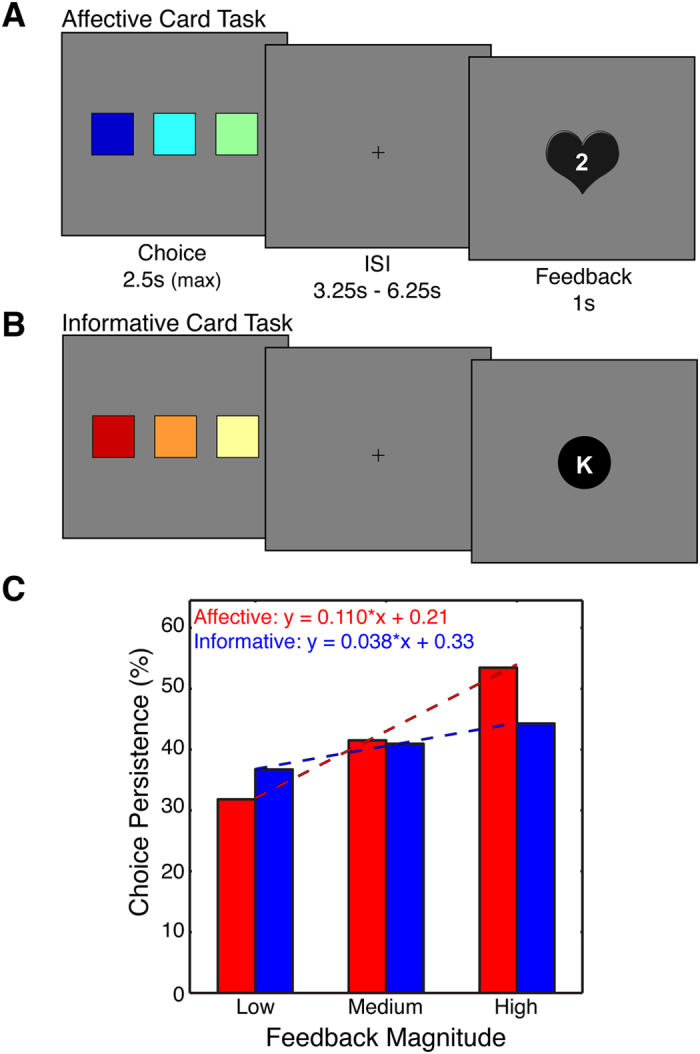
Figure 1
Figure 1. Experimental Tasks and Choice Behavior.
Affective and informative components of reward were investigated using two parallel card-guessing tasks. Both card-guessing tasks were predicated on distinct goals related to a bonus game played for monetary compensation at conclusion of the experiment. (A) In the Affective Card Task (ACT), the goal for the participants was to earn enough points to play in the bonus game. On each trial of the ACT, participants chose from three decks of cards containing variable amounts of points (1–3). (B) In the Informative Card Task (ICT), the goal for the participants was to learn the contents of each deck of cards because the bonus game would explicitly test this knowledge through a series of questions asking the participant which deck was most likely to contain a shown letter. To ensure valid comparisons with the ACT, the ICT utilized an identical trial structure, where participants chose between three decks containing letters (D, K, X) that appeared with different probabilities in each deck (50%, 33%, 17%). (C) To facilitate comparisons across tasks, both tasks delivered no feedback on a subset of trials (i.e., no points or no letter). Thus, feedback magnitude in both tasks was anchored to a common minimum, allowing us to make meaningful comparisons across tasks. Our behavioral analysis indicated that choice persistence—the likelihood of staying with a particular deck choice—increased with increasing feedback, an effect that was more pronounced during the ACT. Shown are the best-fit lines. We note that slopes of these lines were variable across participants (affective: range = −0.21:0.44, SD = 0.15; informative: range = −0.22:0.34, SD = 0.10), suggesting that choice persistence in some participants was not influenced by feedback magnitude.
Figure 2
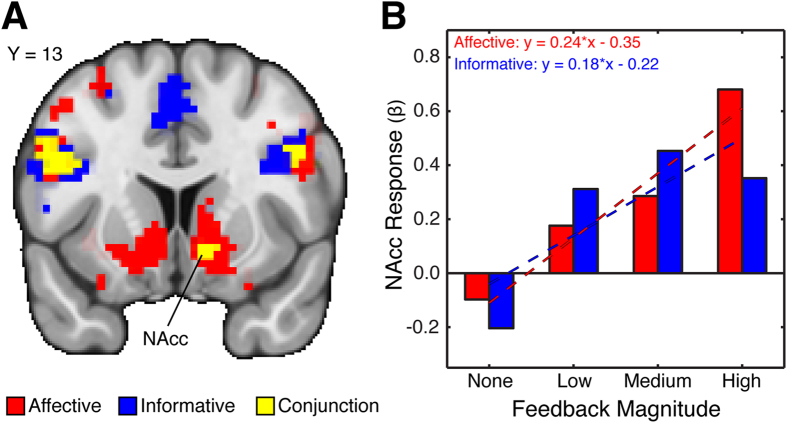
Figure 2. Affective and Informative Reward Properties Evoke Similar Responses within the Nucleus Accumbens.
(A) To identify brain regions whose activation tracked increasing levels of affective and informative reward properties, we constructed a parametric model based on normalized feedback magnitude. We found that affective (red) and informative (blue) feedback evoked activation in the striatum. To identify regions responding to both affective and informative feedback, we conducted a cluster-based conjunction analysis using the minimum statistic, which identified a cluster within nucleus accumbens (yellow) [MNIx,y,z = 9, 14, −7 (26 voxels)]. All areas of activation passed an initial cluster-forming threshold of z = 3.1, with whole-brain cluster correction at p = 0.05 (corrected for multiple comparisons). (B) Interrogation of the ventral striatum region revealed linear trends of activation for both conditions, with higher activation corresponding to higher feedback magnitude and lower activation corresponding to lower feedback magnitude. For descriptive purposes, the slopes of the best-fit lines illustrate the similarity in response profiles across increasing affective and informative feedback magnitude.
Figure 3
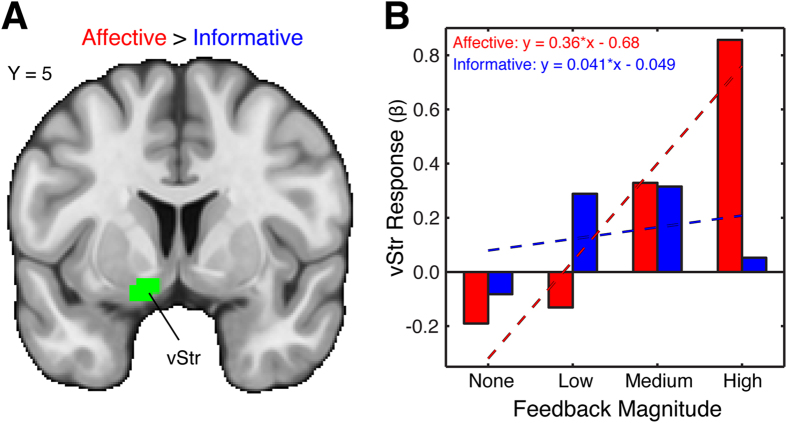
Figure 3. Affective Reward Properties Evoke Greater Responses within the Ventral Striatum.
(A) We also contrasted responses to affective and informative reward properties. This analysis revealed a cluster within ventral striatum [MNIx,y,z = −12, 5, −13 (22 voxels)] that responded more to affective reward properties compared to informative reward properties. This area of activation passed an initial cluster-forming threshold of z = 3.1, with whole-brain cluster correction at p = 0.05 (corrected for multiple comparisons). (B) Interrogation of the ventral striatum region revealed a linear trend of activation for the affective condition, with higher activation corresponding to higher feedback magnitude and lower activation corresponding to lower feedback magnitude. For descriptive purposes, the slopes of the best-fit lines illustrate the difference in response profiles across increasing affective and informative feedback magnitude.
Figure 4
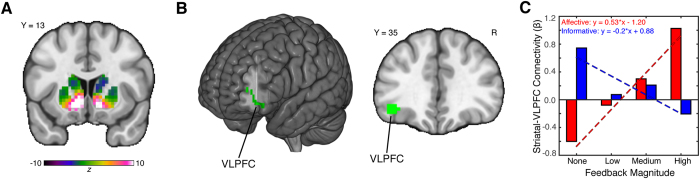
Figure 4. Corticostriatal Interactions Distinguish Affective and Informative Reward Properties.
We utilized a psychophysiological interaction (PPI) analysis to test whether the magnitude of affective and informative reward properties influenced functional connectivity with the striatum (defined by the union of the caudate, putamen, and nucleus accumbens within the Harvard-Oxford atlas). (A) We used independent component analysis to obtain a set of striatal networks—spatial maps containing distinct patterns of responses. Using a variant of dual-regression analysis, we found that one striatal network (i.e., independent component) that responded to affective and informative reward properties (shown as a map of z-scores). (For clarity, other independent components are not shown.) We used the task-sensitive striatal network as the “seed” region in our PPI analysis; its temporal dynamics were extracted from each participant using a variant of the dual-regression analysis. (B) Our task-sensitive striatal network exhibited dissociable patterns of functional connectivity with ventrolateral prefrontal cortex (VLPFC), with greater connectivity during affective feedback compared to informative feedback. We note that VLPFC activation passed an initial cluster-forming threshold of z = 2.3, with whole-brain cluster correction at p = 0.05 (corrected for multiple comparisons). (C) These corticostriatal interactions increased during affective feedback and decreased during informative feedback, suggesting that inputs from VLPFC may distinguish distinct reward properties. For descriptive purposes, the slopes of the best-fit lines illustrate the differences in connectivity strengths across increasing affective and informative feedback magnitude.

References

    1. Smith D. V. & Delgado M. R. In Brain Mapping: An Encyclopedic Reference Vol. 3 (ed. Toga A. W. ) 361–366 (Academic Press, 2015).
    1. Schultz W. Behavioral theories and the neurophysiology of reward. Annu. Rev. Psychol. 57, 87–115, 10.1146/annurev.psych.56.091103.070229 (2006). - DOI - PubMed
    1. O’Doherty J., Kringelbach M. L., Rolls E. T., Hornak J. & Andrews C. Abstract reward and punishment representations in the human orbitofrontal cortex. Nat. Neurosci. 4, 95–102 (2001). - PubMed
    1. D’Ardenne K., McClure S. M., Nystrom L. E. & Cohen J. D. BOLD responses reflecting dopaminergic signals in the human ventral tegmental area. Science 319, 1264–1267, 10.1126/science.1150605 (2008). - DOI - PubMed
    1. Delgado M. R., Nystrom L. E., Fissell C., Noll D. C. & Fiez J. A. Tracking the hemodynamic responses to reward and punishment in the striatum. J. Neurophysiol. 84, 3072–3077 (2000). - PubMed

Publication types

LinkOut - more resources