


Caries remineralisation and arresting effect in children by professionally applied fluoride treatment - a systematic review
- PMID: 26831727
- PMCID: PMC4736084
- DOI: 10.1186/s12903-016-0171-6
Caries remineralisation and arresting effect in children by professionally applied fluoride treatment - a systematic review
Abstract
Background: As a low-cost and easily operated treatment, the use of professionally applied topical fluoride was approved for preventing dental caries and remineralising early enamel caries or white spot lesions. It is also used to arrest dentine caries. The aim of this study is to investigate the clinical efficacy of professional fluoride therapy in remineralising and arresting caries in children.
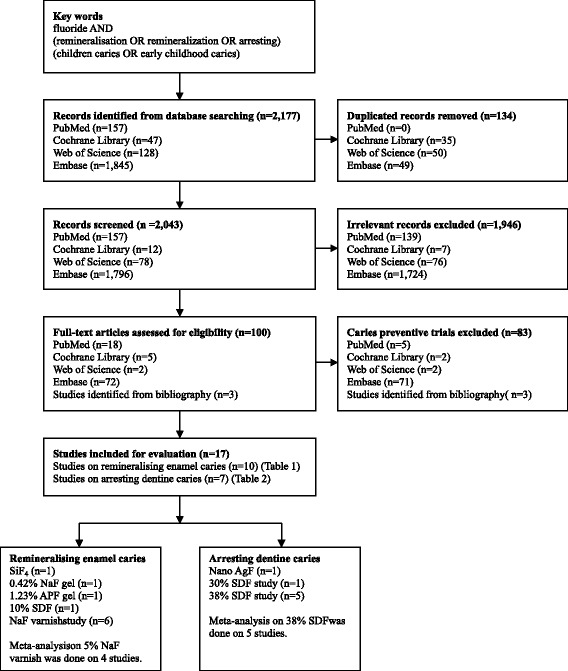
Method: A systematic search of publications from 1948 to 2014 was conducted using four databases: PubMed, Cochrane Library, ISI Web of Science and Embase. The key words used were (fluoride) AND (remineralisation OR remineralization OR arresting) AND (children caries OR early childhood caries). The title and abstract of initially identified publications were screened. Clinical trials about home-use fluorides, laboratory studies, case reports, reviews, non-English articles and irrelevant studies were excluded. The full texts of the remaining papers were retrieved. Manual screening was conducted on the bibliographies of the remaining papers to identify relevant articles.
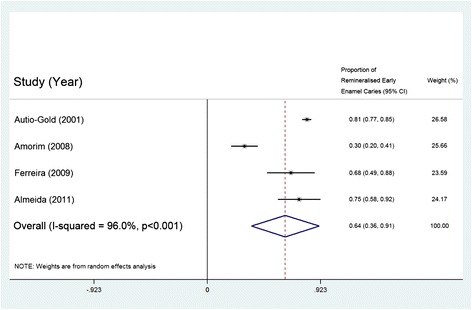
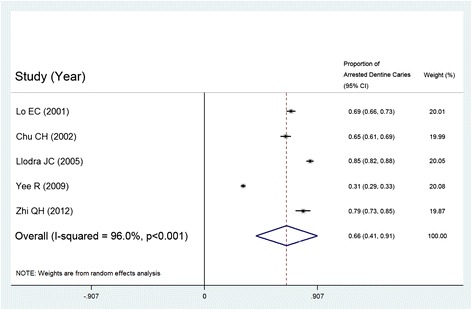
Results: A total of 2177 papers were found, and 17 randomised clinical trials were included in this review. Ten studies investigated the remineralising effect on early enamel caries using silicon tetrafluoride, fluoride gel, silver diamine fluoride or sodium fluoride. Seven studies reported an arresting effect on dentine caries using silver diamine fluoride or nano-silver fluoride. Meta-analysis was performed on four papers using 5 % sodium fluoride varnish to remineralise early enamel caries, and the overall percentage of remineralised enamel caries was 63.6 % (95 % CI: 36.0 % - 91.2 %; p < 0.001). Meta-analysis was also performed on five papers using 38 % silver diamine fluoride to arrest dentine caries and the overall proportion of arrested dentine caries was 65.9 % (95 % CI: 41.2 % - 90.7 %; p < 0.001).
Conclusion: Professionally applied 5 % sodium fluoride varnish can remineralise early enamel caries and 38 % silver diamine fluoride is effective in arresting dentine caries.
Figures
Comment in
-
Remineralisation and arresting caries in children with topical fluorides.Evid Based Dent. 2017 Jun 23;18(2):41-42. doi: 10.1038/sj.ebd.6401234. Evid Based Dent. 2017. PMID: 28642564
References
-
- Dye BA, Tan S, Smith V, Lewis B, Barker L, Thornton-Evans G, et al. Trends in oral health status: United States, 1988-1994 and 1999-2004. Vital and health statistics. Series 11, Data from the national health survey, 2007(248):1-92. - PubMed
-
- Bagramian RA, Garcia-Godoy F, Volpe AR. The global increase in dental caries. A pending public health crisis. Am J Dent. 2009;22(1):3–8. - PubMed
-
- Chu C, Fung D, Lo E. Dental public health: dental caries status of preschool children in Hong Kong. Br Dent J. 1999;187(11):616–620. - PubMed
-
- Chu C, Lo E. Promoting caries arrest in children with silver diamine fluoride: a review. Oral Health Prev Dent. 2008;6(4):315–321. - PubMed
Publication types
MeSH terms
Substances
LinkOut - more resources
Full Text Sources
Other Literature Sources
Medical
Research Materials
