


Association between two CHRNA3 variants and susceptibility of lung cancer: a meta-analysis
- PMID: 26831765
- PMCID: PMC4735583
- DOI: 10.1038/srep20149
Association between two CHRNA3 variants and susceptibility of lung cancer: a meta-analysis
Abstract
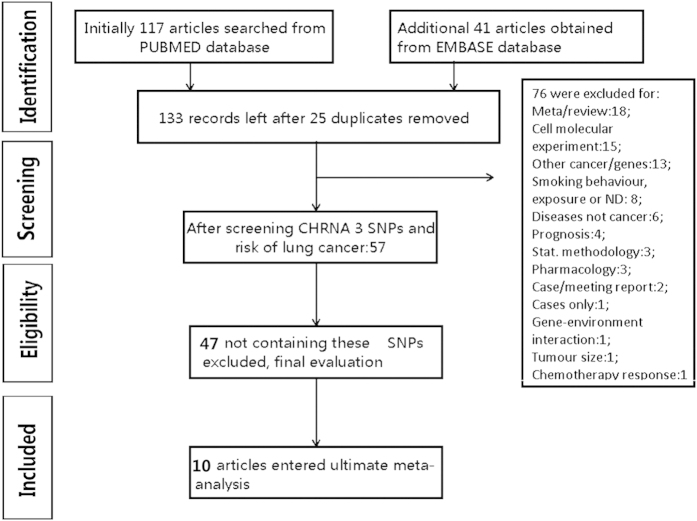
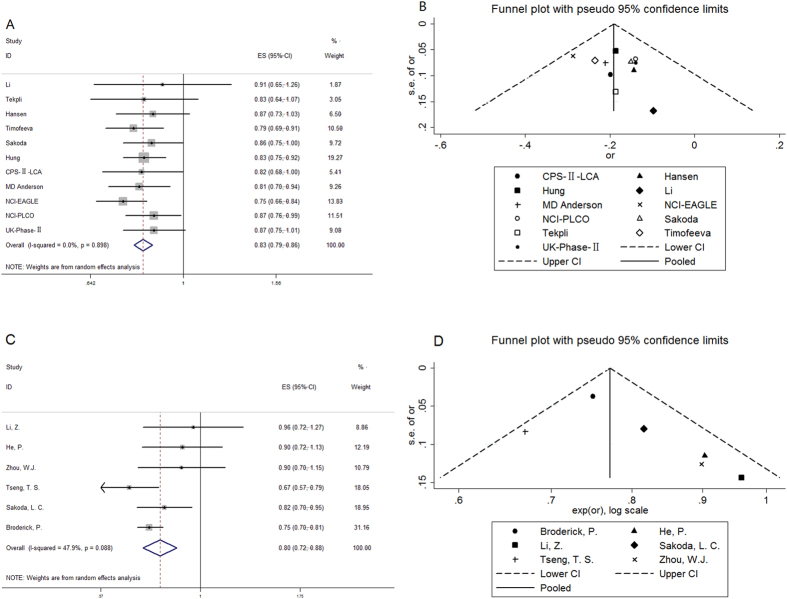
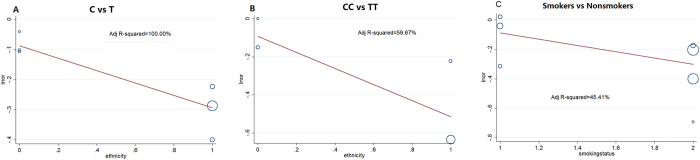
Genome-wide association studies (GWAS) have identified two CHRNA3 polymorphisms (rs578776 and rs938682) associated with lung cancer risk. Furthermore, these polymorphisms were investigated and genotyped by PCR analysis. All eligible case-control studies published up to Mar 1st 2015 were identified by searching Pubmed and Embase database. Negative association between rs578776-T allele and risk of lung cancer was obtained without obvious heterogeneity (OR: 0.83, 95% CI: 0.79-0.86; p = 0.898 for Q test). Rs938682-C allele carriers had a 12% to 28% decreased risk. Genotype model analysis showed results of dominant model for rs578776 (OR with 95% CI: 0.839(0.718-0.981)), dominant model for rs938682 (OR with 95% CI: 0.778(0.663-0.912)) and homozygous model for rs938682 (OR with 95% CI: 0.767(0.708-0.831)) were statistically significant. Subgroup analysis indicated rs578776-T variant had protective effect in Smokers, Caucasians, two histology subgroups, and two match subgroups. Meanwhile, rs938682-C allele was associated with decreased risk in Smokers, Caucasians, Lung cancer, and two match subgroups. Meta-regression suggested ethnicity might be the major source of heterogeneity in allele model and homozygous model for rs938682. Moreover, smoking status might contribute to part of heterogeneity under allele model. In summary, this meta-analysis suggested both rs578776 and rs938682 were significantly associated with the susceptibility of lung cancer.
Figures
References
-
- Wipfli H. & Samet J. M. Global economic and health benefits of tobacco control: part 1. Clin Pharmacol Ther 86, 263–71 (2009). - PubMed
-
- National Center for Chronic Disease, P. Health Promotion Office on, S. & Health. In The Health Consequences of Smoking-50 Years of Progress: A Report of the Surgeon General (Centers for Disease Control and Prevention (US), Atlanta (GA), 2014).
-
- Wynder E. L. & Graham E. A. Tobacco smoking as a possible etiologic factor in bronchiogenic carcinoma; a study of 684 proved cases. J Am Med Assoc 143, 329–36 (1950). - PubMed
-
- Wogan G. N., Hecht S. S., Felton J. S., Conney A. H. & Loeb L. A. Environmental and chemical carcinogenesis. Semin Cancer Biol 14, 473–486 (2004). - PubMed
Publication types
MeSH terms
Substances
LinkOut - more resources
Full Text Sources
Other Literature Sources
Medical
