. 2016 Sep;26(9):2183-2189.
doi: 10.1007/s11695-016-2072-9.

A Genetic Risk Score Is Associated with Weight Loss Following Roux-en Y Gastric Bypass Surgery

Affiliations

A Genetic Risk Score Is Associated with Weight Loss Following Roux-en Y Gastric Bypass Surgery

Marcus Bandstein et al. Obes Surg. 2016 Sep.

Abstract

Background: Currently, Roux-en Y gastric bypass (RYGB) is the most efficient therapy for severe obesity. Weight loss after surgery is, however, highly variable and genetically influenced. Genome-wide association studies have identified several single nucleotide polymorphisms (SNP) associated with body mass index (BMI) and waist-hip ratio (WHR). We aimed to identify two genetic risk scores (GRS) composed of weighted BMI and WHR-associated SNPs to estimate their impact on excess BMI loss (EBMIL) after RYGB surgery.

Methods: Two hundred and thirty-eight obese patients (BMI 45.1 ± 6.2 kg/m(2), 74 % women), who underwent RYGB, were genotyped for 35 BMI and WHR-associated SNPs and were followed up after 2 years. SNPs with high impact on post-surgical weight loss were filtered out using a random forest model. The filtered SNPs were combined into a GRS and analyzed in a linear regression model.

Results: An up to 11 % lower EBMIL with higher risk score was estimated for two GRS models (P = 0.026 resp. P = 0.021) composed of seven BMI-associated SNPs (closest genes: MC4R, TMEM160, PTBP2, NUDT3, TFAP2B, ZNF608, MAP2K5, GNPDA2, and MTCH2) and of three WHR-associated SNPs (closest genes: HOXC13, LYPLAL1, and DNM3-PIGC). Patients within the lowest GRS quartile had higher EBMIL compared to patients within the other three quartiles in both models.

Conclusions: We identified two GRSs composed of BMI and WHR-associated SNPs with significant impact on weight loss after RYGB surgery using random forest analysis as a SNP selection tool. The GRS may be useful to pre-surgically evaluate the risks for patients undergoing RYGB surgery.

Keywords: Genetic risk score; Obesity; Post-operative weight loss; Random forest model; Roux-en Y gastric bypass surgery.


Conflict of interest statement

Conflict of Interest

The authors declare that they have no competing interests.

Grant Information

The studies were supported by the Swedish Research Foundation, the Åhlens Foundation, the Novo Nordisk Foundation, and the Swedish Brain Research Foundation.

Figures
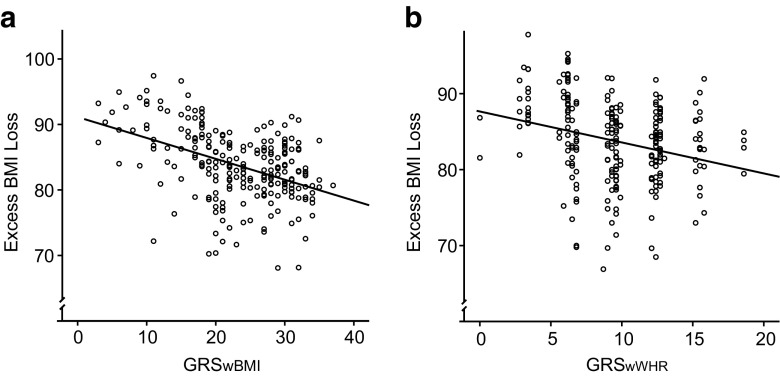
Fig. 1
Fig. 1
The genetic risk scores (GRS), calculated on the basis of weighted single nucleotide polymorphisms associated with BMI (a GRSwBMI) and waist-hip ratio (b GRSwWHR) estimated an up to 11 % difference in excess BMI loss (EBMIL) after Roux-en Y gastric bypass surgery with increasing risk score for both models. Each GRS was inserted individually in an adjusted multiple linear regression with EBMIL as the independent variable. a GRSwBMI included genetic variants of MC4R, TMEM160, PTBP2, NUDT3, TFAP2B, ZNF608, MAP2K5, GNPDA2, and MTCH2 and had a significant impact on EBMIL in a multilinear regression model adjusting for age, sex, initial BMI, and surgery type (P value of 0.026, line equation; y = 1.1–0.32x; R 2 = 0.181. b GRSwWHR consisted of variants within or near by the genes HOXC13, LYPLAL1, and DNM3-PIGC, P = 0.021, line equation; y = 89.4–0.59x; R 2 = 0.071
Fig. 2
Fig. 2
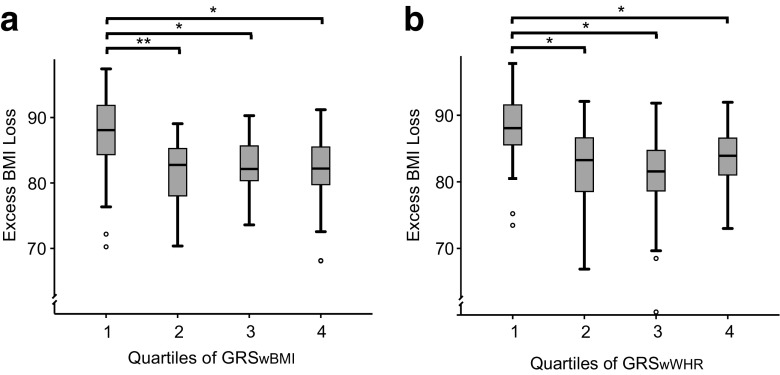
Quartiles of the genetic risk scores (GRS) indicate that patients with none or very few risk alleles have a higher expected excess BMI loss (EBMIL) following RYGB surgery than patients with a higher number of risk alleles. GRSs quartiles were inserted as factors in an adjusted multiple linear regressions with EBMIL as the independent variable. a In GRSwBMI Q1, the mean EBMIL was with 89 % significantly different from the means of Q2, Q3, and Q4 (79 to 83 %), Benjamini Hochberg-adjusted P < 0.027. b GRSwWHR Q1 corresponded to a mean EBMIL of 89 % compared to 81 to 82 % in Q2–Q4 (Benjamini Hochberg-adjusted P < 0.048). *P < 0.05, **P < 0.01

References

    1. Käkelä P, Jääskeläinen T, Torpström J, et al. Genetic risk score does not predict the outcome of obesity surgery. Obes Surg. 2014;24(1):128–33. doi: 10.1007/s11695-013-1080-2. - DOI - PubMed
    1. Elder KA, Wolfe BM. Bariatric surgery: a review of procedures and outcomes. Gastroenterology. 2007;132(6):2253–71. doi: 10.1053/j.gastro.2007.03.057. - DOI - PubMed
    1. Griffith PS, Birch DW, Sharma AM, et al. Managing complications associated with laparoscopic Roux-en-Y gastric bypass for morbid obesity. Can J Surg. 2012;55(5):329–36. doi: 10.1503/cjs.002011. - DOI - PMC - PubMed
    1. de Hollanda A, Ruiz T, Jimenez A, et al. Patterns of weight loss response following gastric bypass and sleeve gastrectomy. Obes Surg. 2015;25(7):1177–83. doi: 10.1007/s11695-014-1512-7. - DOI - PubMed
    1. Sevilla S, Hubal MJ. Genetic modifiers of obesity and bariatric surgery outcomes. Semin Pediatr Surg. 2014;23(1):43–8. doi: 10.1053/j.sempedsurg.2013.10.017. - DOI - PubMed