. 2016 Feb 9;14(5):991-999.
doi: 10.1016/j.celrep.2016.01.004. Epub 2016 Jan 28.

Inborn Errors of Long-Chain Fatty Acid β-Oxidation Link Neural Stem Cell Self-Renewal to Autism

Affiliations

Inborn Errors of Long-Chain Fatty Acid β-Oxidation Link Neural Stem Cell Self-Renewal to Autism

Zhigang Xie et al. Cell Rep. .

Abstract

Inborn errors of metabolism (IEMs) occur with high incidence in human populations. Especially prevalent among these are inborn deficiencies in fatty acid β-oxidation (FAO), which are clinically associated with developmental neuropsychiatric disorders, including autism. We now report that neural stem cell (NSC)-autonomous insufficiencies in the activity of TMLHE (an autism risk factor that supports long-chain FAO by catalyzing carnitine biosynthesis), of CPT1A (an enzyme required for long-chain FAO transport into mitochondria), or of fatty acid mobilization from lipid droplets reduced NSC pools in the mouse embryonic neocortex. Lineage tracing experiments demonstrated that reduced flux through the FAO pathway potentiated NSC symmetric differentiating divisions at the expense of self-renewing stem cell division modes. The collective data reveal a key role for FAO in controlling NSC-to-IPC transition in the mammalian embryonic brain and suggest NSC self renewal as a cellular mechanism underlying the association between IEMs and autism.


Figures

Figure 1
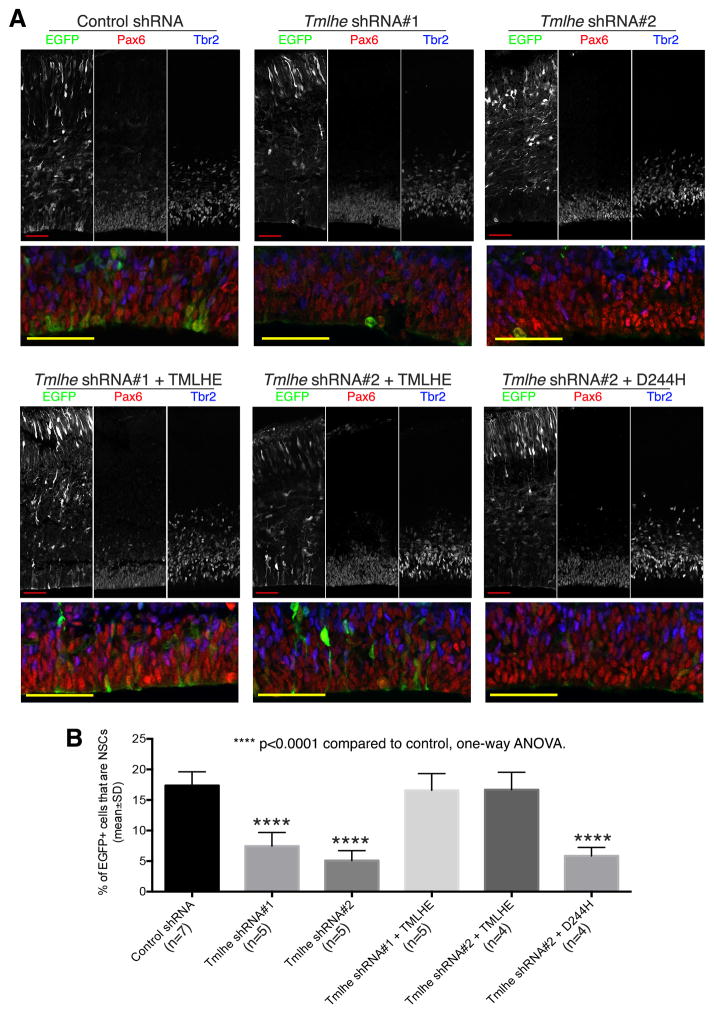
Figure 1. TMLHE Regulates the Size of NSC Pool in Mouse Embryonic Neocortex
Mouse embryos were co-electroporated with an EGFP plasmid and control or Tmlhe shRNA plasmid at E12.5, and sacrificed at E15.5. In rescue groups, a plasmid for expressing shRNA-resistant wild-type TMLHE (Tmlhe shRNA + TMLHE), or shRNA-resistant TMLHED244H (Tmlhe shRNA + D244H), was co-electroporated with Tmlhe shRNA and EGFP plasmid. (A) Representative confocal images. Areas of the ventricular zone (Pax6+ layer) are shown at higher magnification in bottom panels. (B) Quantification and statistics. Scale bars: 50μm. See also Figures S1 and S2.
Figure 2
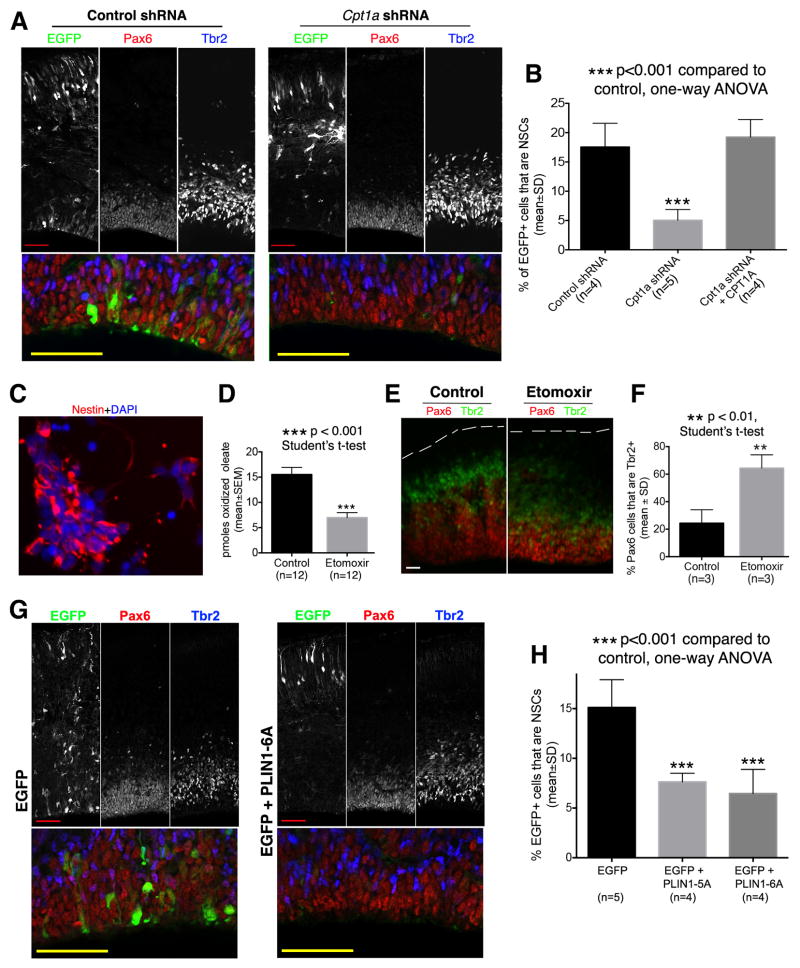
Figure 2. Targeting CPT1 or Fatty Acid Mobilization Diminished the NSC Pool
(A and B) Silencing Cpt1a diminished the NSC pool. Mouse embryos were electroporated at E12.5 and sacrificed at E15.5. In the rescue group (Cpt1a shRNA + CPT1A), a plasmid for expressing shRNA-resistant mouse Cpt1a cDNA was co-electroporated with Cpt1a shRNA and EGFP plasmid. (A) Representative confocal images. Areas of the ventricular zone (Pax6+ layer) are shown at higher magnification in bottom panels. Scale bars: 50μm. (B) Quantifications. (C–F) Etomoxir induces increased differentiation of NSCs. (C) Neocortical cells used for FAO assay. Dissociated neocortical cells of E11.5 mouse embryos were cultured overnight, and then used in [14C]-oleate oxidation assay for assessing FAO activity. Most cultured cells express the NSC marker Nestin. DAPI labels the nucleus of all cells. Scale bar: 10μm. (D) [14C]-Oleate oxidation assay confirms etomoxir inhibited FAO activity in cultured NSCs. (E and F) Etomoxir potentiated NSC differentiation in organotypic culture of forebrain hemispheres. (E) Representative images from three independent experiments showing reduced thickness of ventricular zone (Pax6+ layer) in etomoxir group and increased fraction of Pax6+ cells that co-express Tbr2. The pial surface is outlined by dashed lines. Scale bars: 20μm. (F) Quantifications. The percentage of Pax6+ cells that co-express Tbr2 was significantly increased in the etomoxir group. (G and H) Blocking fatty acid mobilization from lipid droplets by overexpressing dominant-negative mutants of PLIN1 diminished the NSC pool. Mouse embryos were electroporated at E12.5 and sacrificed at E15.5. (G) Representative confocal images. Areas of the ventricular zone (Pax6+ layer) are shown at higher magnification in bottom panels. Scale bars: 50μm. (H) Quantification and statistics. See also Figure S3.
Figure 3
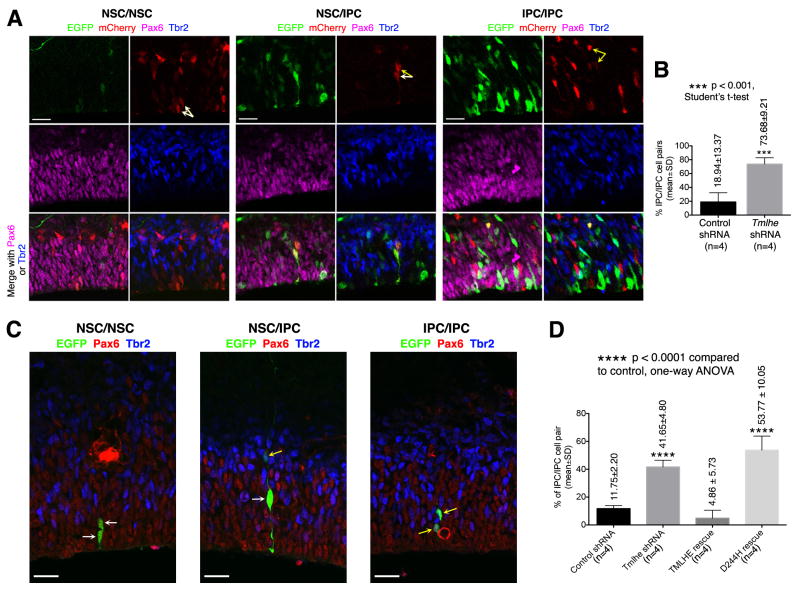
Figure 3. TMLHE Inhibits Symmetric NSC Division that Produces Two IPCs
(A and B) Analysis of NSC division by two-step electroporation assay. (A) Representative images showing vicinal EGFP+mCherry+ cell pairs of NSC/NSC, NSC/IPC, and IPC/IPC. White and yellow arrows indicate NSCs (Pax6+Tbr2) and IPCs (Tbr2+), respectively. Scale bars: 20μm. (B) Quantification and statistics. (C and D) Analysis of NSC division using Attractene-mediated transfection. (C) Representative images showing vicinal EGFP+ cell pairs of NSC/NSC, NSC/IPC, and IPC/IPC. White and yellow arrows indicate NSCs and IPCs, respectively. Scale bars: 20μm. (D) Quantification and statistics. See also Figure S4.
Figure 4
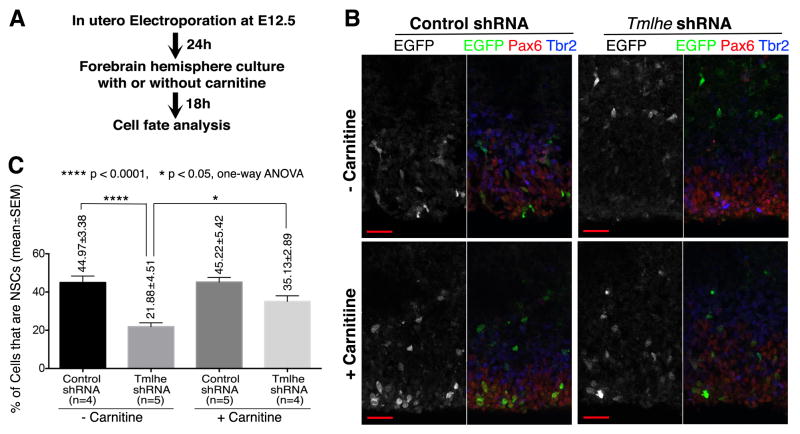
Figure 4. Exogenous Carnitine Largely Rescues Tmlhe shRNA-Induced NSC Defects
(A) Experimental procedures. (B) Representative confocal images. Scale bars: 20μm. (C) Quantification and statistics.

References

    1. Bélanger M, Allaman I, Magistretti PJ. Brain energy metabolism: focus on astrocyte-neuron metabolic cooperation. Cell Metab. 2011;14:724–738. - PubMed
    1. Bian S, Hong J, Li Q, Schebelle L, Pollock A, Knauss JL, Garg V, Sun T. MicroRNA cluster miR-17-92 regulates neural stem cell expansion and transition to intermediate progenitors in the developing mouse neocortex. Cell Rep. 2013;3:1398–1406. - PMC - PubMed
    1. Bush KT, Lee H, Nagele RG. Lipid droplets of neuroepithelial cells are a major calcium storage site during neural tube formation in chick and mouse embryos. Experientia. 1992;48:516–519. - PubMed
    1. Celestino-Soper PB, Violante S, Crawford EL, Luo R, Lionel AC, Delaby E, Cai G, Sadikovic B, Lee K, Lo C, et al. A common X-linked inborn error of carnitine biosynthesis may be a risk factor for nondysmorphic autism. Proc Natl Acad Sci U S A. 2012;109:7974–7981. - PMC - PubMed
    1. Clark-Taylor T, Clark-Taylor BE. Is autism a disorder of fatty acid metabolism? Possible dysfunction of mitochondrial beta-oxidation by long chain acyl-CoA dehydrogenase. Med Hypotheses. 2004;62:970–975. - PubMed

Publication types

MeSH terms