


Supporting breastfeeding In Local Communities (SILC) in Victoria, Australia: a cluster randomised controlled trial
- PMID: 26832427
- PMCID: PMC4746449
- DOI: 10.1136/bmjopen-2015-008292
Supporting breastfeeding In Local Communities (SILC) in Victoria, Australia: a cluster randomised controlled trial
Abstract
Objectives: Breastfeeding has significant health benefits for mothers and infants. Despite recommendations from the WHO, by 6 months of age 40% of Australian infants are receiving no breast milk. Increased early postpartum breastfeeding support may improve breastfeeding maintenance. 2 community-based interventions to increase breastfeeding duration in local government areas (LGAs) in Victoria, Australia, were implemented and evaluated.
Design: 3-arm cluster randomised trial.
Setting: LGAs in Victoria, Australia.
Participants: LGAs across Victoria with breastfeeding initiation rates below the state average and > 450 births/year were eligible for inclusion. The LGA was the unit of randomisation, and maternal and child health centres in the LGAs comprised the clusters.
Interventions: Early home-based breastfeeding support by a maternal and child health nurse (home visit, HV) with or without access to a community-based breastfeeding drop-in centre (HV+drop-in).
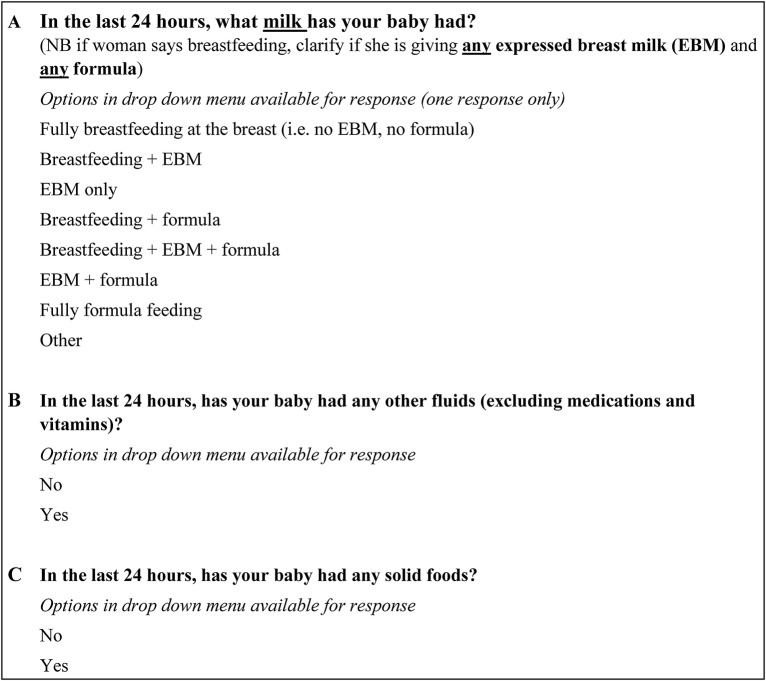
Main outcome measures: The proportion of infants receiving 'any' breast milk at 3, 4 and 6 months (women's self-report).
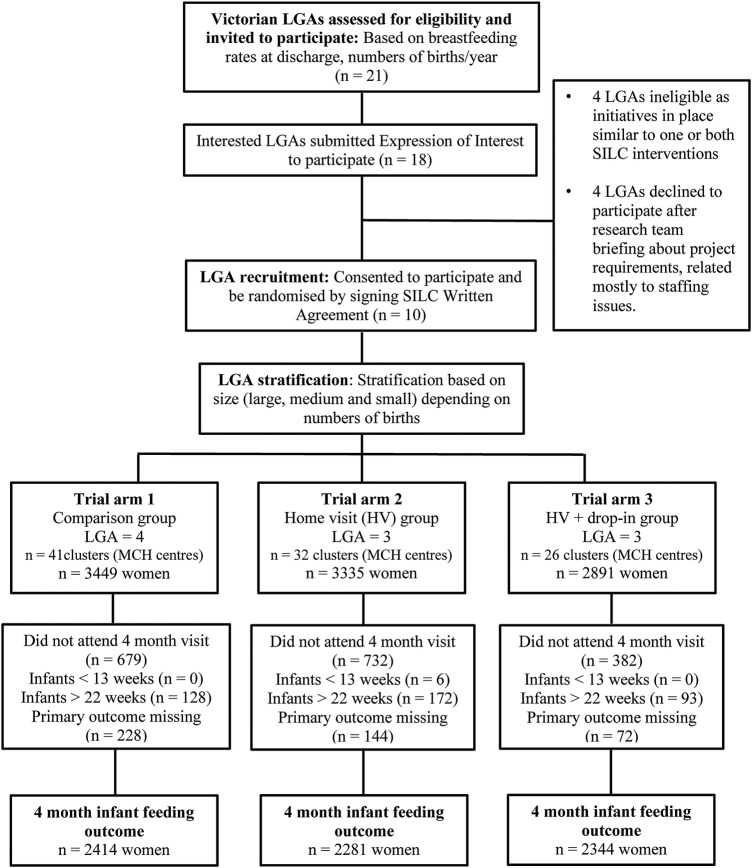
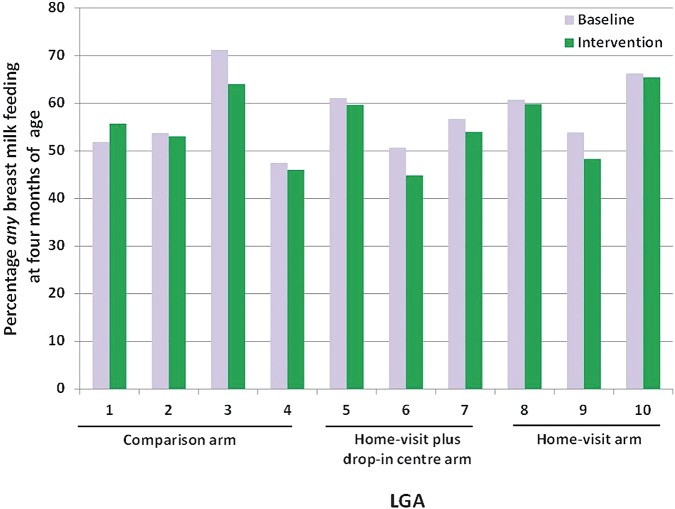
Findings: 4 LGAs were randomised to the comparison arm and provided usual care (n=41 clusters; n=2414 women); 3 to HV (n=32 clusters; n=2281 women); and 3 to HV+drop-in (n=26 clusters; 2344 women). There was no difference in breastfeeding at 4 months in either HV (adjusted OR 1.04; 95% CI 0.84 to 1.29) or HV+drop-in (adjusted OR 0.92; 95% CI 0.78 to 1.08) compared with the comparison arm, no difference at 3 or 6 months, nor in any LGA in breastfeeding before and after the intervention. Some issues were experienced with intervention protocol fidelity.
Conclusions: Early home-based and community-based support proved difficult to implement. Interventions to increase breastfeeding in complex community settings require sufficient time and partnership building for successful implementation. We cannot conclude that additional community-based support is ineffective in improving breastfeeding maintenance given the level of adherence to the planned protocol.
Trial registration number: ACTRN12611000898954; Results.
Keywords: NUTRITION & DIETETICS; PUBLIC HEALTH.
Published by the BMJ Publishing Group Limited. For permission to use (where not already granted under a licence) please go to http://www.bmj.com/company/products-services/rights-and-licensing/
Figures
References
-
- United Nations Children's Fund (UNICEF). Breastfeeding on the Worldwide Agenda: findings from a landscape analysis on political commitment for programmes to protect, promote and support breastfeeding. New York, NY, USA, 2013.
-
- National Health and Medical Research Council. Infant Feeding Guidelines: information for health workers. Canberra: National Health and Medical Research Council, 2012. - PubMed
-
- World Health Organization. Expert consultation on the optimal duration of exclusive breastfeeding. Conclusions and recommendations. Secondary expert consultation on the optimal duration of exclusive breastfeeding. Conclusions and recommendations, 2001. http://www.who.int/inf-pr-2001/en/note2001–07.html
-
- Australian Institute of Health and Welfare. 2010 Australian National Infant Feeding Survey: indicator results. Canberra: AIHW, 2011.
-
- Amir LH, Donath SM. Socioeconomic status and rates of breastfeeding in Australia: evidence from three recent national health surveys. Med J Aust 2008;189:254–6. - PubMed
Publication types
MeSH terms
Associated data
LinkOut - more resources
Full Text Sources
Other Literature Sources
Medical
