. 2016 Aug;27(8):2270-5.
doi: 10.1681/ASN.2015060676. Epub 2016 Feb 1.

Caspase-1, but Not Caspase-3, Promotes Diabetic Nephropathy

Affiliations

Caspase-1, but Not Caspase-3, Promotes Diabetic Nephropathy

Khurrum Shahzad et al. J Am Soc Nephrol. 2016 Aug.

Abstract

Glomerular apoptosis may contribute to diabetic nephropathy (dNP), but the pathophysiologic relevance of this process remains obscure. Here, we administered two partially disjunct polycaspase inhibitors in 8-week-old diabetic (db/db) mice: M-920 (inhibiting caspase-1, -3, -4, -5, -6, -7, and -8) and CIX (inhibiting caspase-3, -6, -7, -8, and -10). Notably, despite reduction in glomerular cell death and caspase-3 activity by both inhibitors, only M-920 ameliorated dNP. Nephroprotection by M-920 was associated with reduced renal caspase-1 and inflammasome activity. Accordingly, analysis of gene expression data in the Nephromine database revealed persistently elevated glomerular expression of inflammasome markers (NLRP3, CASP1, PYCARD, IL-18, IL-1β), but not of apoptosis markers (CASP3, CASP7, PARP1), in patients with and murine models of dNP. In vitro, increased levels of markers of inflammasome activation (Nlrp3, caspase-1 cleavage) preceded those of markers of apoptosis activation (caspase-3 and -7, PARP1 cleavage) in glucose-stressed podocytes. Finally, caspase-3 deficiency did not protect mice from dNP, whereas both homozygous and hemizygous caspase-1 deficiency did. Hence, these results suggest caspase-3-dependent cell death has a negligible effect, whereas caspase-1-dependent inflammasome activation has a crucial function in the establishment of dNP. Furthermore, small molecules targeting caspase-1 or inflammasome activation may be a feasible therapeutic approach in dNP.

Keywords: apoptosis; diabetic nephropathy; immunology; renal protection.


Figures

Figure 1.
Figure 1.
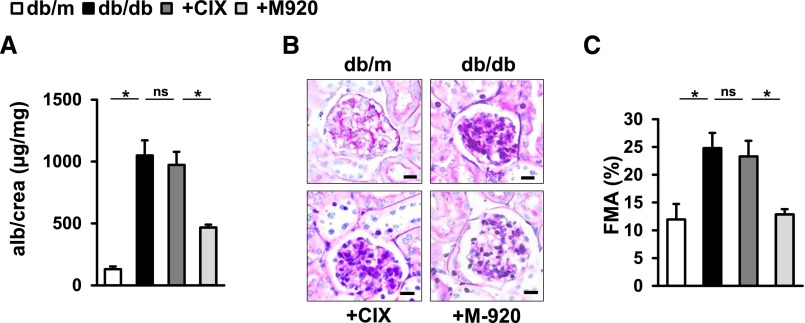
Differential effect of caspase inhibitors M-920 and CIX on diabetic nephropathy in db/db mice. (A) Albuminuria and extracellular matrix accumulation, as reflected by the fractional mesangial area (FMA), are decreased in M-920-treated db/db mice (+M-920; targeting caspases 1, 3, 4, 5, 6, 7, and 8) as compared with PBS-treated db/db mice (db/db). Treatment with CIX (+CIX; targeting caspases 3, 6, 7, 8, and 10) has no effect on these markers in db/db mice. Treatment was initiated at age 8 weeks and continued for 12 weeks. Mean value±SEM. At least six mice in each group. (B) FMA; periodic acid–Schiff–stained glomeruli (size bar: 20 µm). (C) FMA; mean value±SEM. *P<0.05. alb, albumin; crea, creatinine; db/m, nondiabetic control; ns, not significant.
Figure 2.
Figure 2.
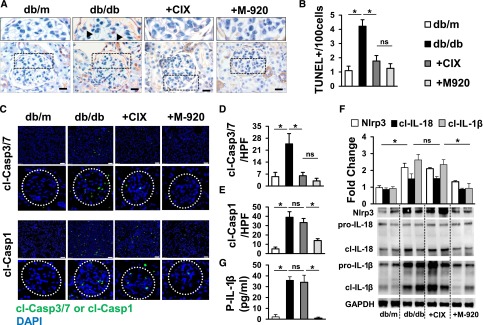
M-920 prevents inflammasome activation in addition to glomerular cell death. (A, B) Both caspase inhibitors (M-920 and CIX) decrease glomerular cell death in db/db mice as detected by the TUNEL assay. (A) Representative TUNEL-stained glomeruli (size bar: 20 µm Higher magnification (top) of glomeruli indicated by black dotted lines and TUNEL-positive cells indicated by black arrowheads. (C, D) Both M-920 and CIX decrease caspase-3/7 activity, as detected by the FLICA assay. However, only M-920, but not CIX, also reduces caspase-1 activity (C, E). (F) In db/db mice treated with M-920, but not in those treated with CIX, the cleaved forms of IL-1β and IL-18 and expression of Nlrp3 are reduced in renal cortex extracts. (G) Renal inflammasome inhibition in M-920-treated db/db mice is associated with lower plasma IL-1β levels. (B, D–G) Mean value±SEM of at least six mice in each group; (C) representative images of frozen sections incubated with FLICA probes – overviews (size bar: 20 µm) and higher (4×) magnification of glomeruli (glomeruli indicated by white dotted circles); (F) representative immunoblots; *P<0.05. cl-Casp1, cleaved caspase-1; cl-Casp3/7, cleaved caspase-3/7; cl-IL-1β, cleaved IL-1β; cl-IL-18, cleaved IL-18; DAPI, 4′,6-diamidino-2-phenylindole; db/m, nondiabetic control; GAPDH, glyceraldehyde-3-phosphate dehydrogenase; HPF, high-power field; ns, not significant; P-IL-1β, plasma-IL-1β.
Figure 3.
Figure 3.
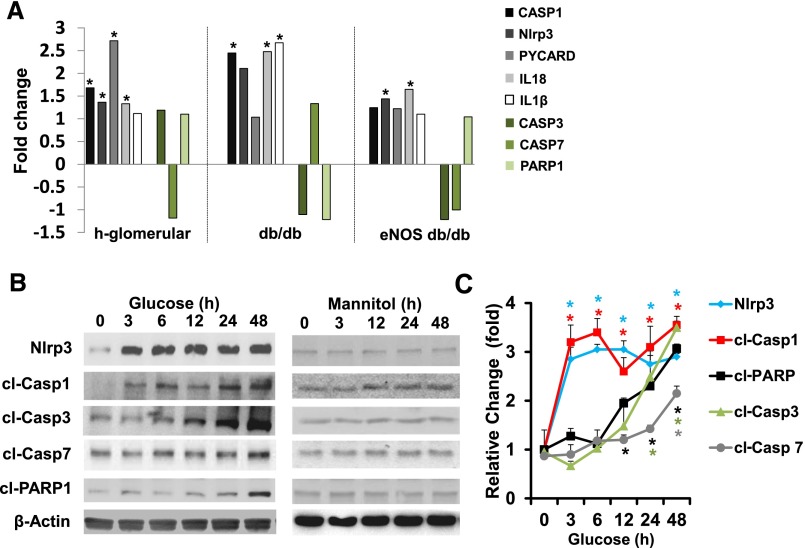
Inflammasome and apoptosis markers are differentially regulated in dNP and glucose-treated podocytes in vitro. We screened the Woroniecka cohort in the Nephromine database (human dNP) for glomerular expression of inflammasome- and apoptosis-related genes. (A) Only the inflammasome-related regulators, caspase-1 (CASP1), IL-18, ASC (PYCARD), and Nlrp3 (NLRP3), but not the apoptosis-related genes, caspase-3 (CASP3), caspase-7 (CASP7), and PARP-1 (PARP1) are significantly induced in microdissected glomeruli of patients with diabetes with dNP (h-glomerular) as compared with nondiabetic controls. Likewise, significant induction of inflammasome-related genes (CASP1, IL-18, and IL-1β for db/db C57BLKS mice, and CASP1 and IL-18 for eNOS−/− db/db mice), but not of apoptosis-related genes (CASP3, CASP7, and PARP1), is observed within the Nephromine Hodgin dataset as compared with nondiabetic db/m mice or eNOS+/+ m/m mice. The fold changes of the log2 median centered intensity from the Nephromine database (Life Technologies, Ann Arbor, MI) are used for graphical representation. High glucose (25 mM; [B, C]), but not mannitol (25 mM; [B]), induces the inflammasome markers Nlrp3 and cleaved caspase-1 within 3 hours in murine podocytes in vitro, preceding the induction of cleaved PARP1 (12 hours), cleaved caspase-3 (24 hours), and cleaved caspase-7 (48 hours; [C]). (B) Representative immunoblots of at least three repeat experiments; (C, E) mean value±SEM; *P<0.05. cl-Casp1, cleaved caspase-1; cl-Casp3, cleaved caspase-3; cl-Casp7, cleaved caspase-7; cl-PARP1, cleaved PARP1.
Figure 4.
Figure 4.
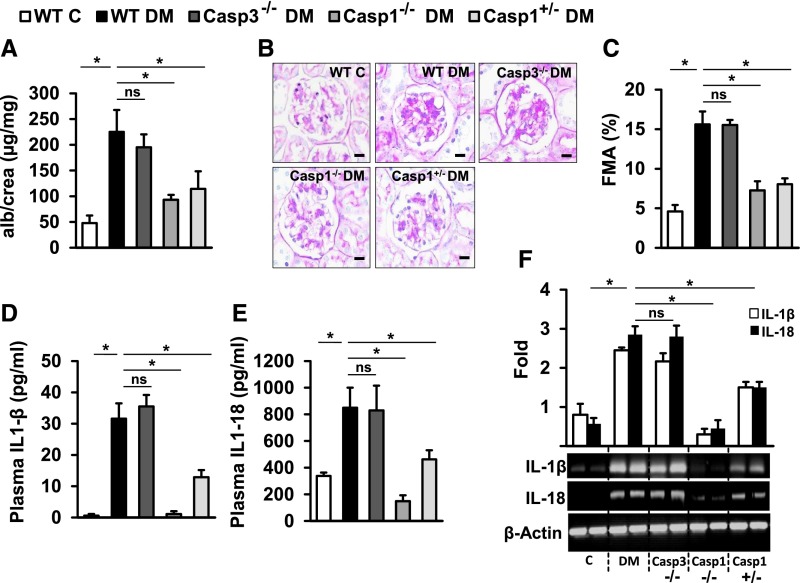
Caspase-3 deficiency fails to protect against diabetic nephropathy. (A) Compared with nondiabetic wild-type control mice (WT C), STZ induced diabetic mice (WT DM) show markedly increased albuminuria, and (B, C) increased fractional mesangial area (FMA). (A–C) Caspase-3 deficiency (Casp3−/−) fails to reduce albuminuria and the FMA in diabetic mice, whereas homozygous (Casp1−/−) or hemizygous (Casp1+/−) caspase-1 deficiency is protective. (D) IL-1β and (E) IL-18 plasma levels and (F) renal IL-1β/IL-18 expression are unaffected in caspase-3−/− mice, but are reduced in caspase-1+/−, and reduced to a larger extent in caspase-1−/− mice. (A, C–F) Mean value±SEM; at least six mice in each group; (B) representative periodic acid–Schiff–stained glomeruli (size bar: 20 µm); (F) representative agarose-gels are shown; *P<0.05. alb, albumin; C, control; crea, creatinine; ns, not significant.

References

    1. Susztak K, Raff AC, Schiffer M, Böttinger EP: Glucose-induced reactive oxygen species cause apoptosis of podocytes and podocyte depletion at the onset of diabetic nephropathy. Diabetes 55: 225–233, 2006 - PubMed
    1. Kumar D, Robertson S, Burns KD: Evidence of apoptosis in human diabetic kidney. Mol Cell Biochem 259: 67–70, 2004 - PubMed
    1. Shahzad K, Bock F, Dong W, Wang H, Kopf S, Kohli S, Al-Dabet MM, Ranjan S, Wolter J, Wacker C, Biemann R, Stoyanov S, Reymann K, Söderkvist P, Groß O, Schwenger V, Pahernik S, Nawroth PP, Gröne HJ, Madhusudhan T, Isermann B: Nlrp3-inflammasome activation in non-myeloid-derived cells aggravates diabetic nephropathy. Kidney Int 87: 74–84, 2015 - PMC - PubMed
    1. Mudaliar H, Pollock C, Panchapakesan U: Role of Toll-like receptors in diabetic nephropathy. Clin Sci (Lond) 126: 685–694, 2014 - PubMed
    1. Fischer U, Schulze-Osthoff K: Apoptosis-based therapies and drug targets. Cell Death Differ 12[Suppl 1]: 942–961, 2005 - PubMed

Publication types