


Genome-Wide Meta-Analysis of Cotinine Levels in Cigarette Smokers Identifies Locus at 4q13.2
- PMID: 26833182
- PMCID: PMC4735517
- DOI: 10.1038/srep20092
Genome-Wide Meta-Analysis of Cotinine Levels in Cigarette Smokers Identifies Locus at 4q13.2
Abstract
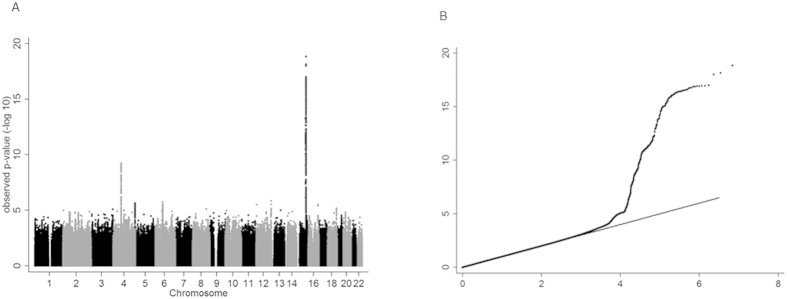
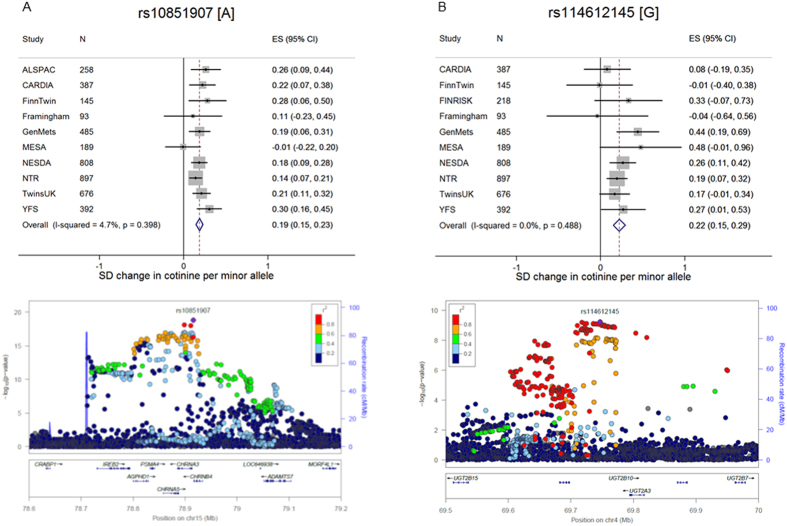
Genome-wide association studies (GWAS) of complex behavioural phenotypes such as cigarette smoking typically employ self-report phenotypes. However, precise biomarker phenotypes may afford greater statistical power and identify novel variants. Here we report the results of a GWAS meta-analysis of levels of cotinine, the primary metabolite of nicotine, in 4,548 daily smokers of European ancestry. We identified a locus close to UGT2B10 at 4q13.2 (minimum p = 5.89 × 10(-10) for rs114612145), which was consequently replicated. This variant is in high linkage disequilibrium with a known functional variant in the UGT2B10 gene which is associated with reduced nicotine and cotinine glucuronidation activity, but intriguingly is not associated with nicotine intake. Additionally, we observed association between multiple variants within the 15q25.1 region and cotinine levels, all located within the CHRNA5-A3-B4 gene cluster or adjacent genes, consistent with previous much larger GWAS using self-report measures of smoking quantity. These results clearly illustrate the increase in power afforded by using precise biomarker measures in GWAS. Perhaps more importantly however, they also highlight that biomarkers do not always mark the phenotype of interest. The use of metabolite data as a proxy for environmental exposures should be carefully considered in the context of individual differences in metabolic pathways.
Conflict of interest statement
TK and JK have acted as consultants on nicotine dependence for Pfizer (2011-2014). RFT has consulted for pharmaceutical companies, primarily in relation to smoking cessation.
Figures
References
Publication types
MeSH terms
Substances
Grants and funding
- T32 MH20030/MH/NIMH NIH HHS/United States
- MC_UU_12013/6/MRC_/Medical Research Council/United Kingdom
- DH_/Department of Health/United Kingdom
- MC_UU_12013/1/MRC_/Medical Research Council/United Kingdom
- AA-12502/AA/NIAAA NIH HHS/United States
- R01 DA018673/DA/NIDA NIH HHS/United States
- CRUK_/Cancer Research UK/United Kingdom
- G9815508/MRC_/Medical Research Council/United Kingdom
- MC_UU_12013/3/MRC_/Medical Research Council/United Kingdom
- R25 DA26119/DA/NIDA NIH HHS/United States
- BHF_/British Heart Foundation/United Kingdom
- R01DA032246/DA/NIDA NIH HHS/United States
- TMH109787/CAPMC/ CIHR/Canada
- T32 MH020030/MH/NIMH NIH HHS/United States
- MR/K023195/1/MRC_/Medical Research Council/United Kingdom
- MR/J012165/1/MRC_/Medical Research Council/United Kingdom
- 284167/ERC_/European Research Council/International
- MC_PC_15018/MRC_/Medical Research Council/United Kingdom
- DA020830/DA/NIDA NIH HHS/United States
- WT083431MA/WT_/Wellcome Trust/United Kingdom
- 202802/Z/16/Z/WT_/Wellcome Trust/United Kingdom
LinkOut - more resources
Full Text Sources
Other Literature Sources
Molecular Biology Databases
