


Medications development for the treatment of alcohol use disorder: insights into the predictive value of animal and human laboratory models
- PMID: 26833803
- PMCID: PMC4969222
- DOI: 10.1111/adb.12349
Medications development for the treatment of alcohol use disorder: insights into the predictive value of animal and human laboratory models
Abstract
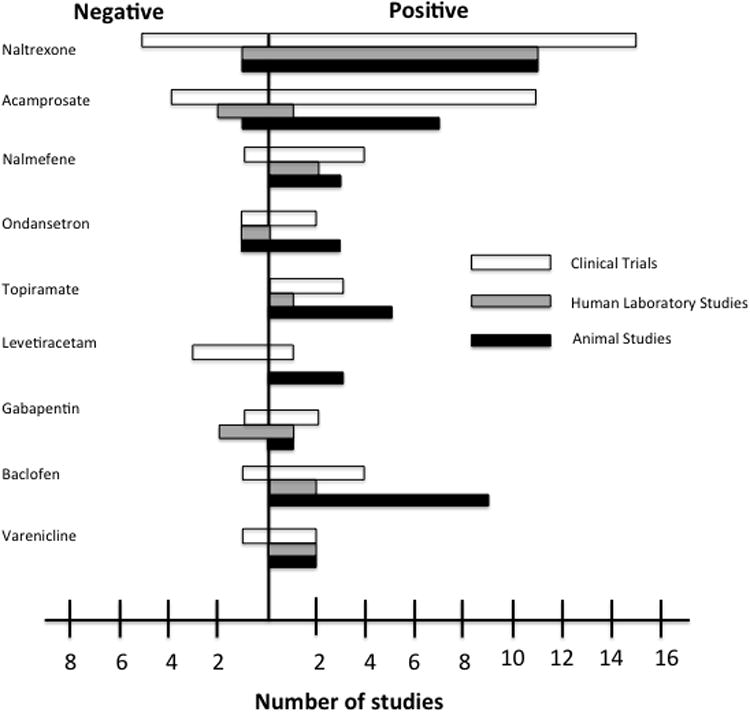
Development of effective treatments for alcohol use disorder (AUD) represents an important public health goal. This review provides a summary of completed preclinical and clinical studies testing pharmacotherapies for the treatment of AUD. We discuss opportunities for improving the translation from preclinical findings to clinical trial outcomes, focusing on the validity and predictive value of animal and human laboratory models of AUD. Specifically, while preclinical studies of medications development have offered important insights into the neurobiology of the disorder and alcohol's molecular targets, limitations include the lack of standardized methods and streamlined processes whereby animal studies can readily inform human studies. Behavioral pharmacology studies provide a less expensive and valuable opportunity to assess the feasibility of a pharmacotherapy prior to initiating larger scale clinical trials by providing insights into the mechanism of the drug, which can then inform recruitment, analyses, and assessments. Summary tables are provided to illustrate the wide range of preclinical, human laboratory, and clinical studies of medications development for alcoholism. Taken together, this review highlights the challenges associated with animal paradigms, human laboratory studies, and clinical trials with the overarching goal of advancing treatment development and highlighting opportunities to bridge the gap between preclinical and clinical research.
Keywords: Addiction; novel therapeutics; valley of death.
© 2016 Society for the Study of Addiction.
Conflict of interest statement
Figures
References
-
- Addolorato G, Caputo F, Capristo E, Domenicali M, Bernardi M, Janiri L, Agabio R, Colombo G, Gessa GL, Gasbarrini G. Baclofen efficacy in reducing alcohol craving and intake: a preliminary double-blind randomized controlled study. Alcohol Alcohol. 2002;37:504–508. - PubMed
-
- Addolorato G, Leggio L, Ferrulli A, Cardone S, Bedogni G, Caputo F, Gasbarrini G, Landolfi R Group BS. Dose–Response Effect of Baclofen in Reducing Daily Alcohol Intake in Alcohol Dependence: Secondary Analysis of a Randomized, Double-Blind, Placebo-Controlled Trial. Alcohol Alcohol. 2011;46:312–317. - PubMed
-
- Addolorato G, Leggio L, Ferrulli A, Cardone S, Vonghia L, Mirijello A, Abenavoli L, D'Angelo C, Caputo F, Zambon A, Haber PS, Gasbarrini G. Effectiveness and safety of baclofen for maintenance of alcohol abstinence in alcohol-dependent patients with liver cirrhosis: randomised, double-blind controlled study. Lancet. 2007;370:1915–1922. - PubMed
Publication types
MeSH terms
Substances
Grants and funding
LinkOut - more resources
Full Text Sources
Other Literature Sources
Miscellaneous
