


Songs for the Ego: Theorizing Musical Self-Enhancement
- PMID: 26834675
- PMCID: PMC4718989
- DOI: 10.3389/fpsyg.2016.00002
Songs for the Ego: Theorizing Musical Self-Enhancement
Abstract
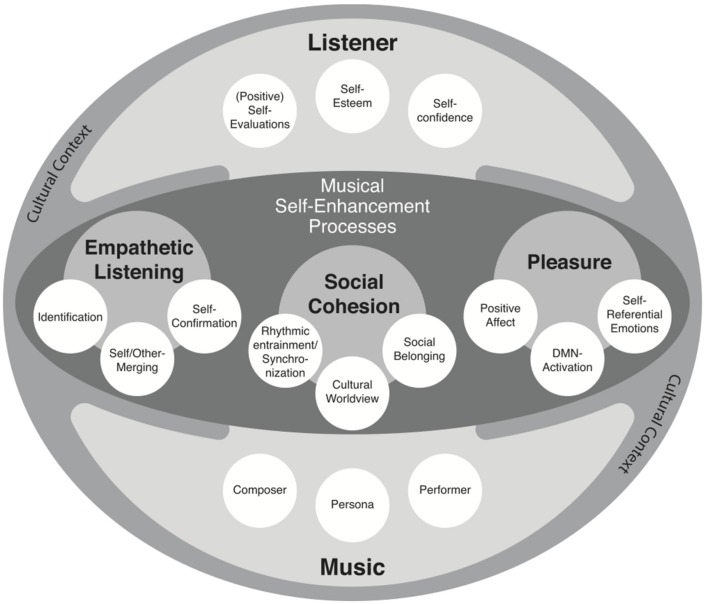
This paper outlines a theoretical account of musical self-enhancement. I claim that listening to music serves as a resource for actively manipulating affective states so that a positive self-view is maintained and a sense of optimism is provided. Self-enhancement-the process by which individuals modify their self-worth and gain self-esteem-typically takes place in social interactions. I argue that experiencing music may serve as a unique "esthetic surrogate" for interaction, which equally enables self-enhancement. This ability relies on three main characteristics of the musical experience, namely, its capacity to (a) evoke empathetic feelings, (b) elicit social cohesion and affiliation, and (c) elicit feelings of reward. I outline how these characteristics relate to theories of music cognition and empirical findings in psychology and neuroscience research. I also explain the specifics of musical self-enhancement and how it differs from music's other regulatory functions such as mood- and emotion regulation. My aim in introducing the notion of musical self-enhancement is to broaden our understanding of how music functions as an environmental resource entailing access to unique affective states and how musical experiences are co-constituted by both the agent and the sonic environment. This specific use of music for self-enhancement can be regarded as a form of affective niche construction, providing the external conditions in which people can experience themselves more positively and maintain high self-esteem.
Keywords: music; music and affectivity; music and emotion; music and social cognition; self-enhancement; self-esteem.
Figures
References
-
- Alicke M. D. (1985). Global self-evaluation as determined by the desirability and controllability of trait adjectives. J. Pers. Soc. Psychol. 49 1621–1630. 10.1037/0022-3514.49.6.1621 - DOI
-
- Aristotle (1944). Politics, Trans. Rackham H. Harvard, MA: Harvard University Press.
-
- Batt-Rawden K. B., DeNora T., Ruud E. (2005). Music listening and empowerment in health promotion: a study of the role and significance of music in everyday life of the long-term ill. Nord. J. Music Ther. 14 120–136. 10.1080/08098130509478134 - DOI
-
- Baumeister R. F., Vohs K. D. (2012). “Self-regulation and the executive function of the self,” in Handbook of Self and Identity, eds Leary M. R., Tangney J. P. (New York, NY: Guilford; ), 180–197.
-
- Beer J. S. (2012). “Self-evaluation and self-knowledge,” in The SAGE Handbook of Social Cognition, eds Fiske S. T., Macrae C. N. (London: Sage; ), 330–349.
LinkOut - more resources
Full Text Sources
Other Literature Sources
