doi: 10.1021/jacs.6b00250.
Epub 2016 Feb 9.
Practical Ni-Catalyzed Aryl-Alkyl Cross-Coupling of Secondary Redox-Active Esters
Affiliations
- PMID: 26835704
- PMCID: PMC4768290
- DOI: 10.1021/jacs.6b00250
Item in Clipboard
Practical Ni-Catalyzed Aryl-Alkyl Cross-Coupling of Secondary Redox-Active Esters
J Am Chem Soc.
.
Abstract
A new transformation is presented that enables chemists to couple simple alkyl carboxylic acids with aryl zinc reagents under Ni-catalysis. The success of this reaction hinges on the unique use of redox-active esters that allow one to employ such derivatives as alkyl halides surrogates. The chemistry exhibits broad substrate scope and features a high degree of practicality. The simple procedure and extremely inexpensive nature of both the substrates and pre-catalyst (NiCl2·6H2O, ca. $9.5/mol) bode well for the immediate widespread adoption of this method.
Conflict of interest statement
The authors declare no competing financial interest.
Figures
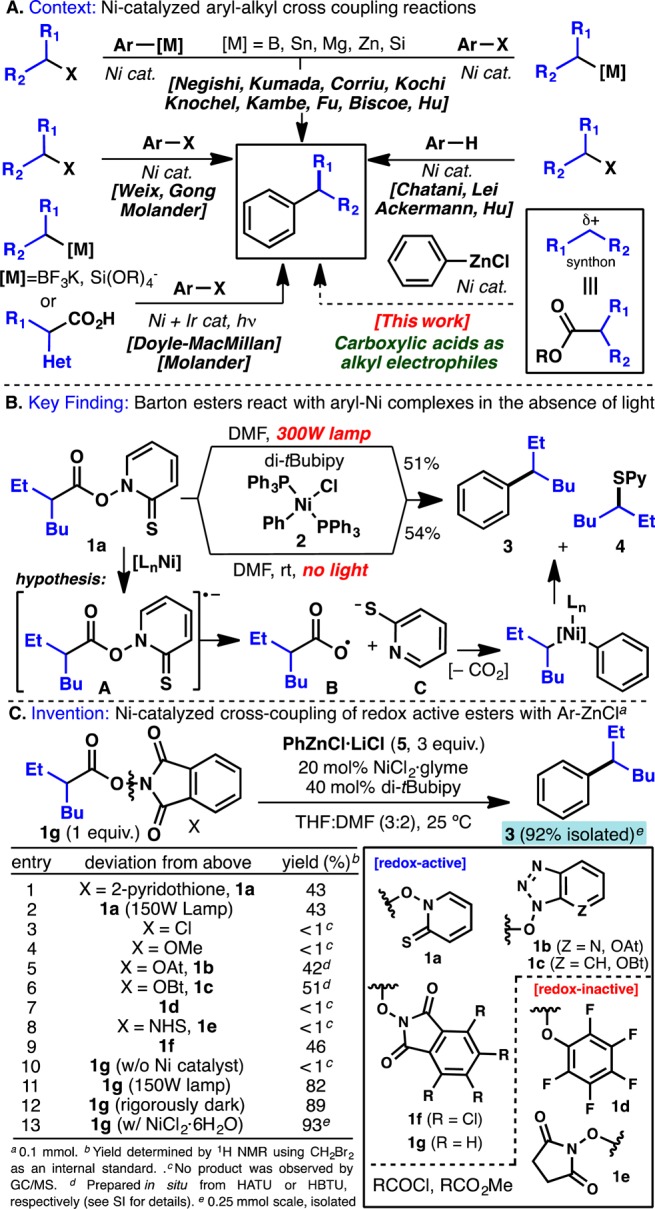
(A) A brief historical perspective of Ni-catalyzed alkyl-aryl
cross-coupling.
(B) An attempted intercepted Barton decarboxylation leads to a new
hypothesis. (C) Invention of a new Ni-catalyzed decarboxylative cross-coupling.
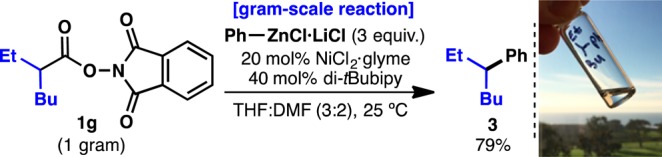
Nickel-catalyzed decarboxylative cross-coupling
performed on gram
scale.
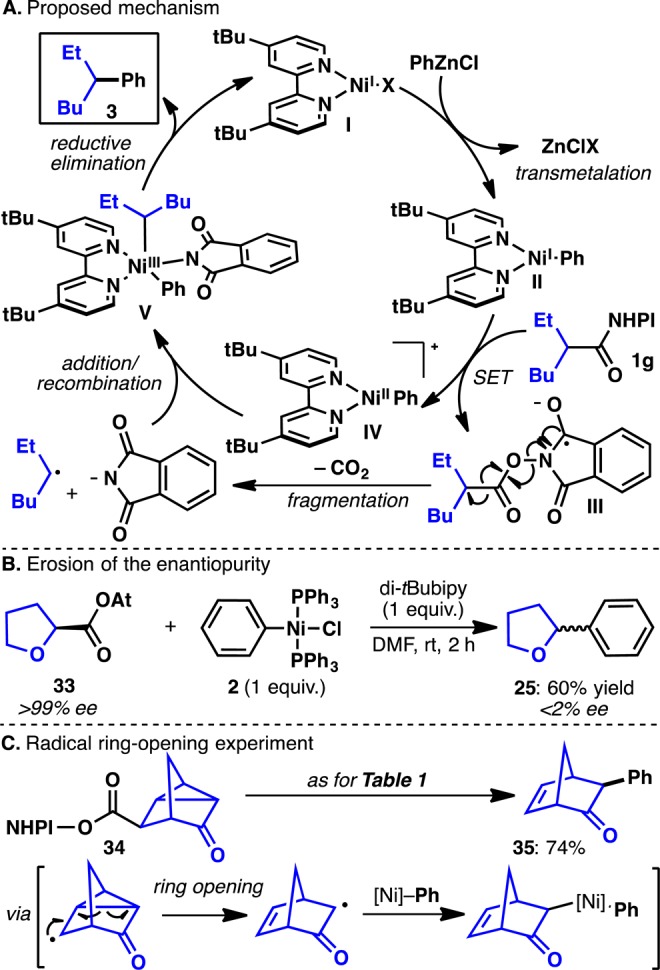
(A) Working hypothesis for the “redox-active”
ester
cross-coupling with aryl zinc reagents. (B) A stoichiometric experiment
in support of a radical intermediate. (C) Ring opening of a carboxylic
acid bearing a cyclopropane moiety.
References
-
- Metal-catalyzed Cross-coupling Reactions;Diederich F., Stang P. J., Eds.; Wiley-VCH: New York, 1998.
-
-
For reviews on cross-coupling of aryl and alkyl organometallic reagents and alkyl or aryl electrophiles, see:
- Jana R.; Pathak T. P.; Sigman M. S. Chem. Rev. 2011, 111, 1417. 10.1021/cr100327p. - DOI - PMC - PubMed
- Frisch A. C.; Beller M. Angew. Chem., Int. Ed. 2005, 44, 674. 10.1002/anie.200461432. - DOI - PubMed
- Rudolph A.; Lautens M. Angew. Chem., Int. Ed. 2009, 48, 2656. 10.1002/anie.200803611. - DOI - PubMed
- Tasker S. Z.; Standley E. A.; Jamison T. F. Nature 2014, 509, 299. 10.1038/nature13274. - DOI - PMC - PubMed
-
-
- Tamao K.; Sumitani K.; Kumada M. J. Am. Chem. Soc. 1972, 94, 4374. 10.1021/ja00767a075. - DOI
- Tamao K.; Kiso Y.; Sumitani K.; Kumada M. J. Am. Chem. Soc. 1972, 94, 9268. 10.1021/ja00781a070. - DOI
- Hayashi T.; Tajika M.; Tamao K.; Kumada M. J. Am. Chem. Soc. 1976, 98, 3718. 10.1021/ja00428a061. - DOI
-
- Corriu R. J. P.; Masse J. P. J. Chem. Soc., Chem. Commun. 1972, 144. 10.1039/c3972000144a. - DOI
-
- Morrell D. G.; Kochi J. K. J. Am. Chem. Soc. 1975, 97, 7262. 10.1021/ja00858a011. - DOI
Publication types
MeSH terms
Substances
Grants and funding
LinkOut - more resources
Full Text Sources
Other Literature Sources