


Current and future effects of varicella and herpes zoster vaccination in Germany - Insights from a mathematical model in a country with universal varicella vaccination
- PMID: 26835890
- PMCID: PMC4964823
- DOI: 10.1080/21645515.2015.1135279
Current and future effects of varicella and herpes zoster vaccination in Germany - Insights from a mathematical model in a country with universal varicella vaccination
Abstract
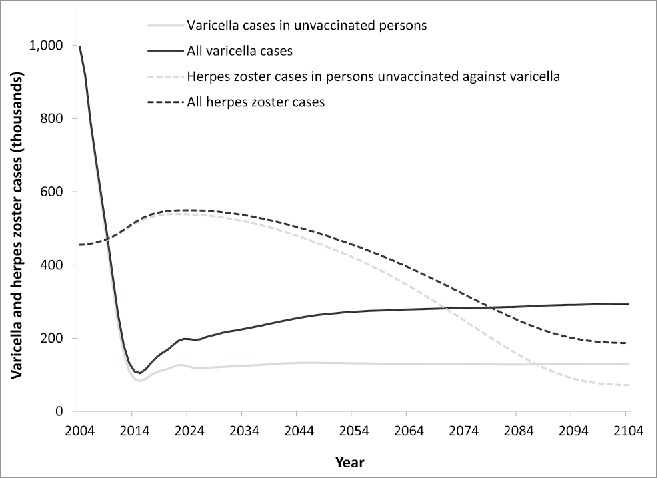
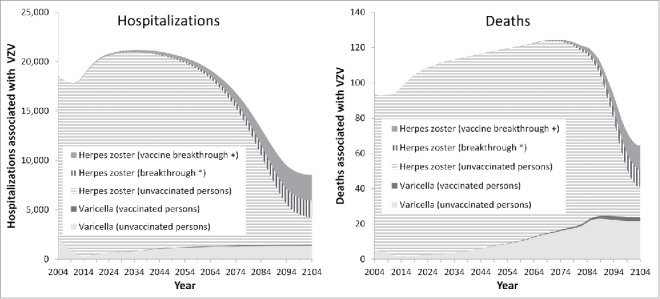
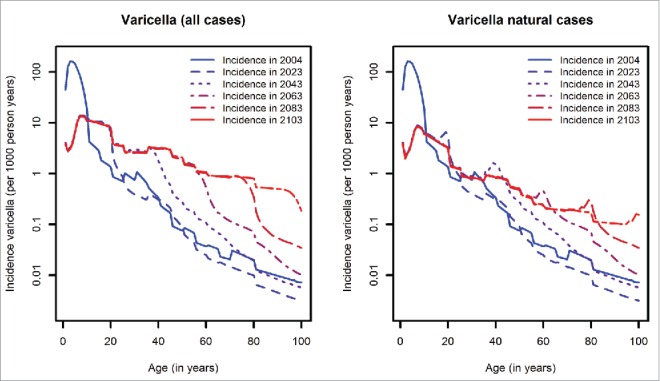
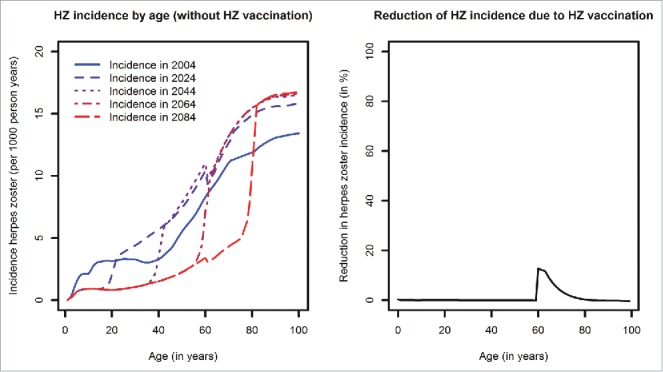
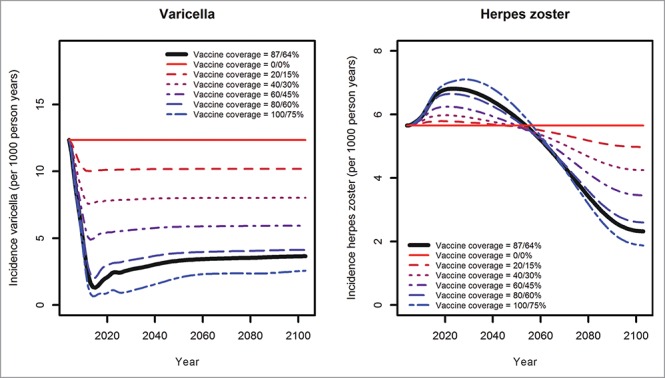
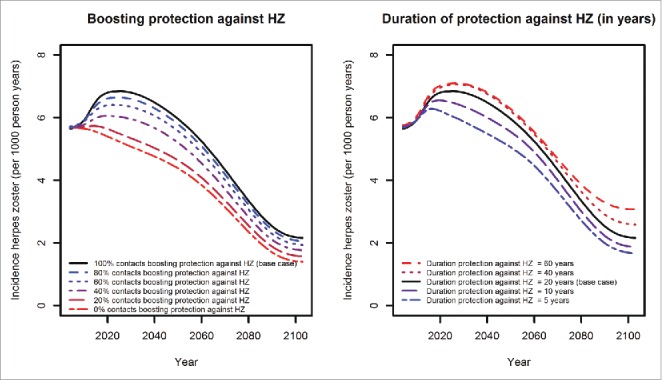
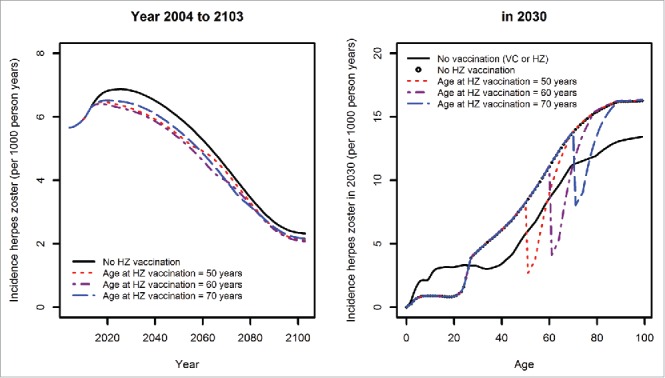
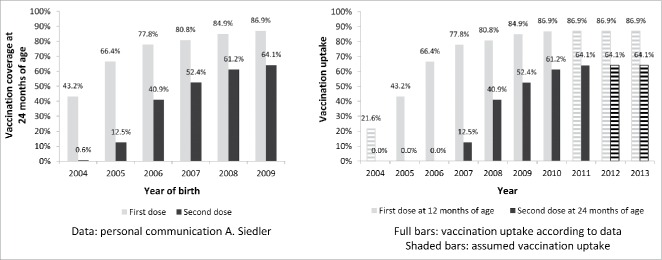
Varicella zoster virus (VZV) is primarily known for causing varicella in childhood, but can reactivate again as herpes zoster (HZ) after a period of latency, mainly in persons older than 50 years. Universal varicella vaccination was introduced in Germany in 2004, while HZ vaccination has not been recommended yet. We aimed to quantify the potential long-term effects of universal childhood varicella vaccination and HZ vaccination of the elderly on varicella and HZ incidence in Germany over a time horizon of 100 years, using a transmission model calibrated to pre-vaccination data and validated against early post-vaccination data. Using current vaccination coverage rates of 87% (64%) with one (two) varicella vaccine dose(s), the model predicts a decrease in varicella cases by 89% for the year 2015. In the long run, the incidence reduction will stabilize at about 70%. Under the assumption of the boosting hypothesis of improved HZ protection caused by exposure to VZV, the model predicts a temporary increase in HZ incidence of up to 20% for around 50 years. HZ vaccination of the elderly with an assumed coverage of 20% has only limited effects in counteracting this temporary increase in HZ incidence. However, HZ incidence is shown to decrease in the long-term by 58% as vaccinated individuals get older and finally reach age-classes with originally high HZ incidence. Despite substantial uncertainties around several key variables, the model's results provide valuable insights that support decision-making regarding national VZV vaccination strategies.
Keywords: herpes zoster; transmission model; uncertainty; varicella; varicella vaccination; zoster vaccination.
Figures


References
-
- Fairley CK, Miller E. Varicella-zoster virus epidemiology–a changing scene? J Infect Dis 1996; 174 Suppl 3:S314-9; PMID:8896538; http://dx.doi.org/ 10.1093/infdis/174.Supplement_3.S314 - DOI - PubMed
-
- Kawai K, Gebremeskel BG, Acosta CJ. Systematic review of incidence and complications of herpes zoster: towards a global perspective. BMJ open 2014; 4:e004833; PMID:24916088; http://dx.doi.org/ 10.1136/bmjopen-2014-004833 - DOI - PMC - PubMed
-
- Begründung der STIKO für eine allgemeine Varizellenimpfung. Epidemiologisches Bulletin 2004; 49:421.
-
- Dworkin RH, Portenoy RK. Pain and its persistence in herpes zoster. Pain 1996; 67:241-51; PMID:8951917; http://dx.doi.org/ 10.1016/0304-3959(96)03122-3 - DOI - PubMed
-
- Streng A, Grote V, Carr D, Hagemann C, Liese JG. Varicella routine vaccination and the effects on varicella epidemiology - results from the Bavarian Varicella Surveillance Project (BaVariPro), 2006–2011. BMC Infect Dis 2013; 13:303; PMID:23815523; http://dx.doi.org/ 10.1186/1471-2334-13-303 - DOI - PMC - PubMed
MeSH terms
Substances
LinkOut - more resources
Full Text Sources
Other Literature Sources
Medical
Molecular Biology Databases
