


Association of early withdrawal of life-sustaining therapy for perceived neurological prognosis with mortality after cardiac arrest
- PMID: 26836944
- PMCID: PMC4834233
- DOI: 10.1016/j.resuscitation.2016.01.016
Association of early withdrawal of life-sustaining therapy for perceived neurological prognosis with mortality after cardiac arrest
Abstract
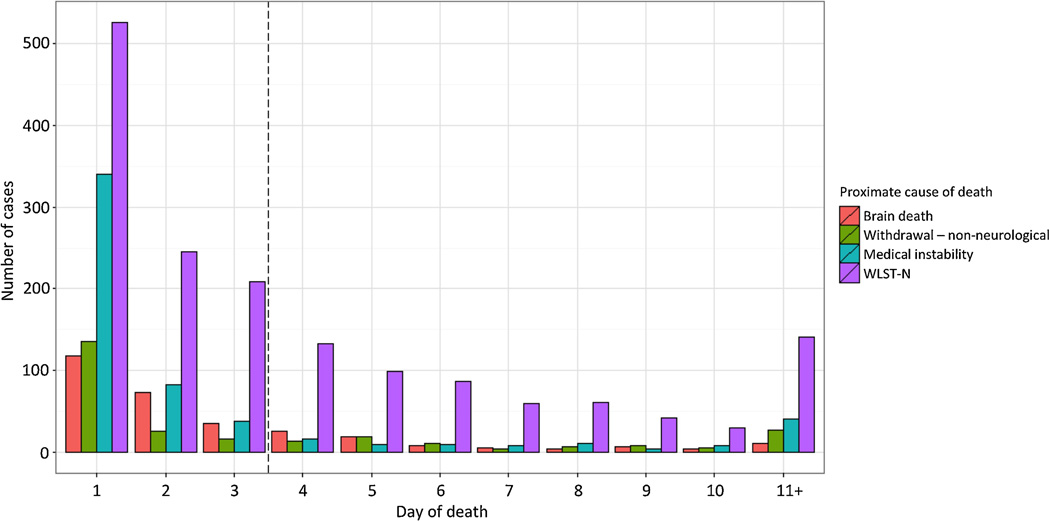
Background: Withdrawing life-sustaining therapy because of perceived poor neurological prognosis (WLST-N) is a common cause of hospital death after out-of-hospital cardiac arrest (OHCA). Although current guidelines recommend against WLST-N before 72h (WLST-N<72), this practice is common and may increase mortality. We sought to quantify these effects.
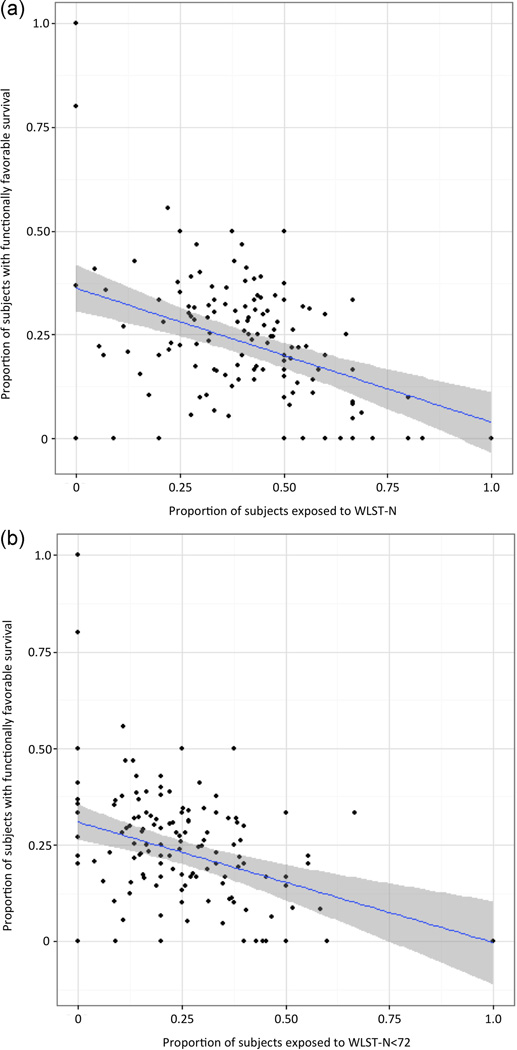
Methods: In a secondary analysis of a multicenter OHCA trial, we evaluated survival to hospital discharge and survival with favorable functional status (modified Rankin Score ≤3) in adults alive >1h after hospital admission. Propensity score modeling the probability of exposure to WLST-N<72 based on pre-exposure covariates was used to match unexposed subjects with those exposed to WLST-N<72. We determined the probability of survival and functionally favorable survival in the unexposed matched cohort, fit adjusted logistic regression models to predict outcomes in this group, and then used these models to predict outcomes in the exposed cohort. Combining these findings with current epidemiologic statistics we estimated mortality nationally that is associated with WLST-N<72.
Results: Of 16,875 OHCA subjects, 4265 (25%) met inclusion criteria. WLST-N<72 occurred in one-third of subjects who died in-hospital. Adjusted analyses predicted that exposed subjects would have 26% survival and 16% functionally favorable survival if WLST-N<72 did not occur. Extrapolated nationally, WLST-N<72 may be associated with mortality in approximately 2300 Americans each year of whom nearly 1500 (64%) might have had functional recovery.
Conclusions: After OHCA, death following WLST-N<72 may be common and is potentially avoidable. Reducing WLST-N<72 has national public health implications and may afford an opportunity to decrease mortality after OHCA.
Keywords: Cardiac arrest; Neurological prognosis; Prognostication; Resuscitation; Withdrawal of care.
Copyright © 2016 Elsevier Ireland Ltd. All rights reserved.
Conflict of interest statement
Figures

Comment in
-
Does early withdrawal of life-sustaining treatment increase mortality after cardiac arrest?Resuscitation. 2016 May;102:A3-4. doi: 10.1016/j.resuscitation.2016.02.007. Epub 2016 Feb 21. Resuscitation. 2016. PMID: 26903287 No abstract available.
References
-
- Mozaffarian D, Benjamin EJ, Go AS, Arnett DK, Blaha MJ, Cushman M, et al. Heart disease and stroke statistics--2015 update: a report from the American Heart Association. Circulation. 2015;131:e29–e322. - PubMed
-
- Fugate JE, Brinjikji W, Mandrekar JN, Cloft HJ, White RD, Wijdicks EF, et al. Post-cardiac arrest mortality is declining: a study of the US National Inpatient Sample 2001 to 2009. Circulation. 2012;126:546–550. - PubMed
-
- Lemiale V, Dumas F, Mongardon N, Giovanetti O, Charpentier J, Chiche JD, et al. Intensive care unit mortality after cardiac arrest: the relative contribution of shock and brain injury in a large cohort. Intensive care medicine. 2013;39:1972–1980. - PubMed
Publication types
MeSH terms
Grants and funding
- U01 HL077866/HL/NHLBI NIH HHS/United States
- HL077881/HL/NHLBI NIH HHS/United States
- HL077908/HL/NHLBI NIH HHS/United States
- K12 HL109068/HL/NHLBI NIH HHS/United States
- U01 HL077871/HL/NHLBI NIH HHS/United States
- U01 HL077887/HL/NHLBI NIH HHS/United States
- U01 HL077885/HL/NHLBI NIH HHS/United States
- U01 HL077863/HL/NHLBI NIH HHS/United States
- U01 HL077908/HL/NHLBI NIH HHS/United States
- HL077867/HL/NHLBI NIH HHS/United States
- Canadian Institutes of Health Research/Canada
- HL077872/HL/NHLBI NIH HHS/United States
- T32CA09168/CA/NCI NIH HHS/United States
- HL077866/HL/NHLBI NIH HHS/United States
- U01 HL077873/HL/NHLBI NIH HHS/United States
- T32 CA009168/CA/NCI NIH HHS/United States
- 5K12HL109068/HL/NHLBI NIH HHS/United States
- 5U01 HL077863/HL/NHLBI NIH HHS/United States
- HL077887/HL/NHLBI NIH HHS/United States
- U01 HL077881/HL/NHLBI NIH HHS/United States
- L30 NS089025/NS/NINDS NIH HHS/United States
- U01 HL077867/HL/NHLBI NIH HHS/United States
- HL077885/HL/NHLBI NIH HHS/United States
- HL077873/HL/NHLBI NIH HHS/United States
- U01 HL077872/HL/NHLBI NIH HHS/United States
- HL077871/HL/NHLBI NIH HHS/United States
LinkOut - more resources
Full Text Sources
Other Literature Sources
Medical
Miscellaneous
