


Two betweenness centrality measures based on Randomized Shortest Paths
- PMID: 26838176
- PMCID: PMC4738330
- DOI: 10.1038/srep19668
Two betweenness centrality measures based on Randomized Shortest Paths
Abstract
This paper introduces two new closely related betweenness centrality measures based on the Randomized Shortest Paths (RSP) framework, which fill a gap between traditional network centrality measures based on shortest paths and more recent methods considering random walks or current flows. The framework defines Boltzmann probability distributions over paths of the network which focus on the shortest paths, but also take into account longer paths depending on an inverse temperature parameter. RSP's have previously proven to be useful in defining distance measures on networks. In this work we study their utility in quantifying the importance of the nodes of a network. The proposed RSP betweenness centralities combine, in an optimal way, the ideas of using the shortest and purely random paths for analysing the roles of network nodes, avoiding issues involving these two paradigms. We present the derivations of these measures and how they can be computed in an efficient way. In addition, we show with real world examples the potential of the RSP betweenness centralities in identifying interesting nodes of a network that more traditional methods might fail to notice.
Figures
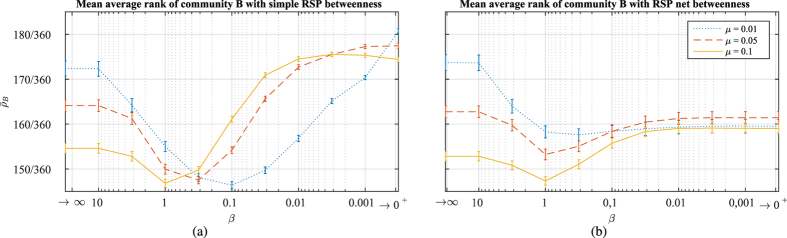
 of the nodes of community B which lies in between two other communities, A and C, based on the nodes’ RSP betweenness (a) and RSP net betweenness values (b) over 200 networks of 360 nodes generated using the LFR algorithm, as described in the body text (with low rank meaning a high betweenness score). The results are plotted for varying values of β and for three values of the mixing parameter μ with error bars indicating the standard error of the mean over the 200 runs. In both plots, the values at the left end of the curves (as β → ∞) show the results with the shortest path likelihood betweenness and at the right end (as β → 0+) the results with the degree centrality in (a), and the current flow betweenness in (b).
References
-
- Freeman L. A set of measures of centrality based on betweenness. Sociometry 40, 35–41 (1977).
-
- Freeman L. Centrality in social networks conceptual clarification. Soc. Networks 1, 215–239 (1978–1979).
-
- Brandes U. A faster algorithm for betweenness centrality. J. Math. Sociol. 25, 163–177 (2001).
-
- Newman M. A measure of betweenness centrality based on random walks. Soc. Networks 27, 39–54 (2005).
-
- Brandes U. & Fleischer D. Centrality measures based on current flow. In Proceedings of the 22nd Annual Symposium on Theoretical Aspects of Computer Science (STACS), 533–544 (2005).
Publication types
LinkOut - more resources
Full Text Sources
Other Literature Sources
Miscellaneous
