


The "Liquid Biopsy": the Role of Circulating DNA and RNA in Central Nervous System Tumors
- PMID: 26838352
- PMCID: PMC8423147
- DOI: 10.1007/s11910-016-0629-6
The "Liquid Biopsy": the Role of Circulating DNA and RNA in Central Nervous System Tumors
Abstract
The detection of tumor-derived circulating nucleic acids in patients with cancer, known as the "liquid biopsy," has expanded from use in plasma to other bodily fluids in an increasing number of malignancies. Circulating nucleic acids could be of particular use in central nervous system tumors as biopsy carries a 5-7 % risk of major morbidity. This application presents unique challenges that have limited the use of cell-free DNA and RNA in the diagnosis and monitoring of CNS tumors. Recent work suggests that cerebrospinal fluid may be a useful source of CNS tumor-derived circulating nucleic acids. In this review, we discuss the available data and future outlook on the use of the liquid biopsy for CNS tumors.
Keywords: Brain tumor; Circulating tumor cells; Liquid biopsy; cfDNA; miRNA.
Conflict of interest statement
Figures
References
-
- Rowley AH, Whitley RJ, Lakeman FD, Wolinksy SM. Rapid detection of herpes-simplex-virus DNA in cerebrospinal fluid of patients with herpes simplex encephalitis method of making. Lancet. 1990;1:440–1. - PubMed
-
- Cristofanilli M, Budd GT, Ellis MJ, Stopeck A, Matera J, Miller MC, et al. Circulating tumor cells, disease progression, and survival in metastatic breast cancer. N Engl J Med. 2004;351:781–91. - PubMed
-
- Committee Opinion Summary No. 640 [Internet]. Obstet. Gynecol 2015. Available from: http://content.wkhealth.com/linkback/openurl?sid=WKPTLP:landingpage&an=0... - PubMed
-
- Gerlinger M, Rowan AJ, Horswell S, Larkin J, Endesfelder D, Gronroos E, et al. Intratumor heterogeneity and branched evolution revealed by multiregion sequencing. N Engl J Med. [Internet].2012;366:883–92. Available from: http://www.ncbi.nlm.nih.gov/pubmed/22397650 - PMC - PubMed
-
- Wang Y, Springer S, Zhang M, McMahon KW, Kinde I, Dobbyn L, et al. Detection of tumor-derived DNA in cerebrospinal fluid of patients with primary tumors of the brain and spinal cord. Proc Natl Acad Sci. 2015;112(31):9704–9. doi: 10.1073/pnas.1511694112. - DOI - PMC - PubMed
-
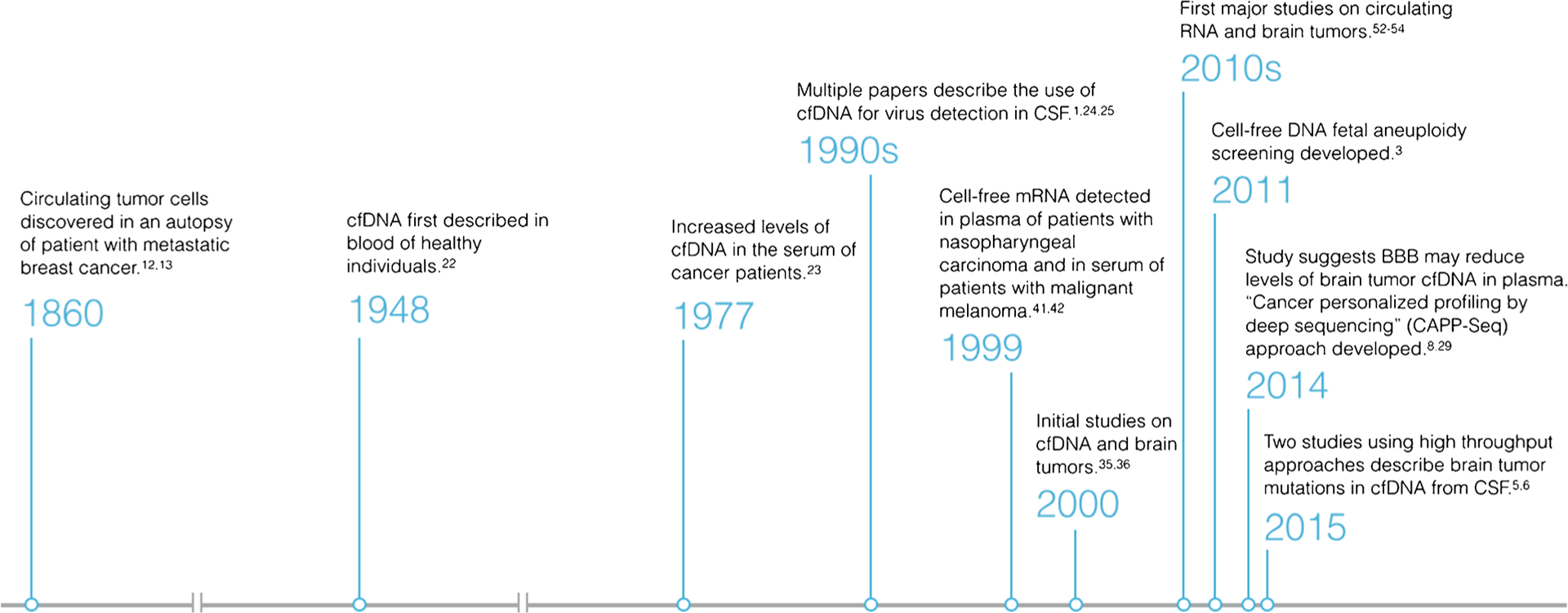
Wang et al. investigated the use of CSF as a reservior for the detection of cfDNA brain and spinal tumor mutations using a high throughput sequencing approach. In a large cohort of 35 primary CNS tumors, the authors demonstrated that cfDNA tumor mutations can be detected in CSF when the tumor interfaces with a CSF reservior.
Publication types
MeSH terms
Substances
Grants and funding
LinkOut - more resources
Full Text Sources
Other Literature Sources
