Use of Optical Fiber Imported Intra-Tissue Photodynamic Therapy for Treatment of Moderate to Severe Acne Vulgaris
- PMID: 26839152
- PMCID: PMC4745657
- DOI: 10.12659/msm.896586
Use of Optical Fiber Imported Intra-Tissue Photodynamic Therapy for Treatment of Moderate to Severe Acne Vulgaris
Abstract
Background: To treat moderate to severe acne vulgaris, we developed an optical fiber imported intra-tissue photodynamic therapy: the optical fiber irradiation 5-aminolevulinic acid photodynamic therapy (OFI-ALA-PDT). The aim of this study was to compare the treatment effect and tolerability of OFI-ALA-PDT versus traditional ALA-PDT in the treatment of moderate to severe acne vulgaris.
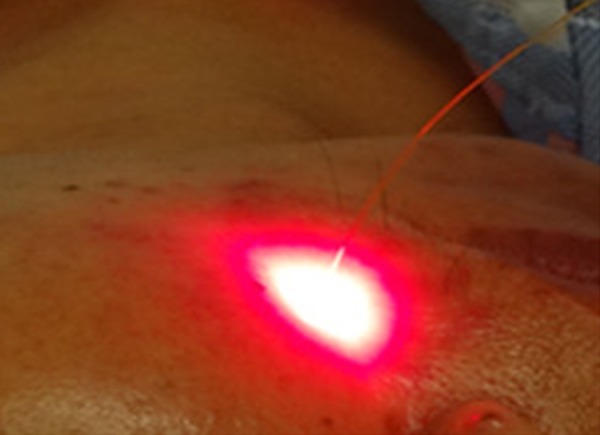
Material/methods: 60 patients with facial acne enrolled into this study were randomly divided into an OFI-ALA-PDT group and a traditional ALA-PDT group, with 30 patients in each group. The difference between these 2 groups was the red light irradiation methods used. In the OFI-ALA-PDT group we used intra-tissue irradiation (import the red light directly into the target lesion with optical fiber) for 5 min, while the traditional ALA-PDT group received whole-face irradiation for 20 min. All patients received 1 irradiation every 7 to 10 days for a total of 6 irradiations. Treatment effects and adverse reactions were recorded after the 4th and 6th irradiation, and at 4, 8, 16 weeks after the entire treatment.
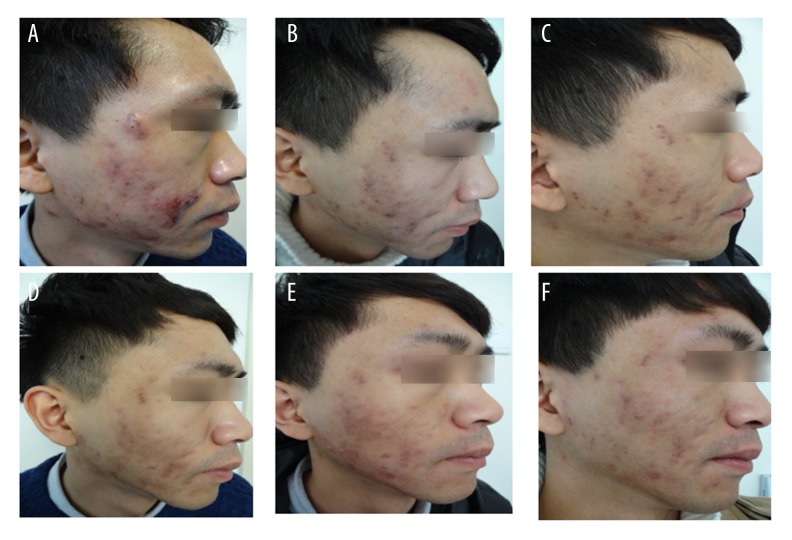
Results: After the 4th irradiation, significantly different effective rates were observed in these groups (90.0% for the OFI-ALA-PDT group and 66.7% for the control group). However, no significant difference in effective rate was recorded in the later observations. There were 182 adverse reactions in the OFI-ALA-PDT group and 497 in the control group, which showed a significant difference (P<0.05).
Conclusions: OFI-ALA-PDT showed improved treatment effective rate in the early stage of irradiation, and it had fewer adverse reactions.
Figures
References
-
- van de Kerkhof PC, Kleinpenning MM, de Jong EM, et al. Current and future treatment options for acne. J Dermatolog Treat. 2006;17(4):198–204. - PubMed
-
- Holmes SC, Bankowska U, Mackie RM. The prescription of isotretinoin to women: is every precaution taken? Br J Dermatol. 1998;138(3):450–55. - PubMed
-
- Kennedy JC, Pottier RH. Endogenous protoporphyrin IX, a clinically useful photosensitizer for photodynamic therapy. J Photochem Photobiol B. 1992;14(4):275–92. - PubMed
-
- Hongcharu W, Taylor CR, Chang Y, et al. Topical ALA-photodynamic therapy for the treatment of acne vulgaris. J Invest Dermatol. 2000;115(2):183–92. - PubMed
Publication types
MeSH terms
Substances
LinkOut - more resources
Full Text Sources
Medical