


Interaction Between Leg Muscle Performance and Sprint Acceleration Kinematics
- PMID: 26839607
- PMCID: PMC4723183
- DOI: 10.1515/hukin-2015-0109
Interaction Between Leg Muscle Performance and Sprint Acceleration Kinematics
Abstract
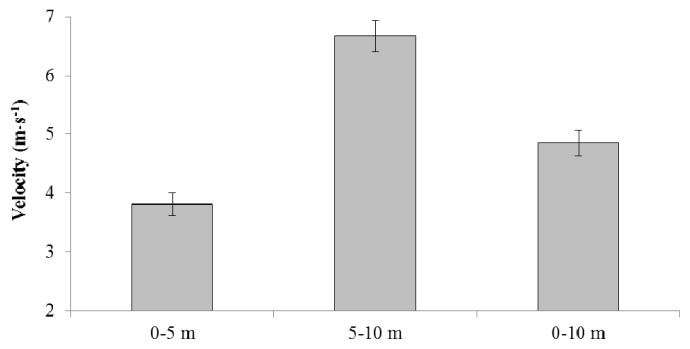
This study investigated relationships between 10 m sprint acceleration, step kinematics (step length and frequency, contact and flight time), and leg muscle performance (power, stiffness, strength). Twenty-eight field sport athletes completed 10 m sprints that were timed and filmed. Velocity and step kinematics were measured for the 0-5, 5-10, and 0-10 m intervals to assess acceleration. Leg power was measured via countermovement jumps (CMJ), a five-bound test (5BT), and the reactive strength index (RSI) defined by 40 cm drop jumps. Leg stiffness was measured by bilateral and unilateral hopping. A three-repetition maximum squat determined strength. Pearson's correlations and stepwise regression (p ≤ 0.05) determined velocity, step kinematics, and leg muscle performance relationships. CMJ height correlated with and predicted velocity in all intervals (r = 0.40-0.54). The 5BT (5-10 and 0-10 m intervals) and RSI (5-10 m interval) also related to velocity (r = 0.37-0.47). Leg stiffness did not correlate with acceleration kinematics. Greater leg strength related to and predicted lower 0-5 m flight times (r = -0.46 to -0.51), and a longer 0-10 m step length (r = 0.38). Although results supported research emphasizing the value of leg power and strength for acceleration, the correlations and predictive relationships (r(2) = 0.14-0.29) tended to be low, which highlights the complex interaction between sprint technique and leg muscle performance. Nonetheless, given the established relationships between speed, leg power and strength, strength and conditioning coaches should ensure these qualities are expressed during acceleration in field sport athletes.
Keywords: field sports; leg power; musculotendinous stiffness; squat strength; step kinematics.
Figures
References
-
- Arampatzis A, Brüggeman GP, Metzler V. The effect of speed on leg stiffness and joint kinetics in human running. J Biomech. 1999;32:1349–1353. - PubMed
-
- Baker D, Nance S. The relation between running speed and measures of strength and power in professional rugby league players. J Strength Cond Res. 1999;13:230–235.
-
- Bangsbo J, Nørregaard L, Thorsø F. Activity profile of competition soccer. Can J Sport Sci. 1991;16:110–116. - PubMed
-
- Bobbert MF, Huijing PA, van Ingen Schenau GJ. Drop jumping. II. The influence of dropping height on the biomechanics of drop jumping. Med Sci Sports Exerc. 1987;19:339–346. - PubMed
-
- Bradshaw EJ, Maulder PS, Keogh JW. Biological movement variability during the sprint start: performance enhancement or hindrance? Sports Biomech. 2007;6:246–260. - PubMed
LinkOut - more resources
Full Text Sources
Other Literature Sources