


Antidepressants in association with reducing risk of oral cancer occurrence: a nationwide population-based cohort and nested case-control studies
- PMID: 26840257
- PMCID: PMC4905503
- DOI: 10.18632/oncotarget.7049
Antidepressants in association with reducing risk of oral cancer occurrence: a nationwide population-based cohort and nested case-control studies
Abstract
Objectives: Several studies suggested that antidepressant use may increase or decrease the risk of cancer occurrence, depending on specific cancer types. The possible carcinogenic effect of antidepressants has received substantial attention; however, evidence remains inconclusive. Here we investigated associations between the use of antidepressants and occurrences of oral cancer (OC).
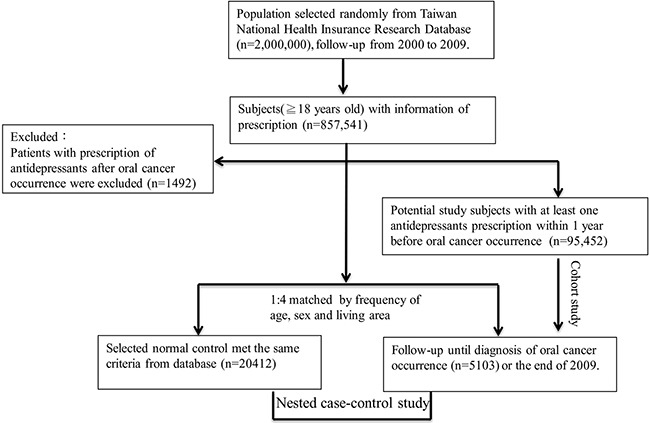
Methods: Two million samples were randomly collected from the National Health Insurance Research Database in Taiwan, which covers 98% of the total population (23 million). All patients from2000 to 2009 were followed up. We identified 5103 patients newly diagnosed with OC after antidepressants use in addition to 20,412 non-OC matched subjects and 95,452 unmatched non-OC subjects.
Results: In nested case control analysis, factors associating with OC, including age [OR = 1.02; 95% confidence interval (CI) = 1.01-1.03) and male (OR = 5.30; 95% CI = 4.92-5.70) were independently associated with increased risk of OC. Based on the functions of antidepressants, antidepressants treatment medications were further classified to investigate risk of OC. Selective serotonin reuptake inhibitors (OR = 0.61; 95% CI = 0.53-0.70) and tricyclic antidepressants (OR = 0.57; 95% CI = 0.52-0.63) were associated with reduced risk of OC. The risk of developing OC among subjects taking antidepressants was less than 26% [hazard ratio (HR) =0.74; 95% CI = 0.68-0.81] in prospective cohort study. The effect of a cumulative duration and dose was a significantly reduced risk of OC.
Conclusions: The association between antidepressant use and decreasing OC risk were demonstrated by both prospective and nested case-control studies.
Keywords: antidepressants; cohort; oral cancer.
Conflict of interest statement
No potential conflicts of interest were disclosed.
Figures
References
-
- Patten SB, Williams JV, Wang J, Adair CE, Brant R, Casebeer A, Barbui C. Antidepressant pharmacoepidemiology in a general population sample. Journal of clinical psychopharmacology. 2005;25:285–287. - PubMed
-
- Loprinzi CL, Sloan JA, Perez EA, Quella SK, Stella PJ, Mailliard JA, Halyard MY, Pruthi S, Novotny PJ, Rummans TA. Phase III evaluation of fluoxetine for treatment of hot flashes. Journal of clinical oncology. 2002;20:1578–1583. - PubMed
-
- Smith EM, Pang H, Cirrincione C, Fleishman S, Paskett ED, Ahles T, Bressler LR, Fadul CE, Knox C, Le-Lindqwister N, Gilman PB, Shapiro CL, Alliance for Clinical Trials in O Effect of duloxetine on pain, function, and quality of life among patients with chemotherapy-induced painful peripheral neuropathy: a randomized clinical trial. Jama. 2013;309:1359–1367. - PMC - PubMed
MeSH terms
Substances
LinkOut - more resources
Full Text Sources
Other Literature Sources
Medical
