. 2016 Feb 16;7(7):7455-68.
doi: 10.18632/oncotarget.7059.

Identification of novel plasma glycosylation-associated markers of aging

Affiliations

Identification of novel plasma glycosylation-associated markers of aging

Mariangela Catera et al. Oncotarget. .

Abstract

The pro- or anti-inflammatory activities of immunoglobulins G (IgGs) are controlled by the structure of the glycan N-linked to Asn297 of their heavy chain. The age-associated low grade inflammation (inflammaging) is associated with increased plasmatic levels of agalactosylated IgGs terminating with N-acetylglucosamine (IgG-G0) whose biogenesis has not been fully explained. Although the biosynthesis of glycans is in general mediated by glycosyltransferases associated with internal cell membranes, the extracellular glycosylation of circulating glycoproteins mediated by plasmatic glycosyltransferases has been recently demonstrated. In this study we have investigated the relationship between plasmatic glycosyltransferases, IgG glycosylation and inflammatory and aging markers. In cohorts of individuals ranging from infancy to centenarians we determined the activity of plasmatic β4 galactosyltransferase(s) (B4GALTs) and of α2,6-sialyltransferase ST6GAL1, the glycosylation of IgG, the GlycoAge test (a glycosylation-based marker of aging) and the plasma level of inflammatory and liver damage markers. Our results show that: 1) plasmatic B4GALTs activity is a new marker of aging, showing a linear increase throughout the whole age range. 2) plasmatic ST6GAL1 was high only in children and in people above 80, showing a quadratic relationship with age. 3) Neither plasmatic glycosyltransferase correlated with markers of liver damage. 4) plasmatic ST6GAL1 showed a positive association with acute phase proteins in offspring of short lived parents, but not in centenarians or in their offspring. 5) Although the glycosylation of IgGs was not correlated with the level of the two plasmatic glycosyltransferases, it showed progressive age-associated changes consistent with a shift toward a pro-inflammatory glycotype.

Keywords: Gerotarget; antibody glycosylation; inflammaging; plasma galactosyltransferases; plasma sialyltransferases; soluble glycosyltransferases.


Conflict of interest statement

CONFLICTS OF INTEREST

The authors declare there are no conflicts of interests

Figures
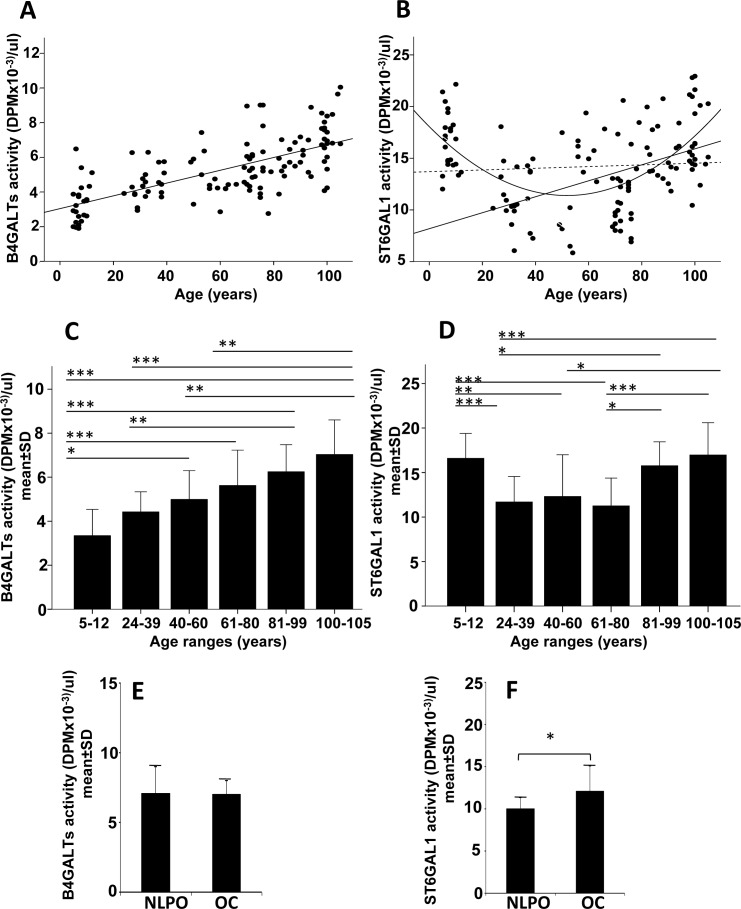
Figure 1
Figure 1. Plasmatic B4GALTs and ST6GAL1 activities in dependence of age
A., C., E. plasmatic B4GALTs; B., D., F. plasmatic ST6GAL1. A and B: regression analysis of enzyme activities in subjects of different ages; C and D: activity of the two enzymes in different age groups; E and F: activity of the two enzymes in offspring of centenarians (OC) or in age- matched offspring of non-long lived parents (NLPO). A: R2 linear (N = 125, all subjects) = 0.466; p < 0.00001. B: R2 quadratic (N = 125, all subjects) = 0.292; p < 0.00001; R2 linear (N = 125, all subjects, dashed line) = 0.0001 p N.S.; R2 linear (N = 102, only adults) = 0.216; p < 0.00001. Comparison of the two glycosyltransferase activities in different age-groups (C and D) and in NLPO and OC (E and F). C-F: *p < 0.05; **p < 0.01; ***p < 0.001 according to Kruskal-Wallis non parametric test.
Figure 2
Figure 2. GlycoAge test and plasmatic glycosyltransferases
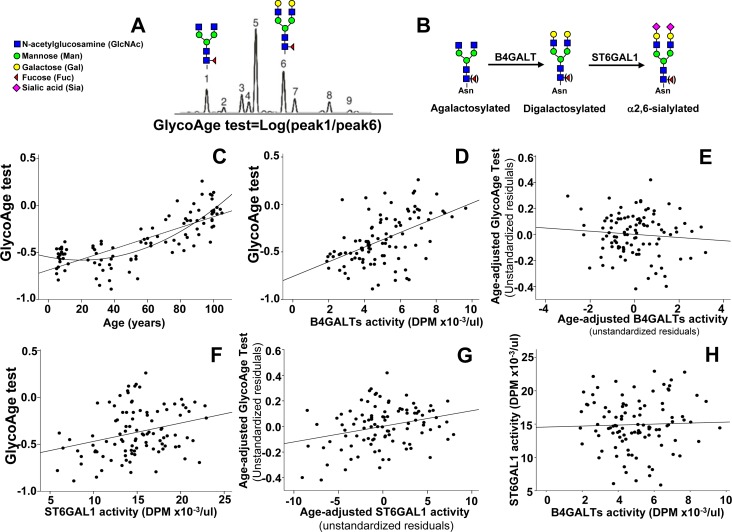
A. example of DSA-FACE analysis of glycans released by a plasma sample. The Log of the ratio of the relative abundance of peaks 1 and 6, whose structure is reported above, is the GlycoAge test. Peak 1 is the agalactosylated glycan also referred to as NGA2F present in IgG-G0. Peak 6 is its bigalactosylated counterpart also referred to as NA2F. B. Role of B4GALTs and of ST6GAL1 in the biosynthesis of N-glycans. Core-linked fucose is in parenthesis to indicate that its presence is not necessary for the activity of the two glycosyltransferases. C. correlation between the GlycoAge test and age in individuals from infancy to centenarians. Both the linear and quadratic relationships were significant (linear: R2 = 0.608; p <= 0.00001; quadratic: R2 = 0.689, p < 0.00001), but the latter fit better. D. the highly significant relationship between the GlycoAge test and B4GALTs activity (R2 = 0.263; p = 0.00001), was lost after age-adjustment E.. F. the significant relationship between the GlycoAge test and plasmatic ST6GAL1 activity (R2 = 0.085; p = 0.0032) was maintained after age adjustment (R2 = 0.083; p = 0.0036) G. H. no significant relationship existed between plasmatic ST6GAL1 and B4GALTs activities (R2 = 0.003; p 0.561).
Figure 3
Figure 3. Age-dependent α2,6-sialylation of major plasmatic glycoproteins
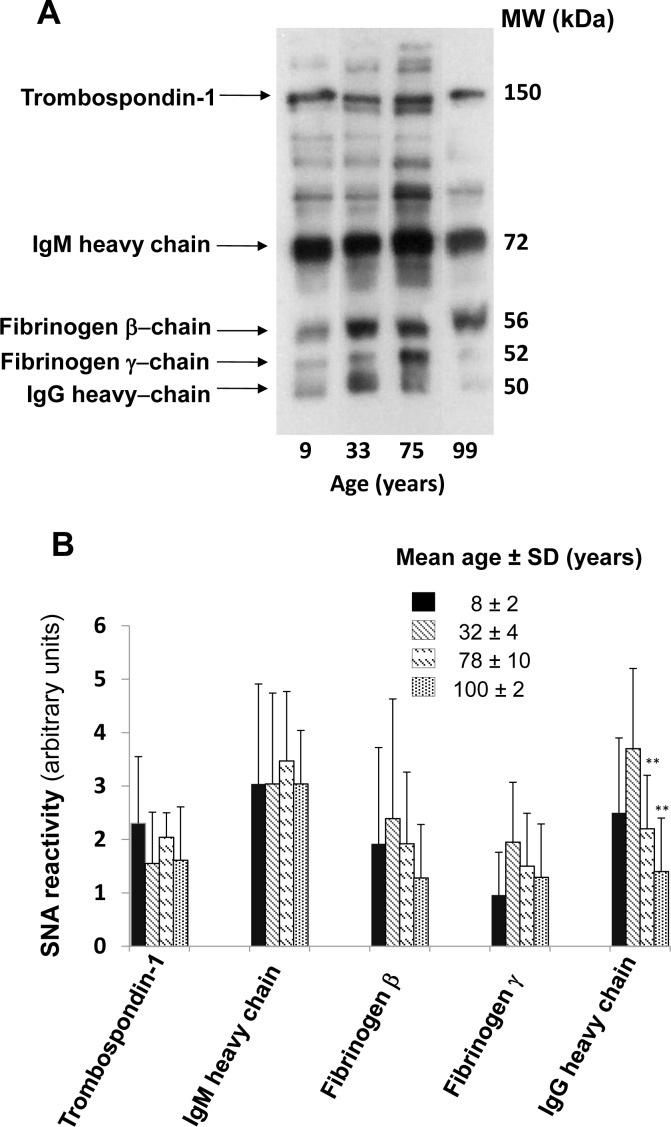
A. One hundred fold diluted human plasma was analyzed by SNA lectin blot. The identity of the major SNA reactive bands, identified by MALDI-TOF/TOF mass spectrometry is indicated on the left. B. Quantification of SNA-reactive bands in the indicated four age groups. The mean ± SD of the SNA reactivity of the five identified glycoproteins in the four age groups is reported. Only the SNA-reactivity of IgG heavy chains showed a statistically significant age-dependent decrease (Student's t test for independent samples).
Figure 4
Figure 4. Lectin blot analysis of IgG glycosylation
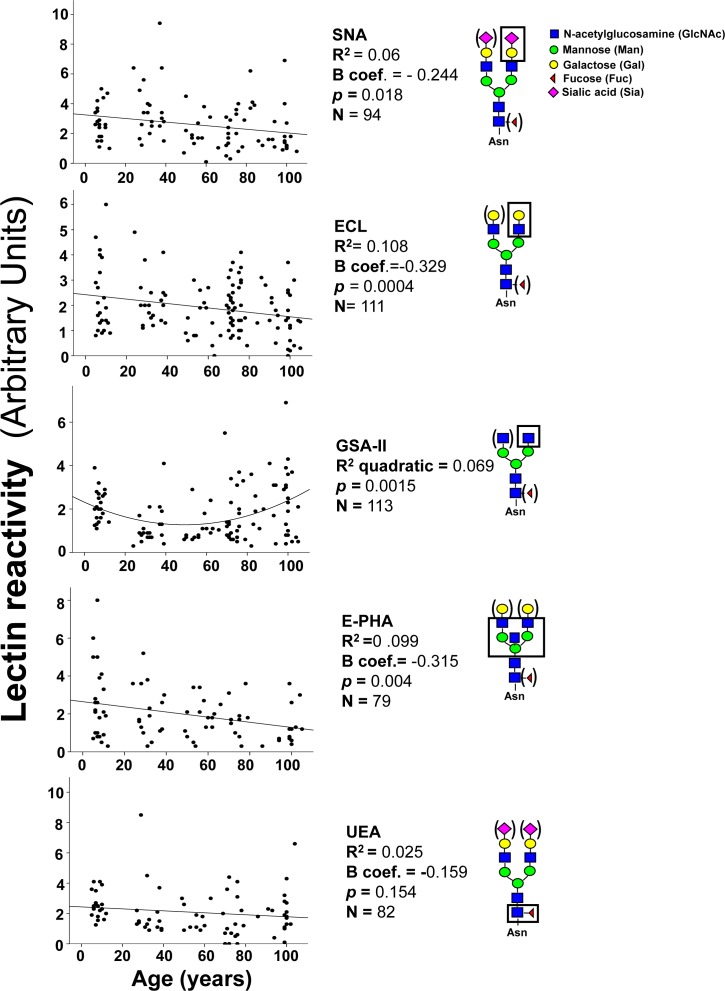
Diluted plasma samples were analyzed after blotting with five lectins. In each gel, the reactivity associated with IgG heavy chains of plasma samples was normalized with that of fixed amounts of commercially available IgG, used as an internal standard. Correlation analysis indicated significant inverse linear relationship with age for SNA, ECL and E-PHA and a positive quadratic relationship for GSA-II. The structures recognized by each lectin is boxed. Structures in parenthesis can be present or absent without affecting recognition by the lectin.
Figure 5
Figure 5. Correlation among lectin reactivities
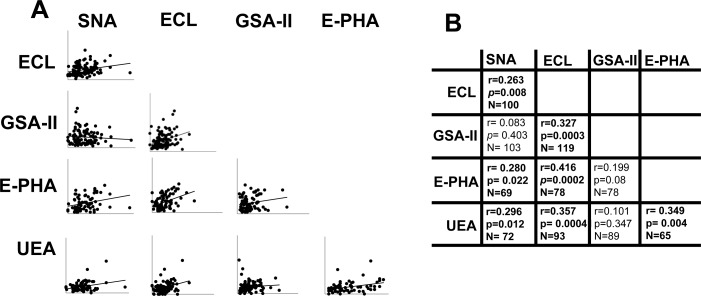
A. The reactivity of each lectin was correlated with that of every other lectin evaluated. The significance of each pair is reported in B. Statistical significant relationships are indicated in bold.

References

    1. Blagosklonny MV. Aging is not programmed: genetic pseudo-program is a shadow of developmental growth. Cell Cycle. 2013;12:3736–3742. - PMC - PubMed
    1. Cevenini E, Caruso C, Candore G, Capri M, Nuzzo D, Duro G, Rizzo C, Colonna-Romano G, Lio D, Di Carlo D, Palmas MG, Scurti M, Pini E, et al. Age-related inflammation: the contribution of different organs, tissues and systems. How to face it for therapeutic approaches. Curr Pharm Des. 2010;16:609–618. - PubMed
    1. Franceschi C, Bonafe M, Valensin S, Olivieri F, De Luca M, Ottaviani E, De Benedictis G. Inflamm-aging. An evolutionary perspective on immunosenescence. Ann N Y Acad Sci. 2000;908:244–254. - PubMed
    1. Franceschi C, Capri M, Monti D, Giunta S, Olivieri F, Sevini F, Panourgia MP, Invidia L, Celani L, Scurti M, Cevenini E, Castellani GC, Salvioli S. Inflammaging and anti-inflammaging: a systemic perspective on aging and longevity emerged from studies in humans. Mech Ageing Dev. 2007;128:92–105. - PubMed
    1. Franceschi C. Inflammaging as a major characteristic of old people: can it be prevented or cured? Nutr Rev. 2007;65:S173–S176. - PubMed

Publication types

MeSH terms