


Factors Associated with Functional Recovery among Older Intensive Care Unit Survivors
- PMID: 26840348
- PMCID: PMC4970594
- DOI: 10.1164/rccm.201506-1256OC
Factors Associated with Functional Recovery among Older Intensive Care Unit Survivors
Abstract
Rationale: Most of the 1.4 million older adults who survive the intensive care unit (ICU) annually in the United States face increased disability, but little is known about those who achieve functional recovery.
Objectives: Our objectives were twofold: to evaluate the incidence and time to recovery of premorbid function within 6 months of a critical illness and to identify independent predictors of functional recovery among older ICU survivors.
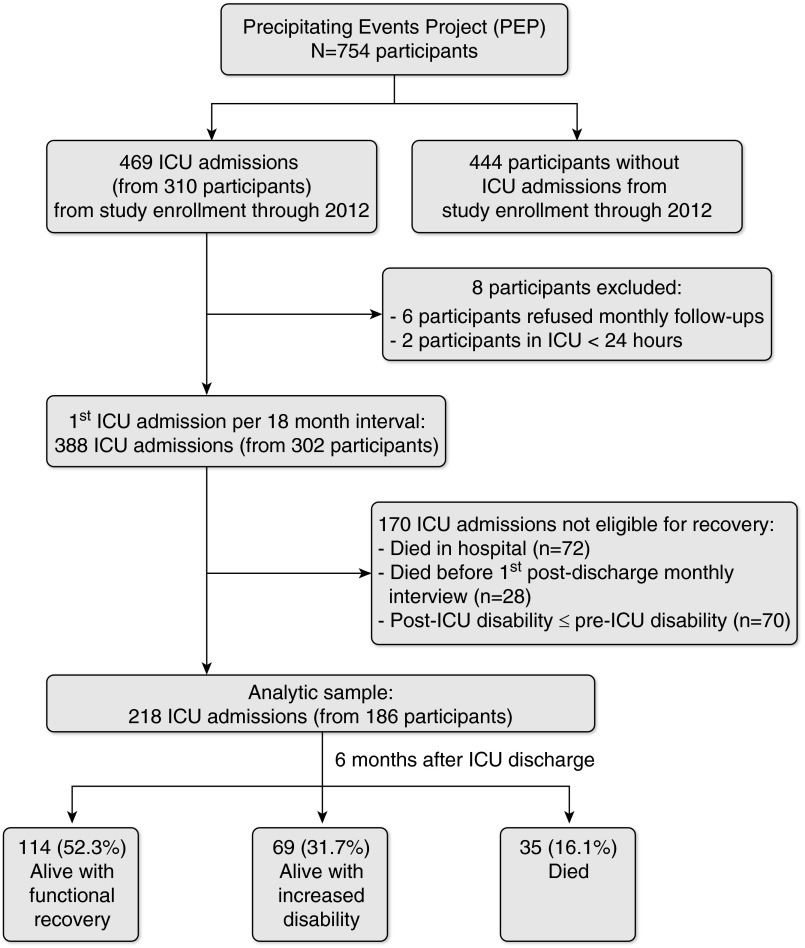
Methods: Potential participants included 754 persons aged 70 years or older who were evaluated monthly in 13 functional activities (1998-2012). The analytic sample included 218 ICU admissions from 186 ICU survivors. Functional recovery was defined as returning to a disability count less than or equal to the pre-ICU disability count within 6 months. Twenty-one potential predictors were evaluated for their associations with recovery.
Measurements and main results: Functional recovery was observed for 114 (52.3%) of the 218 admissions. In multivariable analysis, higher body mass index (hazard ratio [HR], 1.07; 95% confidence interval [CI], 1.03-1.12) and greater functional self-efficacy (HR, 1.05; 95% CI, 1.02-1.08), a measure of confidence in performing various activities, were associated with recovery, whereas pre-ICU impairment in hearing (HR, 0.38; 95% CI, 0.22-0.66) and vision (HR, 0.59; 95% CI, 0.37-0.95) were associated with a lack of recovery.
Conclusions: Among older adults who survived an ICU admission with increased disability, pre-ICU hearing and vision impairment were strongly associated with poor functional recovery within 6 months, whereas higher body mass index and functional self-efficacy were associated with recovery. Future research is needed to evaluate whether interventions targeting these factors improve functional outcomes among older ICU survivors.
Keywords: Medicare; functional status; intensive care; quality of life.
Figures
Comment in
-
Loud and Clear: Sensory Impairment, Delirium, and Functional Recovery in Critical Illness.Am J Respir Crit Care Med. 2016 Aug 1;194(3):252-3. doi: 10.1164/rccm.201602-0372ED. Am J Respir Crit Care Med. 2016. PMID: 27479057 Free PMC article. No abstract available.
References
-
- Wunsch H, Guerra C, Barnato AE, Angus DC, Li G, Linde-Zwirble WT. Three-year outcomes for Medicare beneficiaries who survive intensive care. JAMA. 2010;303:849–856. - PubMed
-
- Fried LP, Guralnik JM. Disability in older adults: evidence regarding significance, etiology, and risk. J Am Geriatr Soc. 1997;45:92–100. - PubMed
Publication types
MeSH terms
Grants and funding
LinkOut - more resources
Full Text Sources
Other Literature Sources
