


Theory of Mind in Children with Fetal Alcohol Spectrum Disorders
- PMID: 26842255
- PMCID: PMC4743533
- DOI: 10.1111/acer.12961
Theory of Mind in Children with Fetal Alcohol Spectrum Disorders
Abstract
Background: Theory of mind (ToM) refers to the ability to understand and make inferences about other people's intentions, feelings, and beliefs. Although children with fetal alcohol spectrum disorders (FASD) are known to have deficits in social-cognitive function, little is known about ToM in FASD.
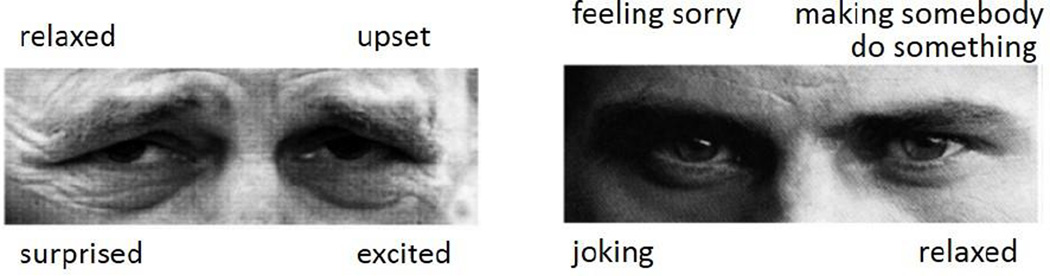
Methods: ToM ability was assessed using a developmentally sensitive ToM battery, including the reading the mind in the eyes (RME) test, a measure of mental inferential ability that has been found to be impaired in other clinical populations. IQ and executive function (EF) were assessed as potential mediating variables. The battery was administered to 63 children (aged 9 to 11 years) from Cape Town, South Africa, whose mothers had been prospectively recruited during pregnancy. Children with fetal alcohol syndrome (FAS; n = 8) and partial FAS (PFAS; n = 19), as well as nonsyndromal heavily exposed children (n = 17), were compared to children born to abstaining or light drinkers (n = 19) from the same community.
Results: No FASD group differences were found on the less challenging ToM tasks. By contrast, children with FAS and PFAS performed more poorly than controls on a more challenging ToM task, the RME test. A continuous measure of prenatal alcohol exposure (PAE) was more sensitive than FASD diagnosis in that it was related to 4 higher-order ToM measures, particularly the ability to attribute mental states assessed on RME. IQ only partially mediated the effect of exposure on RME performance, and these effects were not mediated by EF. Hence, the data suggest that these ToM measures tap into a specific alcohol-related social-cognitive deficit that does not merely reflect poorer EF. FASD diagnosis and PAE were each also related to RME after control for attention deficit/hyperactivity disorder.
Conclusions: These findings suggest that deficits in higher-order ToM function may play a significant role in the social-cognitive behavioral impairment in FASD.
Keywords: Affect Recognition; Fetal Alcohol Spectrum Disorders; Fetal Alcohol Syndrome; Prenatal Alcohol Exposure; Reading the Mind in the Eyes; Social Cognition; Theory of Mind.
Copyright © 2016 by the Research Society on Alcoholism.
Conflict of interest statement
CONFLICT OF INTEREST
None of the authors have any conflicts of interest related to this study.
Figures
References
-
- Adams RB, Rule NO, Franklin RG, Wang E, Stevenson MT, Yoshikawa S, Nomura M, Sato W, Kveraga K, Ambady N. Cross-cultural reading the mind in the eyes: an fMRI investigation. J Cognitive Neurosci. 2009;22:97–108. - PubMed
-
- Baron-Cohen S, Jolliffe T, Mortimore C, Robertson M. Another advanced test of Theory of Mind: evidence from very high functioning adults with autism or Asperger syndrome. J Child Psychol Psyc. 1997;38:813–822. - PubMed
-
- Baron-Cohen S, O’Riordan M, Stone V, Jones R, Plaisted K. Recognition of faux pas by normally developing children and children with Asperger syndrome or high-functioning autism. J Autism Dev Disord. 1999a;29:407–418. - PubMed
-
- Baron-Cohen S, Ring H, Moriarty J, Schmitz B, Costa D, Ell P. Recognition of mental state terms. Clinical findings in children with Autism and a functional neuroimaging study of normal adults. Br J Psychiatry. 1994;165:640–649. - PubMed
Publication types
MeSH terms
Grants and funding
LinkOut - more resources
Full Text Sources
Other Literature Sources
Medical
Research Materials
Miscellaneous
