. 2016 Feb 10;283(1824):20152820.
doi: 10.1098/rspb.2015.2820.

Phylogeny and adaptation shape the teeth of insular mice

Affiliations

Phylogeny and adaptation shape the teeth of insular mice

Ronan Ledevin et al. Proc Biol Sci. .

Abstract

By accompanying human travels since prehistorical times, the house mouse dispersed widely throughout the world, and colonized many islands. The origin of the travellers determined the phylogenetic source of the insular mice, which encountered diverse ecological and environmental conditions on the various islands. Insular mice are thus an exceptional model to disentangle the relative role of phylogeny, ecology and climate in evolution. Molar shape is known to vary according to phylogeny and to respond to adaptation. Using for the first time a three-dimensional geometric morphometric approach, compared with a classical two-dimensional quantification, the relative effects of size variation, phylogeny, climate and ecology were investigated on molar shape diversity across a variety of islands. Phylogeny emerged as the factor of prime importance in shaping the molar. Changes in competition level, mostly driven by the presence or absence of the wood mouse on the different islands, appeared as the second most important effect. Climate and size differences accounted for slight shape variation. This evidences a balanced role of random differentiation related to history of colonization, and of adaptation possibly related to resource exploitation.

Keywords: Mus musculus domesticus; first upper molar; house mouse; insular evolution; three-dimensional geometric morphometrics.


Figures

Figure 1.
Figure 1.
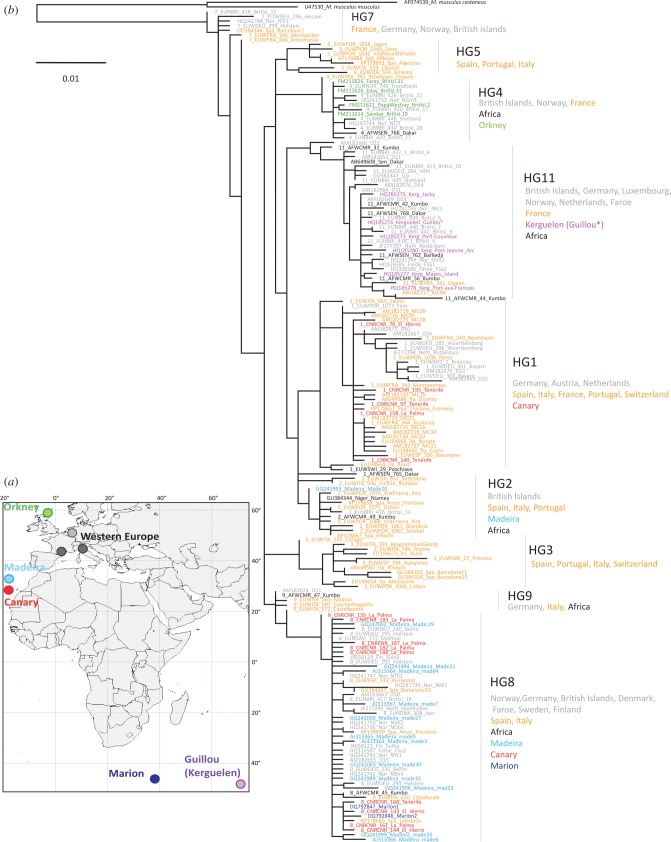
(a) Map of the localities sampled for morphometrics. (b) Phylogenetic tree based on D-loop sequences. Genetic sampling was designed to encompass at best the diversity of Western European mice, as well as the islands studied. Haplogroups defined by Bonhomme et al. [14] are provided. (Online version in colour.)
Figure 2.
Figure 2.
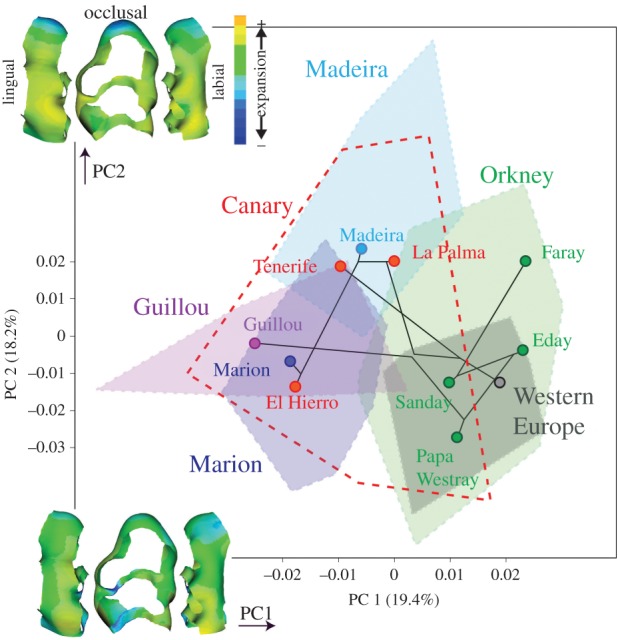
First upper molar differentiation in the morphospace based on 3D morphometrics. Symbols are group means linked by the phylogenetic relationship based on D-loop distances. Envelopes depict range of variation of the geographical groups. Depicted shape changes: along PC1 (from −0.06 to 0.04) and PC2 (from −0.04 to 0.06). (Online version in colour.)
Figure 3.
Figure 3.
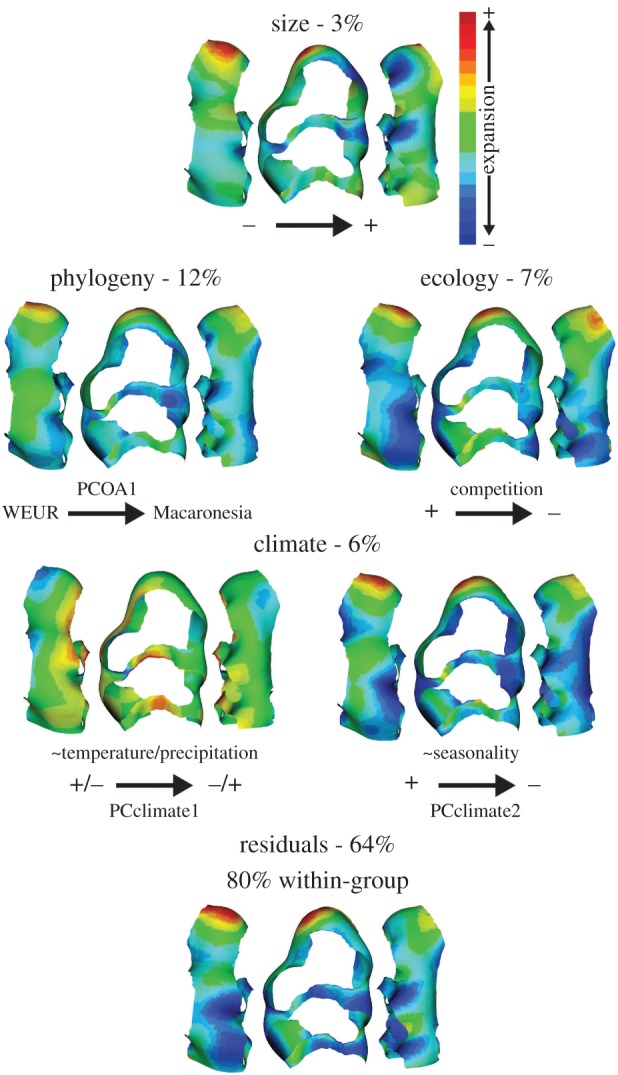
Summary of a model of 3D tooth shape versus explanatory variables: size, phylogeny, ecology and climate and visualization of the various effects. Allometry: shape change with a size increase from 5% to 95% of the distribution. The following representations were computed based on the 29 first PCs (totaling more than 95% of variance) on the size-free variables. Phylogeny: changes along the first phylogenetic axis, roughly corresponding to changes from Western Europe to the Macaronesian cluster. Ecology: change from the presence to absence of inter-specific competition. Climate: changes along the first climatic axis (opposing warm, dry to cold, wet environments) and along the second climatic axis (opposing seasonal, continental environments to non-seasonal, insular environments). In all cases, the shape change between 5% and 95% of the distribution is visualized. The residuals of the model including size, phylogeny, climate and ecology were decomposed into between-group and within-group variances. Shape changes along the first axis of within-group variance are depicted (±0.4 along wgPC1). (Online version in colour.)

References

    1. Pergams ORW, Ashley MV. 2001. Microevolution in island rodents. Genetica 112–113, 245–256. (10.1023/A:1013343923155) - DOI - PubMed
    1. Travisano M, Mongold JA, Bennet AF, Lenski RE. 1995. Experimental tests of the roles of adaptation, chance, and history in evolution. Science 267, 87–90. (10.1126/science.7809610) - DOI - PubMed
    1. Keller SR, Taylor DR. 2008. History, chance and adaptation during biological invasion: separating stochastic phenotypic evolution from response to selection. Ecol. Lett. 11, 852–866. (10.1111/j.1461-0248.2008.01188.x) - DOI - PubMed
    1. Berry RJ. 1973. Chance and change in British long-tailed field mice (Apodemus sylvaticus). J. Zool. 170, 351–366. (10.1111/j.1469-7998.1973.tb01383.x) - DOI
    1. Carroll SP. 2008. Facing change: forms and foundations of contemporary adaptation to biotic invasions. Mol. Ecol. 17, 361–372. (10.1111/j.1365-294X.2007.03484.x) - DOI - PubMed

Publication types

Substances