


Going "social" to access experimental and potentially life-saving treatment: an assessment of the policy and online patient advocacy environment for expanded access
- PMID: 26843367
- PMCID: PMC4739083
- DOI: 10.1186/s12916-016-0568-8
Going "social" to access experimental and potentially life-saving treatment: an assessment of the policy and online patient advocacy environment for expanded access
Abstract
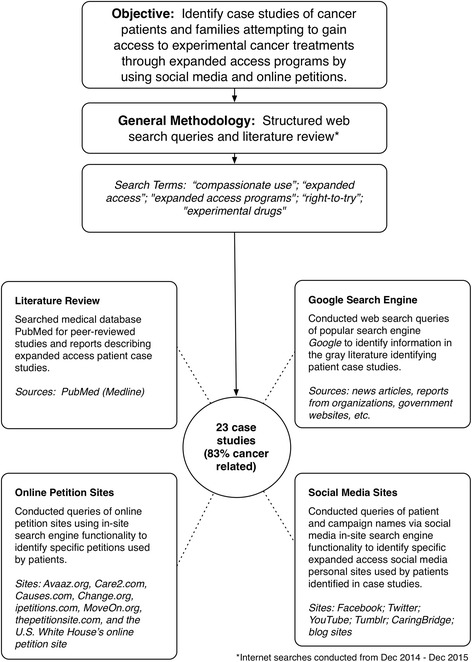
Social media is fundamentally altering how we access health information and make decisions about medical treatment, including for terminally ill patients. This specifically includes the growing phenomenon of patients who use online petitions and social media campaigns in an attempt to gain access to experimental drugs through expanded access pathways. Importantly, controversy surrounding expanded access and "compassionate use" involves several disparate stakeholders, including patients, manufacturers, policymakers, and regulatory agencies-all with competing interests and priorities, leading to confusion, frustration, and ultimately advocacy. In order to explore this issue in detail, this correspondence article first conducts a literature review to describe how the expanded access policy and regulatory environment in the United States has evolved over time and how it currently impacts access to experimental drugs. We then conducted structured web searches to identify patient use of online petitions and social media campaigns aimed at compelling access to experimental drugs. This was carried out in order to characterize the types of communication strategies utilized, the diseases and drugs subject to expanded access petitions, and the prevalent themes associated with this form of "digital" patient advocacy. We find that patients and their families experience mixed results, but still gravitate towards the use of online campaigns out of desperation, lack of reliable information about treatment access options, and in direct response to limitations of the current fragmented structure of expanded access regulation and policy currently in place. In response, we discuss potential policy reforms to improve expanded access processes, including advocating greater transparency for expanded access programs, exploring use of targeted economic incentives for manufacturers, and developing systems to facilitate patient information about existing treatment options. This includes leveraging recent legislative attention to reform expanded access through the CURE Act Provisions contained in the proposed U.S. 21st Century Cures Act. While expanded access may not be the best option for the majority of individuals, terminally ill patients and their families nevertheless deserve better processes, policies, and availability to potentially life-changing information, before they decide to pursue an online campaign in the desperate hope of gaining access to experimental drugs.
Figures
Comment in
-
(R)evolution: toward a new paradigm of policy and patient advocacy for expanded access to experimental treatments.BMC Med. 2016 Feb 29;14:39. doi: 10.1186/s12916-016-0586-6. BMC Med. 2016. PMID: 26926908 Free PMC article.
References
-
- Lauckner C, Whitten P. The differential effects of social media sites for promoting cancer risk reduction. J Canc Educ. 2015:1–4. in press. - PubMed
-
- Pew Research Center. Health fact sheet. http://www.pewinternet.org/fact-sheets/health-fact-sheet/. 31 January 2016.
Publication types
MeSH terms
LinkOut - more resources
Full Text Sources
Other Literature Sources
