


Early Life Growth Predicts Pubertal Development in South African Adolescents
- PMID: 26843589
- PMCID: PMC4763484
- DOI: 10.3945/jn.115.222000
Early Life Growth Predicts Pubertal Development in South African Adolescents
Abstract
Background: Given global trends toward earlier onset of puberty and the adverse psychosocial consequences of early puberty, it is important to understand the childhood predictors of pubertal timing and tempo.
Objective: We examined the association between early growth and the timing and tempo of puberty in adolescents in South Africa.
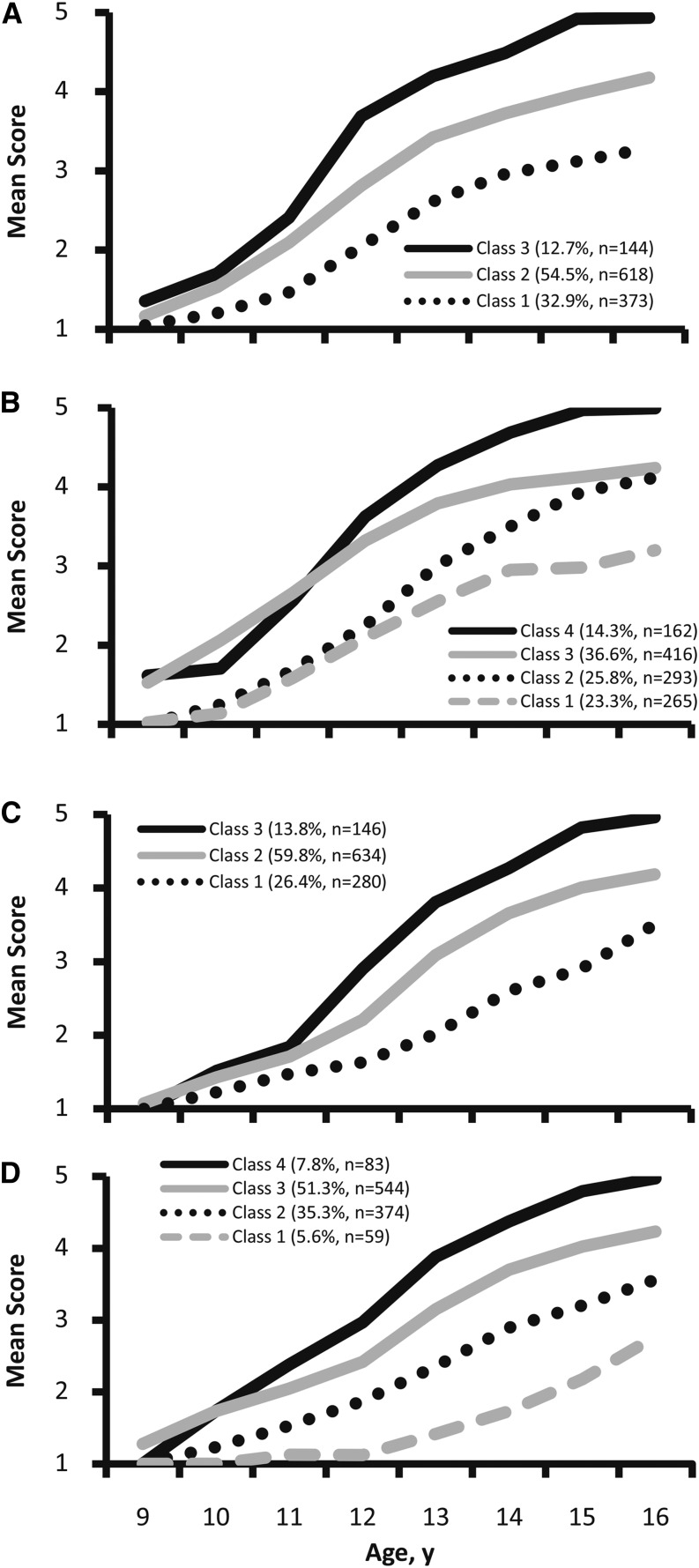
Methods: We analyzed prospectively collected data from 1060 boys and 1135 girls participating in the Birth-to-Twenty cohort in Soweto, South Africa. Height-for-age z scores (HAZs) and body mass index-for-age z scores (BMIZs) were calculated based on height (centimeters) and body mass index (kilograms per meter squared) at ages 5 y and 8 y. The development of genitals, breasts, and pubic hair was recorded annually from 9 to 16 y of age with the use of the Tanner sexual maturation scale (SMS). We used latent class growth analysis to identify pubertal trajectory classes and also characterized children as fast or slow developers based on the SMS score at 12 y of age. We used multinomial logistic regression to estimate associations of HAZ and BMIZ at ages 5 and 8 y with pubertal development.
Results: We identified 3 classes for pubic hair development (for both girls and boys) and 4 classes for breast (for girls) and genital (for boys) development. In girls, both HAZ and BMIZ at age 5 y were positively associated with pubic hair development [relative risk ratio (RRR): 1.57, P < 0.001 and RRR: 1.51, P < 0.01, respectively], as was BMI at age 8 y (RRR: 2.06, P = 0.03); similar findings were observed for breast development. In boys, HAZ and BMIZ at age 5 y were positively associated with pubic hair development (RRR: 1.78, P < 0.001 and RRR: 1.43, P < 0.01, respectively); HAZ at age 5 y was associated with development of genitals (RRR: 2.19, P < 0.01).
Conclusion: In boys and girls, both height and body mass index in early childhood predicted the trajectory of pubertal development. This may provide a tool to identify children at risk of early pubertal onset.
Keywords: adolescent; body mass index; child growth; latent class growth analysis; puberty.
Conflict of interest statement
Author disclosures: EA Lundeen, SA Norris, R Martorell, PS Suchdev, NK Mehta, LM Richter, and AD Stein, no conflicts of interest. The funders had no role in the design and conduct of the study; collection, management, analysis, and interpretation of the data; preparation, review, or approval of the manuscript; or the decision to submit the manuscript for publication.
Figures
References
-
- Phinney VG, Jensen L. The relationship between early development and psychosexual behaviors in adolescent females. Adolescence 1990;25:321. - PubMed
-
- Parent AS, Teilmann G, Juul A, Skakkebaek N, Toppari J, Bourguignon J. The timing of normal puberty and the age limits of sexual precocity: variations around the world, secular trends, and changes after migration. Endocr Rev 2003;24:668–93. - PubMed
Publication types
MeSH terms
Grants and funding
LinkOut - more resources
Full Text Sources
Other Literature Sources
Medical
