


Navigating to health: Evaluation of a community health center patient navigation program
- PMID: 26844134
- PMCID: PMC4721349
- DOI: 10.1016/j.pmedr.2015.08.002
Navigating to health: Evaluation of a community health center patient navigation program
Abstract
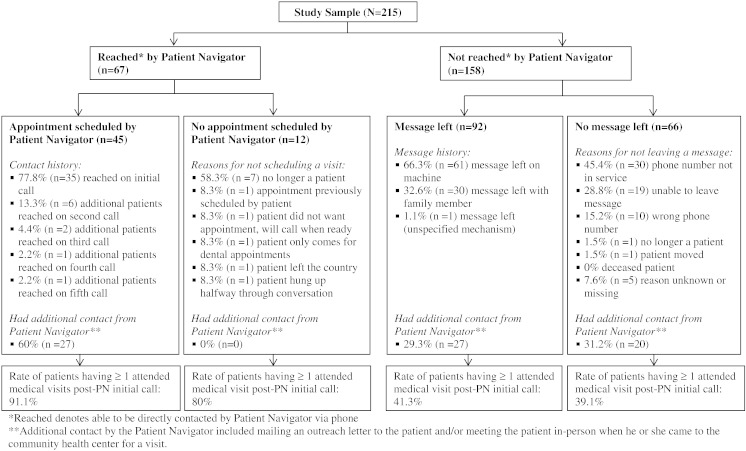
Patient Navigators are trained, lay health care workers who guide patients in overcoming barriers to health care access and utilization. Little evidence exists regarding reach and impact of Patient Navigators for chronic disease management. This study evaluated a Patient Navigator program aimed at optimizing health care utilization among ethnically diverse patients with diabetes and/or hypertension at a community health center (CHC). Trained Patient Navigators contacted eligible patients who had not seen a primary care provider (PCP) for ≥ 6 months. Outcomes included number of patients reached by Patient Navigators and seen by PCPs after Patient Navigator contact. Distributions and frequencies of outcomes pre- and post-call were compared. A total of 215 patients had ≥ 1 call attempt from Patient Navigators. Of these, 74 were additionally contacted via mailed letters or at the time of a CHC visit. Among the 45 patients reached, 77.8% scheduled an appointment through the Patient Navigator. These patients had higher rates of PCP visits 6 months post-call (90%) than those not reached (42.2%) (p < 0.0001). Findings emphasize the value of direct telephone contact in patient health care re-engagement and may inform the development of future Patient Navigator programs to improve reach and effectiveness.
Keywords: Community health center; Patient engagement; Patient navigator; Program evaluation.
Figures
References
-
- Pratt-Chapman M., Willis A. Community cancer center administration and support for navigation services. Semin. Oncol. Nurs. 2013;29:141–148. - PubMed
-
- Freeman H.P. National Institutes of Health, National Cancer Institute; Bethesda, MD: 2001. Voices of a Broken System: Real People, Real Problems.
-
- Freeman H.P. A model patient navigation program. Oncol. Issues. 2004;19:44–46.
Grants and funding
LinkOut - more resources
Full Text Sources
Other Literature Sources
Miscellaneous
