


Preliminary efficacy and feasibility of embedding high intensity interval training into the school day: A pilot randomized controlled trial
- PMID: 26844177
- PMCID: PMC4733031
- DOI: 10.1016/j.pmedr.2015.11.001
Preliminary efficacy and feasibility of embedding high intensity interval training into the school day: A pilot randomized controlled trial
Abstract
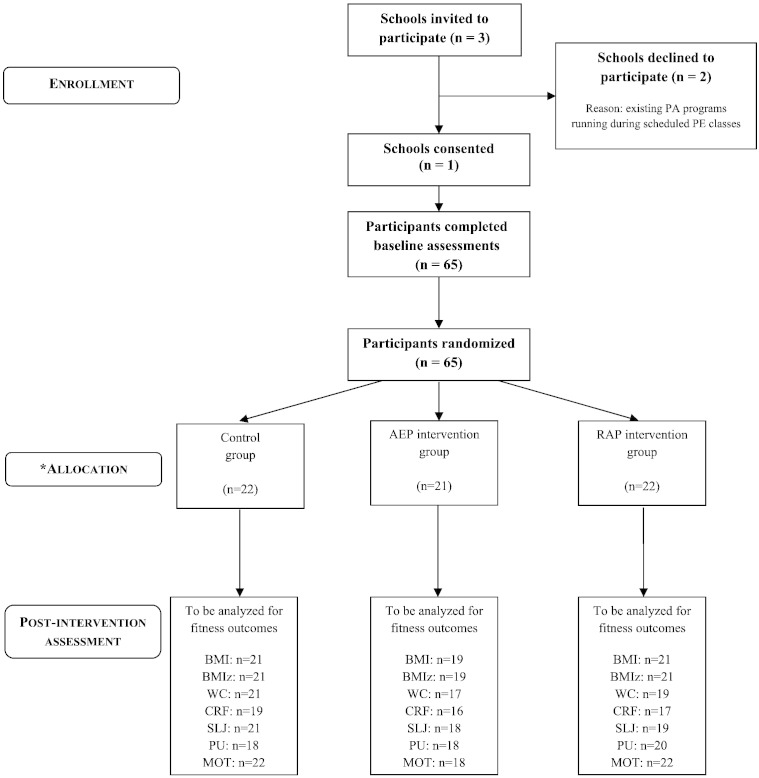
Current physical activity and fitness levels among adolescents are low, increasing the risk of chronic disease. Although the efficacy of high intensity interval training (HIIT) for improving metabolic health is now well established, it is not known if this type of activity can be effective to improve adolescent health. The primary aim of this study is to assess the effectiveness and feasibility of embedding HIIT into the school day. A 3-arm pilot randomized controlled trial was conducted in one secondary school in Newcastle, Australia. Participants (n = 65; mean age = 15.8(0.6) years) were randomized into one of three conditions: aerobic exercise program (AEP) (n = 21), resistance and aerobic exercise program (RAP) (n = 22) and control (n = 22). The 8-week intervention consisted of three HIIT sessions per week (8-10 min/session), delivered during physical education (PE) lessons or at lunchtime. Assessments were conducted at baseline and post-intervention to detect changes in cardiorespiratory fitness (multi-stage shuttle-run), muscular fitness (push-up, standing long jump tests), body composition (Body Mass Index (BMI), BMI-z scores, waist circumference) and physical activity motivation (questionnaire), by researchers blinded to treatment allocation. Intervention effects for outcomes were examined using linear mixed models, and Cohen's d effect sizes were reported. Participants in the AEP and RAP groups had moderate intervention effects for waist circumference (p = 0.024), BMI-z (p = 0.037) and BMI (not significant) in comparison to the control group. A small intervention effect was also evident for cardiorespiratory fitness in the RAP group.
Keywords: Adolescent; Exercise; Fitness; Health promotion; High intensity interval training; Intervention; Physical activity; School.
Figures
References
-
- Assmann S.F., Pocock S.J., Enos L.E. Subgroup analysis and other (mis) uses of baseline data in clinical trials. Lancet. 2000;355(9209):1064–1069. - PubMed
-
- Boer P.-H., Meeus M., Terblanche E. The influence of sprint interval training on body composition, physical and metabolic fitness in adolescents and young adults with intellectual disability: a randomized controlled trial. Clin. Rehabil. 2014;28(3):221–231. - PubMed
-
- Buchan D., Ollis S., Thomas N. Physical activity interventions: effects of duration and intensity. Scand. J. Med. Sci. Sports. 2011;21(6):e341–e350. - PubMed
-
- Buchan D.S., Ollis S., Young J.D. The effects of time and intensity of exercise on novel and established markers of CVD in adolescent youth. Am. J. Hum. Biol. 2011;23(4):517–526. - PubMed
LinkOut - more resources
Full Text Sources
Other Literature Sources
