


Clinical Implications of Serum Albumin Levels in Acute Heart Failure: Insights From DOSE-AHF and ROSE-AHF
- PMID: 26844764
- PMCID: PMC4970961
- DOI: 10.1016/j.cardfail.2016.01.015
Clinical Implications of Serum Albumin Levels in Acute Heart Failure: Insights From DOSE-AHF and ROSE-AHF
Abstract
Background: Hypoalbuminemia is common in patients with chronic heart failure and, as a marker of disease severity, is associated with an adverse prognosis. Whether hypoalbuminemia contributes to (or is associated with) worse outcomes in acute heart failure (AHF) is unclear. We sought to determine the implications of low serum albumin in patients receiving decongestive therapies for AHF.
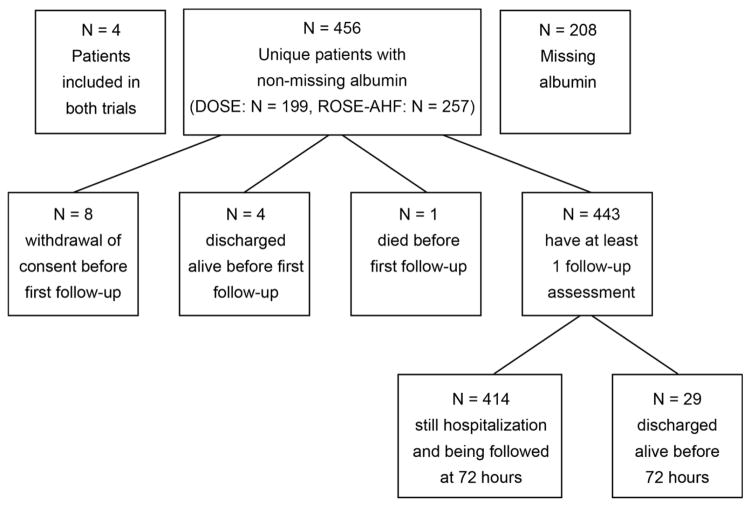
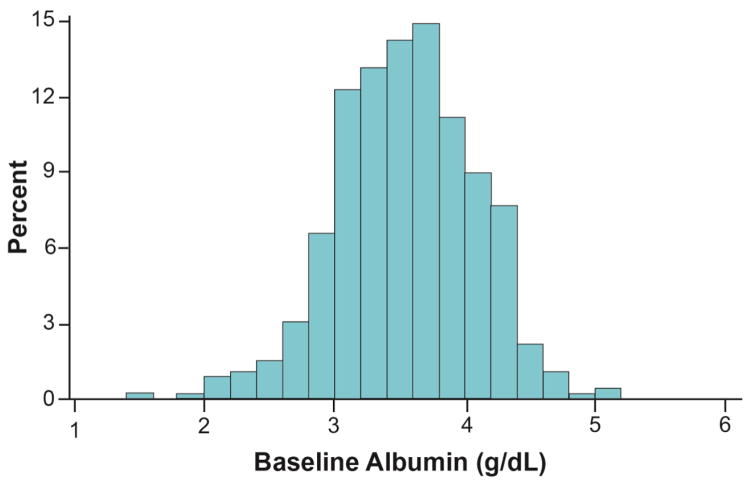
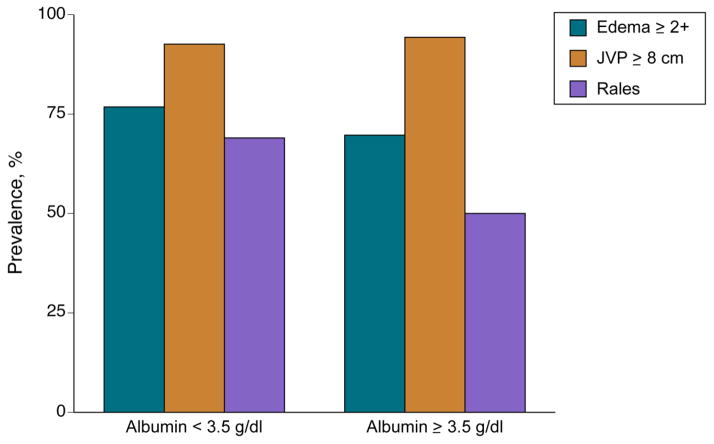
Methods and results: Baseline serum albumin levels were measured in 456 AHF subjects randomized in the DOSE-AHF and ROSE-AHF trials. We assessed the relationship between admission albumin levels (both as a continuous variable and stratified by median albumin [≥3.5 g/dL]) and worsening renal function (WRF), worsening heart failure (WHF), and clinical decongestion by 72 hours; 7-day cardiorenal biomarkers; and post-discharge outcomes. The mean baseline albumin level was 3.5 ± 0.5 g/dL. Albumin was not associated with WRF, WHF, or clinical decongestion by 72 hours. Furthermore, there was no association between continuous albumin levels and symptom change according to visual analog scale or weight change by 72 hours. Albumin was not associated with 60-day mortality, rehospitalization, or unscheduled emergency room visits.
Conclusions: Baseline serum albumin levels were not associated with short-term clinical outcomes for AHF patients undergoing decongestive therapies. These data suggest that serum albumin may not be a helpful tool to guide decongestion strategies.
Keywords: Heart failure; diuretics; proteins.
Copyright © 2016 Elsevier Inc. All rights reserved.
Figures
Similar articles
-
Serum Bicarbonate in Acute Heart Failure: Relationship to Treatment Strategies and Clinical Outcomes.J Card Fail. 2016 Sep;22(9):738-42. doi: 10.1016/j.cardfail.2016.01.007. Epub 2016 Jan 14. J Card Fail. 2016. PMID: 26777758 Free PMC article.
-
Implications of Serum Chloride Homeostasis in Acute Heart Failure (from ROSE-AHF).Am J Cardiol. 2017 Jan 1;119(1):78-83. doi: 10.1016/j.amjcard.2016.09.014. Epub 2016 Sep 30. Am J Cardiol. 2017. PMID: 27816115 Free PMC article. Clinical Trial.
-
Relevance of Changes in Serum Creatinine During a Heart Failure Trial of Decongestive Strategies: Insights From the DOSE Trial.J Card Fail. 2016 Oct;22(10):753-60. doi: 10.1016/j.cardfail.2016.06.423. Epub 2016 Jun 30. J Card Fail. 2016. PMID: 27374839 Free PMC article. Clinical Trial.
-
Acute heart failure: lessons learned so far.Can J Cardiol. 2011 May-Jun;27(3):284-95. doi: 10.1016/j.cjca.2011.02.007. Can J Cardiol. 2011. PMID: 21601768 Review.
-
Cardiorenal interactions in acute decompensated heart failure: contemporary concepts facing emerging controversies.J Card Fail. 2014 Dec;20(12):1004-11. doi: 10.1016/j.cardfail.2014.09.005. Epub 2014 Sep 16. J Card Fail. 2014. PMID: 25230240 Review.
Cited by
-
Causal relationship between hypoalbuminemia and acute kidney injury.World J Nephrol. 2017 Jul 6;6(4):176-187. doi: 10.5527/wjn.v6.i4.176. World J Nephrol. 2017. PMID: 28729966 Free PMC article. Review.
-
Diuretic strategies in acute decompensated heart failure.Heart Fail Rev. 2025 Mar;30(2):417-430. doi: 10.1007/s10741-024-10473-z. Epub 2024 Dec 15. Heart Fail Rev. 2025. PMID: 39676121 Review.
-
Prognostic Impact of Serum Albumin for Developing Heart Failure Remotely after Acute Myocardial Infarction.Nutrients. 2020 Aug 29;12(9):2637. doi: 10.3390/nu12092637. Nutrients. 2020. PMID: 32872477 Free PMC article.
-
Development and validation of a predictive model for prolonged length of stay in elderly type 2 diabetes mellitus patients combined with cerebral infarction.Front Neurol. 2024 Aug 1;15:1405096. doi: 10.3389/fneur.2024.1405096. eCollection 2024. Front Neurol. 2024. PMID: 39148703 Free PMC article.
-
Liver abnormalities in pulmonary arterial hypertension.Pulm Circ. 2021 Oct 21;11(4):20458940211054304. doi: 10.1177/20458940211054304. eCollection 2021 Oct-Dec. Pulm Circ. 2021. PMID: 34707859 Free PMC article. Review.
References
-
- Quinlan GJ, Martin GS, Evans TW. Albumin: biochemical properties and therapeutic potential. Hepatology. 2005;41:1211–9. - PubMed
-
- Allen LA, Felker GM, Pocock S, McMurray JJ, Pfeffer MA, Swedberg K, Wang D, Yusuf S, Michelson EL, Granger CB. Liver function abnormalities and outcome in patients with chronic heart failure: data from the Candesartan in Heart Failure: Assessment of Reduction in Mortality and Morbidity (CHARM) program. European journal of heart failure. 2009;11:170–7. - PMC - PubMed
-
- Horwich TB, Kalantar-Zadeh K, MacLellan RW, Fonarow GC. Albumin levels predict survival in patients with systolic heart failure. Am Heart J. 2008;155:883–9. - PubMed
-
- Arques S, Roux E, Sbragia P, Gelisse R, Pieri B, Ambrosi P. Usefulness of serum albumin concentration for in-hospital risk stratification in frail, elderly patients with acute heart failure. Insights from a prospective, monocenter study. Int J Cardiol. 2008;125:265–7. - PubMed
-
- Guyton AC, Lindsey AW. Effect of elevated left atrial pressure and decreased plasma protein concentration on the development of pulmonary edema. Circulation research. 1959;7:649–57. - PubMed
MeSH terms
Substances
Grants and funding
LinkOut - more resources
Full Text Sources
Other Literature Sources
Medical
