


Distinct neural mechanisms for remembering when an event occurred
- PMID: 26845069
- PMCID: PMC6467645
- DOI: 10.1002/hipo.22571
Distinct neural mechanisms for remembering when an event occurred
Abstract
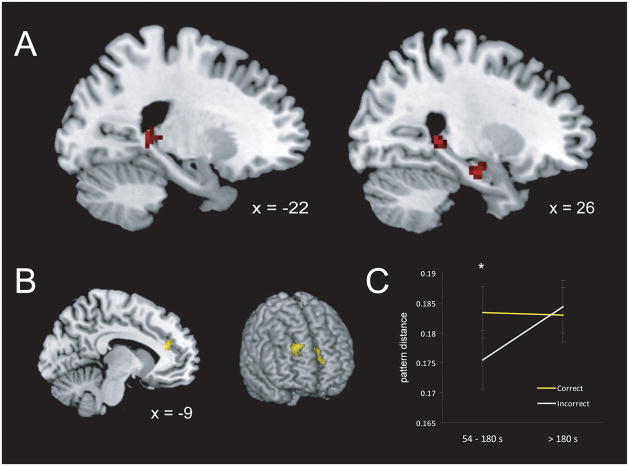
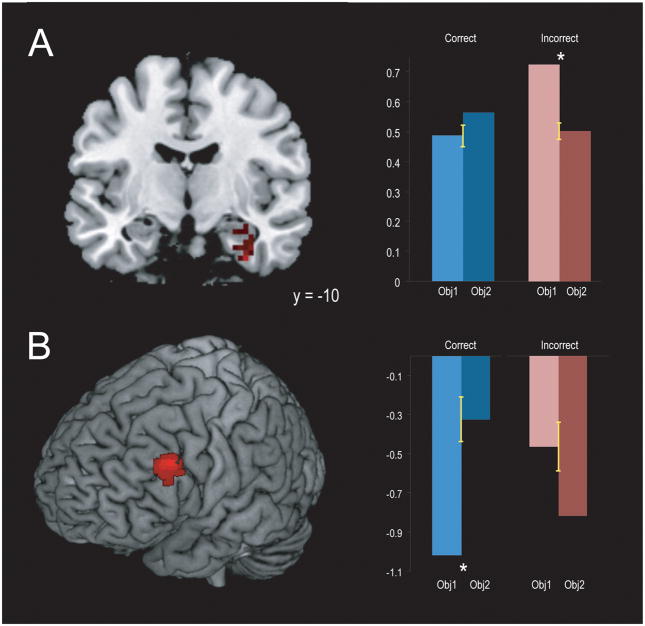
Events are often remembered as having occurred in a specific order, but almost nothing is known about how the brain encodes this temporal information. It is commonly assumed that temporal information is encoded via a single mechanism, based either on the temporal context in which the event occurred or inferred from the strength of the memory trace itself. By analyzing time-dependent changes in activity patterns, we show that the distinctiveness of contextual representations in the hippocampus and anterior and medial prefrontal cortex was associated with accurate recency memory. In contrast, overall activation in the perirhinal and lateral prefrontal cortices predicted whether an object would be judged more recent, regardless of accuracy. These results demonstrate that temporal information was encoded through at least two complementary neural mechanisms.
Keywords: episodic memory; functional MRI; recency discrimination; temporal context; temporal order memory.
© 2016 Wiley Periodicals, Inc.
Figures
Comment in
-
Commentary: Distinct neural mechanisms for remembering when an event occurred.Front Psychol. 2017 Feb 21;8:189. doi: 10.3389/fpsyg.2017.00189. eCollection 2017. Front Psychol. 2017. PMID: 28270781 Free PMC article. No abstract available.
References
-
- Aggleton JP, Brown MW. Episodic memory, amnesia, and the hippocampal-anterior thalamic axis. Behavioral Brain Science. 1999;22:425–489. - PubMed
-
- Bjork RA, Whitten WB. Recency-sensitive retrieval processes in long-term free recall. Cognitive Psychology. 1974;6:173–189.
-
- Block RA. Temporal judgments and contextual change. Journal of Experimental Psychology: Learning, Memory, and Cognition. 1972;8:530–544. - PubMed
-
- Bower GH. Stimulus-sampling theory of encoding variability. In: Melton AW, Martin E, editors. Coding Processes in Human Memory. John Wiley and Sons; 1972. pp. 85–121.
-
- Brown NR, Rips LJ, Shevell SK. The subjective dates of natural events in very-long-term memory. Cognitive Psychology. 1985;17:139–177.
Publication types
MeSH terms
Grants and funding
LinkOut - more resources
Full Text Sources
Other Literature Sources
Medical
