


Development and maturation of natural killer cells
- PMID: 26845614
- PMCID: PMC4801705
- DOI: 10.1016/j.coi.2016.01.007
Development and maturation of natural killer cells
Abstract
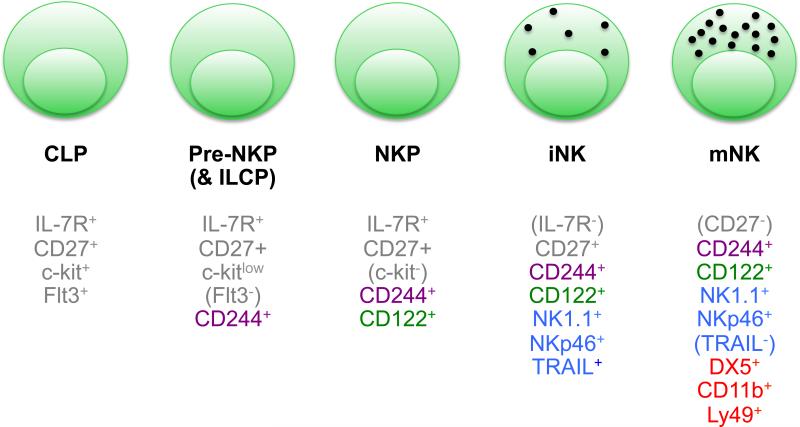
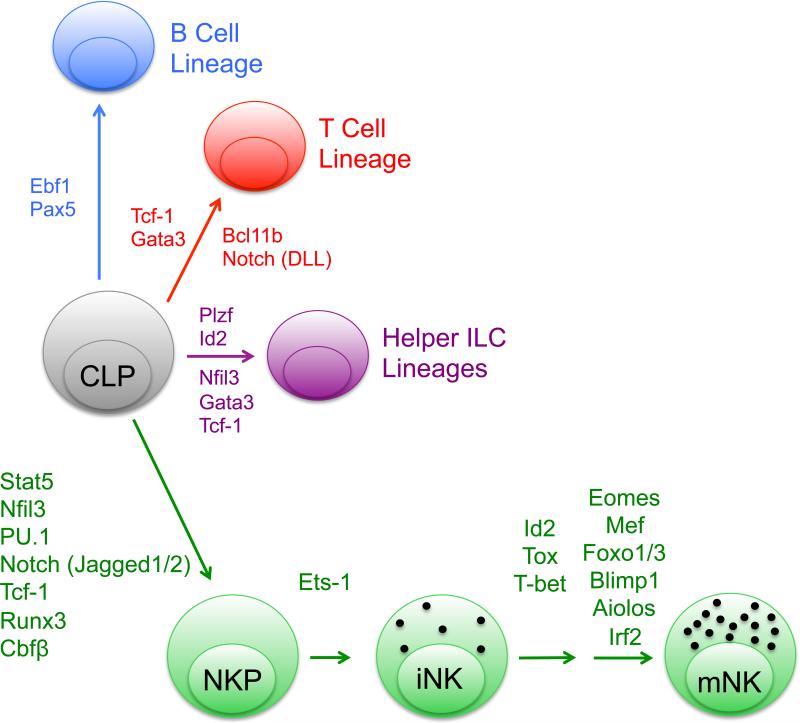
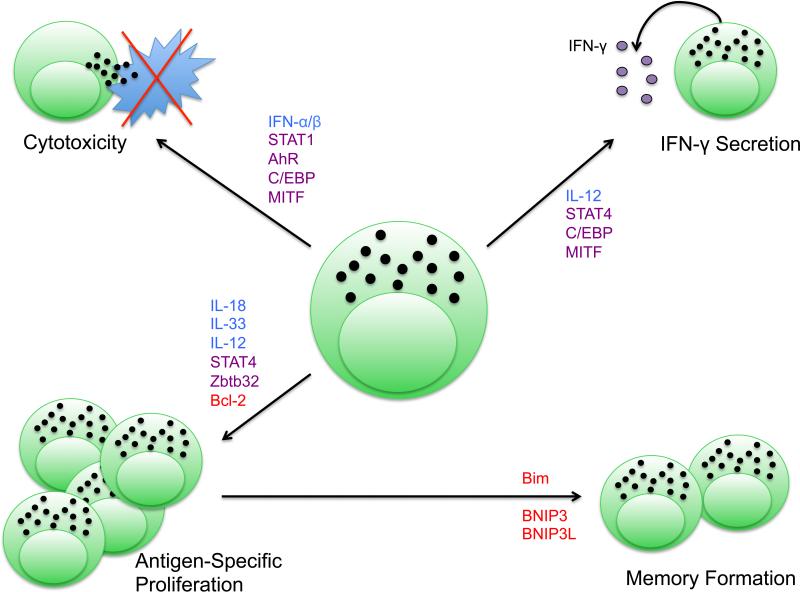
Natural killer (NK) cells are innate lymphocytes that are critical for host protection against pathogens and cancer due to their ability to rapidly release inflammatory cytokines and kill infected or transformed cells. In the 40 years since their initial discovery, much has been learned about how this important cellular lineage develops and functions. We now know that NK cells are the founding members of an expanded family of lymphocyte known as innate lymphoid cells (ILC). Furthermore, we have recently discovered that NK cells can possess features of adaptive immunity such as antigen specificity and long-lived memory responses. Here we will review our current understanding of the molecular mechanisms driving development of NK cells from the common lymphoid progenitor (CLP) to mature NK cells, and from activated effectors to long-lived memory NK cells.
Copyright © 2016 Elsevier Ltd. All rights reserved.
Figures
References
-
- Kondo M, Weissman IL, Akashi K. Identification of clonogenic common lymphoid progenitors in mouse bone marrow. Cell. 1997;91:661–672. - PubMed
-
- Rosmaraki EE, Douagi I, Roth C, Colucci F, Cumano A, Di Santo JP. Identification of committed NK cell progenitors in adult murine bone marrow. Eur J Immunol. 2001;31:1900–1909. - PubMed
-
- Lanier LL, Phillips JH, Hackett J, Tutt M, Kumar V. Natural killer cells: definition of a cell type rather than a function. J Immunol. 1986;137:2735–2739. - PubMed
Publication types
MeSH terms
Substances
Grants and funding
LinkOut - more resources
Full Text Sources
Other Literature Sources
Miscellaneous
