


Centromedian-Parafascicular Complex Deep Brain Stimulation for Tourette Syndrome: A Retrospective Study
- PMID: 26848003
- PMCID: PMC4765735
- DOI: 10.1016/j.mayocp.2015.11.016
Centromedian-Parafascicular Complex Deep Brain Stimulation for Tourette Syndrome: A Retrospective Study
Abstract
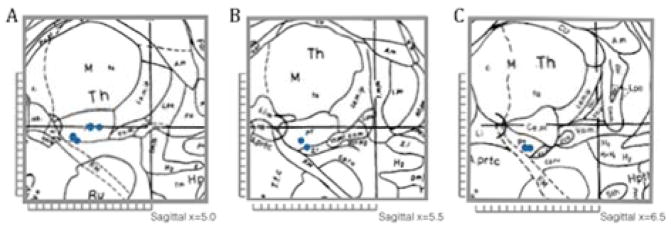
Deep brain stimulation (DBS) of the thalamic centromedian/parafascicular (CM-Pf) complex has been reported as a promising treatment for patients with severe, treatment-resistant Tourette syndrome (TS). In this study, safety and clinical outcomes of bilateral thalamic CM-Pf DBS were reviewed in a series of 12 consecutive patients with medically refractory TS, 11 of whom met the criteria of postsurgical follow-up at our institution for at least 2 months. Five patients were followed for a year or longer. Consistent with many patients with TS, all patients had psychiatric comorbidities. Tic severity and frequency were measured by using the Yale Global Tic Severity Scale (YGTSS) over time (average, 26 months) in 10 subjects. One patient was tested at 2-week follow-up only and thus was excluded from group YGTSS analysis. Final YGTSS scores differed significantly from the preoperative baseline score. The average (n=10) improvement relative to baseline in the total score was 54% (95% CI, 37-70); average improvement relative to baseline in the YGTSS Motor tic, Phonic tic, and Impairment subtests was 46% (95% CI, 34-64), 52% (95% CI, 34-72), and 59% (95% CI, 39-78), respectively. There were no intraoperative complications. After surgery, 1 subject underwent wound revision because of a scalp erosion and wound infection; the implanted DBS system was successfully salvaged with surgical revision and combined antibiotic therapy. Stimulation-induced adverse effects did not prevent the use of the DBS system, although 1 subject is undergoing a trial period with the stimulator off. This surgical series adds to the literature on CM-Pf DBS and supports its use as an effective and safe therapeutic option for severe refractory TS.
Copyright © 2016 Mayo Foundation for Medical Education and Research. Published by Elsevier Inc. All rights reserved.
Conflict of interest statement
Conflict of interest disclosure: The authors report no further financial disclosures.
Figures
References
-
- Leckman JF, Bloch MH, Scahill L, King RA. Tourette syndrome: the self under siege. J Child Neurol. 2006;21(8):642–649. - PubMed
-
- Leckman JF, Zhang H, Vitale A, et al. Course of tic severity in Tourette syndrome: the first two decades. Pediatrics. 1998;102(1 Pt 1):14–19. - PubMed
-
- Malaty IA, Akbar U. Updates in medical and surgical therapies for Tourette syndrome. Curr Neurol Neurosci Rep. 2014;14(7):458. - PubMed
-
- Singer HS. The treatment of tics. Curr Neurol Neurosci Rep. 2001;1(2):195–202. - PubMed
-
- Hassler R, Dieckmann G. Stereotaxic treatment of tics and inarticulate cries or coprolalia considered as motor obsessional phenomena in Gilles de la Tourette’s disease. Rev Neurol (Paris) 1970;123(2):89–100. - PubMed
Publication types
MeSH terms
Grants and funding
LinkOut - more resources
Full Text Sources
Other Literature Sources
Medical
Miscellaneous
