Interaction of Wnt5a with Notch1 is Critical for the Pathogenesis of Psoriasis
- PMID: 26848218
- PMCID: PMC4737835
- DOI: 10.5021/ad.2016.28.1.45
Interaction of Wnt5a with Notch1 is Critical for the Pathogenesis of Psoriasis
Abstract
Background: Psoriasis is characterized by uncontrolled hyperproliferation, aberrant differentiation, and dermal infiltration of immune cells. Recent studies have reported that Wnt5a and Notch1 signaling are altered in psoriatic skin lesions.
Objective: We aimed to investigate the interaction of Wnt5a with Notch 1 with respect to inflammation-mediated epidermal hyperproliferation in psoriasis.
Methods: Expression of Wnt5a and Notch1 signaling-related proteins were examined in psoriatic skin biopsies. Wnt5a was upregulated in human keratinocytes by treating the cells with its recombinant form (rWnt5a).
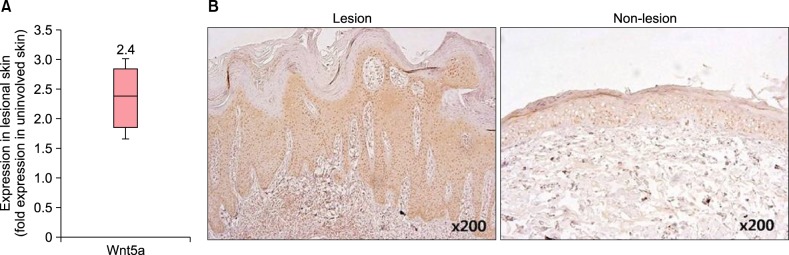
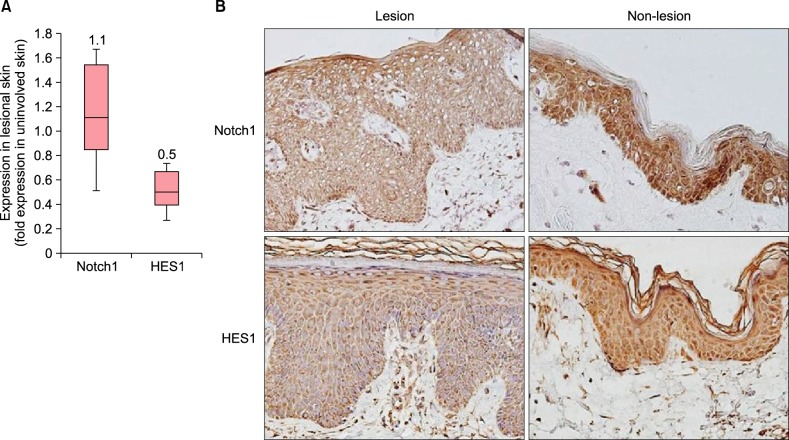
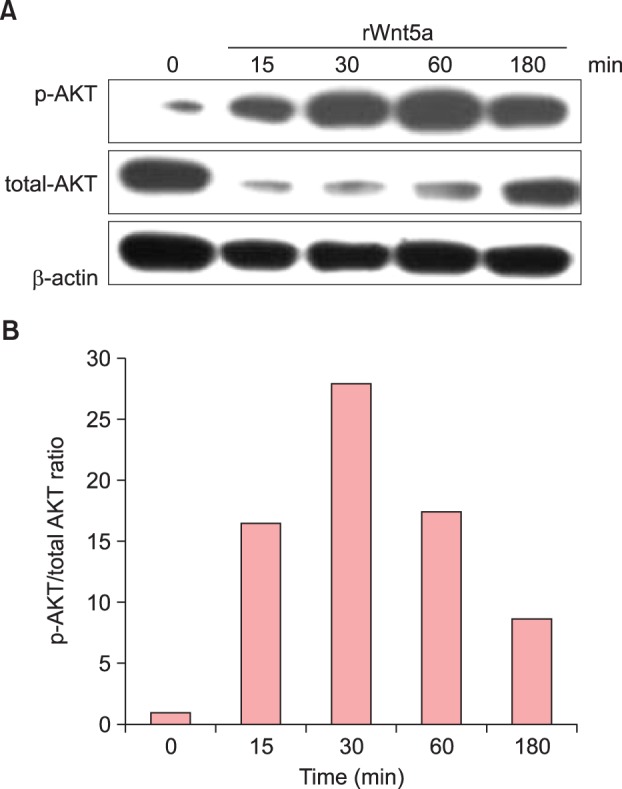
Results: In psoriatic lesions, expression of Wnt5a increased while that of Notch1 decreased when compared to that in non-lesional and normal skin. Treatment with rWnt5a increased the proliferation of keratinocytes and increased their secretion of interleukin (IL)-23, IL-12, and tumor necrosis factor (TNF)-α. Further, exposure of keratinocytes to IL-1α, TNF-α, transforming growth factor-α, and interferon-γ downregulated Notch1 as well as HES 1, which is downstream to Notch1, but increased the Wnt5a levels. The upregulated Wnt5a in keratinocytes downregulated both Notch1 and HES1.
Conclusion: Our data suggest that Wnt5a and Notch1 signaling exert counteracting influences on each other and are involved, in part, in the pathomechanism of psoriasis.
Keywords: Notch1; Psoriasis; Wnt5a.
Figures


References
-
- Nestle FO, Kaplan DH, Barker J. Psoriasis. N Engl J Med. 2009;361:496–509. - PubMed
-
- Reischl J, Schwenke S, Beekman JM, Mrowietz U, Stürzebecher S, Heubach JF. Increased expression of Wnt5a in psoriatic plaques. J Invest Dermatol. 2007;127:163–169. - PubMed
-
- Nicolas M, Wolfer A, Raj K, Kummer JA, Mill P, van Noort M, et al. Notch1 functions as a tumor suppressor in mouse skin. Nat Genet. 2003;33:416–421. - PubMed
LinkOut - more resources
Full Text Sources
Other Literature Sources