. 2016 Apr;129(4):753-765.
doi: 10.1007/s00122-016-2664-8. Epub 2016 Feb 5.

Molecular characterization of CIMMYT maize inbred lines with genotyping-by-sequencing SNPs

Affiliations

Molecular characterization of CIMMYT maize inbred lines with genotyping-by-sequencing SNPs

Yongsheng Wu et al. Theor Appl Genet. 2016 Apr.

Abstract

Molecular characterization information on genetic diversity, population structure and genetic relationships provided by this research will help maize breeders to better understand how to utilize the current CML collection. CIMMYT maize inbred lines (CMLs) have been widely used all over the world and have contributed greatly to both tropical and temperate maize improvement. Genetic diversity and population structure of the current CML collection and of six temperate inbred lines were assessed and relationships among all lines were determined with genotyping-by-sequencing SNPs. Results indicated that: (1) wider genetic distance and low kinship coefficients among most pairs of lines reflected the uniqueness of most lines in the current CML collection; (2) the population structure and genetic divergence between the Temperate subgroup and Tropical subgroups were clear; three major environmental adaptation groups (Lowland Tropical, Subtropical/Mid-altitude and Highland Tropical subgroups) were clearly present in the current CML collection; (3) the genetic diversity of the three Tropical subgroups was similar and greater than that of the Temperate subgroup; the average genetic distance between the Temperate and Tropical subgroups was greater than among Tropical subgroups; and (4) heterotic patterns in each environmental adaptation group estimated using GBS SNPs were only partially consistent with patterns estimated based on combining ability tests and pedigree information. Combining current heterotic information based on combining ability tests and the genetic relationships inferred from molecular marker analyses may be the best strategy to define heterotic groups for future tropical maize improvement. Information resulting from this research will help breeders to better understand how to utilize all the CMLs to select parental lines, replace testers, assign heterotic groups and create a core set of breeding germplasm.


Figures
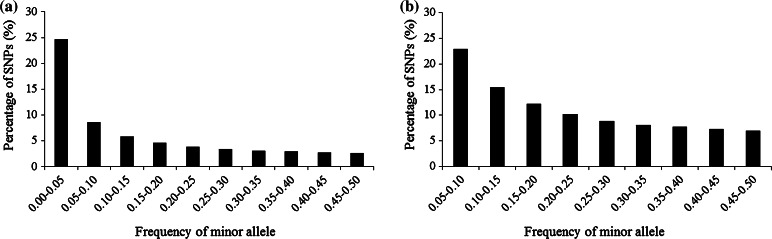
Fig. 1
Fig. 1
Frequency distribution of minor allele in 544 maize inbred lines based on: a 955,120 SNP dataset; b 362,008 SNP dataset
Fig. 2
Fig. 2
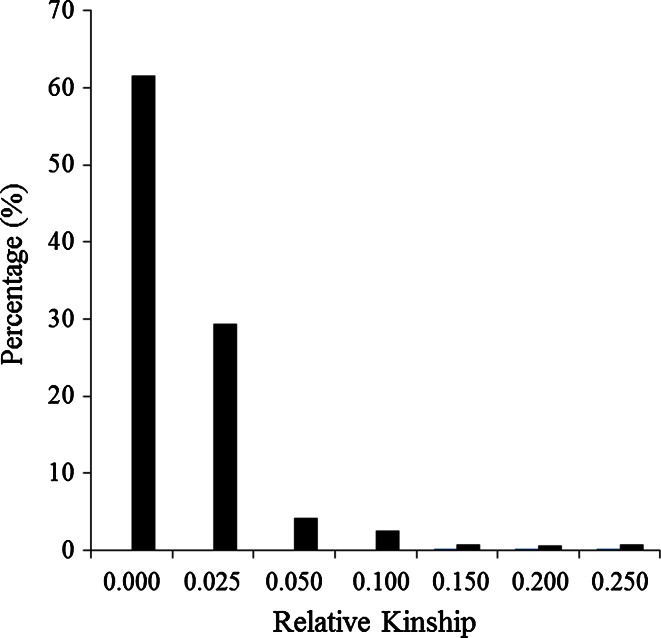
Distribution of pairwise relative kinship for 544 maize inbred lines calculated using 362,008 filtered SNPs
Fig. 3
Fig. 3
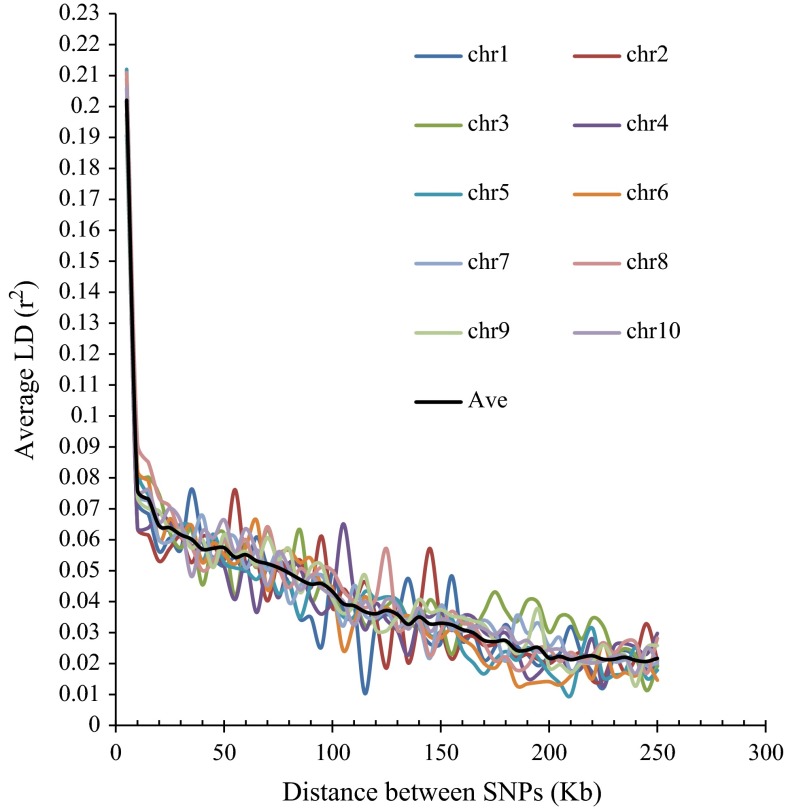
Whole-genome LD in the entire panel. LD within and over chromosomes is given in physical distance of 50 kb
Fig. 4
Fig. 4
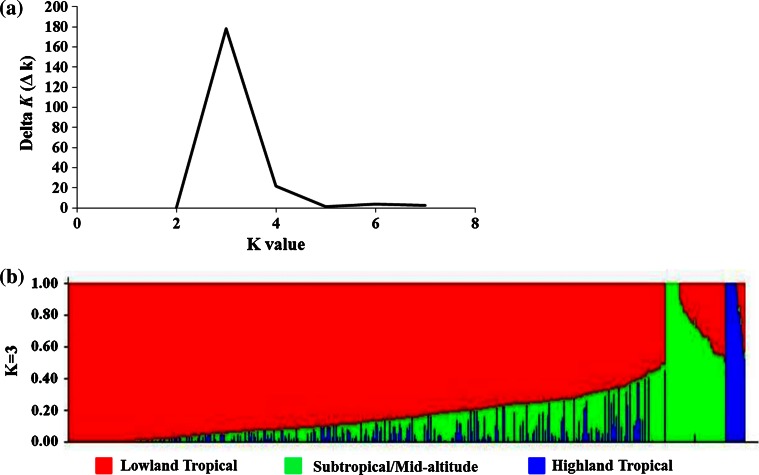
Population structure of 538 CMLs estimated with 7497 SNPs. a Delta K values for K ranging from 2 to 7. b Population structure of 538 CMLs when K = 3. Each of the 538 individuals is represented by a thin vertical bar, which is partitioned into K = 3 colored segments on the x-axis, with lengths proportional to the estimated probability membership in each of the K-inferred clusters (y-axis)
Fig. 5
Fig. 5
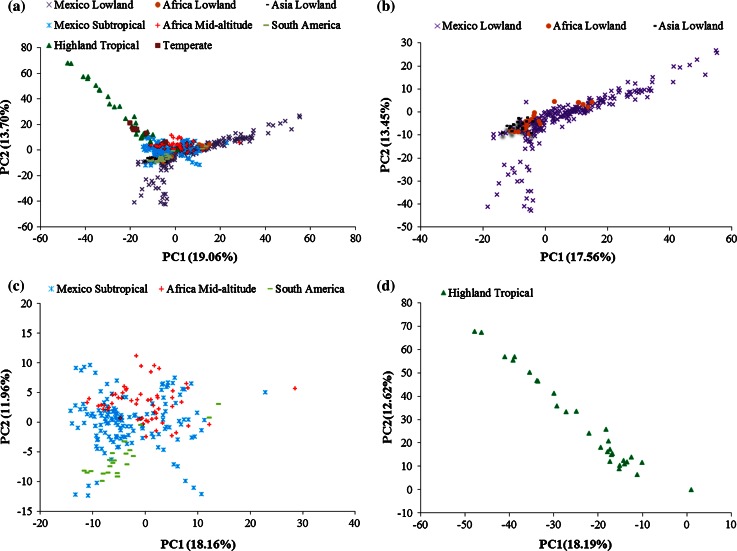
Principal component analysis (PCA) estimated with 362,008 SNPs of a 544 maize inbred lines consisting of 538 CMLs and 6 temperate inbred lines, b 283 Lowland Tropical CMLs, c 225 Subtropical/Mid-altitude CMLs and d 30 Highland Tropical CMLs
Fig. 6
Fig. 6
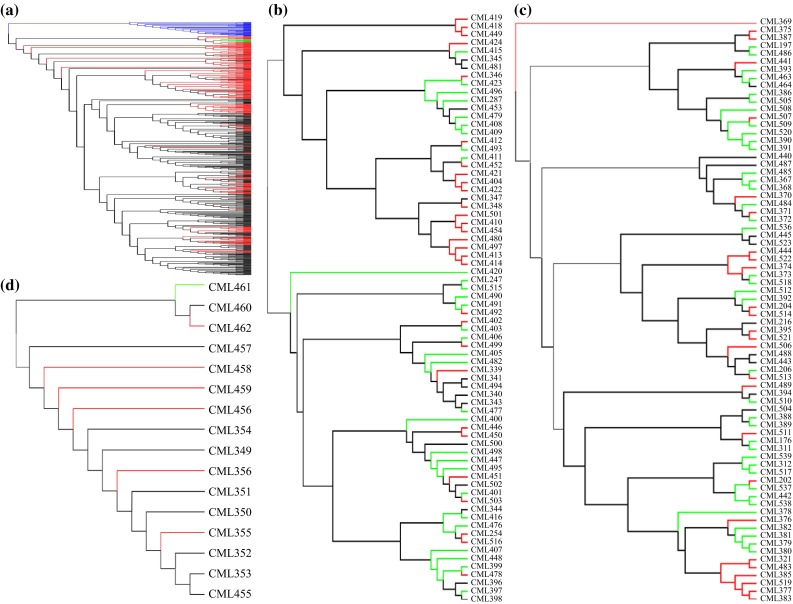
Unweighted pair group method with arithmetic mean (UPGMA) tree based on Rogers’ genetic distance calculated from 362,008 SNPs of a 544 maize inbred lines consisting of 538 CMLs and 6 temperate inbred lines, b 72 selected Lowland Tropical CMLs with high importance, c 74 selected Subtropical/Mid-altitude CMLs with high importance and d 16 selected Highland Tropical CMLs with high importance. In Fig. 6a, subgroups are indicated with different colors; Lowland Tropical lines, Subtropical/Mid-altitude lines, Highland Tropical lines and Temperate lines are represented by black, red, blue and green, respectively. In Fig. 6b, c and d, CMLs assigned to different heterotic groups are indicated with a different color. CMLs from heterotic groups A, B and AB are represented by red, green and black, respectively. Heterotic group information was estimated based on pedigree information and combining ability tests through diallel crosses and line-by-tester analyses

References

    1. Bradbury PJ, Zhang Z, Kroon DE, Casstevens TM, Ramdoss Y, Buckler ES. TASSEL: software for association mapping of complex traits in diverse samples. Bioinformatics. 2007;23:2633–2635. doi: 10.1093/bioinformatics/btm308. - DOI - PubMed
    1. Crossa J, Beyene Y, Kassa S, Perez P, Hickey JM, Chen C, de Los Campos G, Burgueno J, Windhausen VS, Buckler ES, Jannink J, Lopez Cruz MA, Babu R. Genomic prediction in maize breeding populations with genotyping-by-sequencing. G3. 2013;3:1903–1926. doi: 10.1534/g3.113.008227. - DOI - PMC - PubMed
    1. Dillman C, Bar-Hen A, Guerin D, Charcosset A, Murigneux A. Comparison of RFLP and morphological distances between maize Zea mays L. inbred lines. Consequences for germplasm protection purposes. Theor Appl Genet. 1997;95:92–102. doi: 10.1007/s001220050536. - DOI
    1. Elshire RJ, Glaubitz JC, Sun Q, Poland JA, Kawamoto K, Buckler ES, Se Mitchell. A robust, simple genotyping-by-sequencing (GBS) approach for high diversity species. PLoS One. 2011;6:e19379. doi: 10.1371/journal.pone.0019379. - DOI - PMC - PubMed
    1. Evanno G, Regnaut S, Goudet J. Detecting the number of clusters of individuals using the software STRUCTURE: a simulation study. Mol Ecol. 2005;14:2611–2620. doi: 10.1111/j.1365-294X.2005.02553.x. - DOI - PubMed

Publication types

LinkOut - more resources