


Severe Maternal Morbidity and the Use of Assisted Reproductive Technology in Massachusetts
- PMID: 26855105
- PMCID: PMC4764424
- DOI: 10.1097/AOG.0000000000001292
Severe Maternal Morbidity and the Use of Assisted Reproductive Technology in Massachusetts
Abstract
Objective: To assess whether risk of severe maternal morbidity at delivery differed for women who conceived using assisted reproductive technology (ART), those with indicators of subfertility but no ART ("subfertile"), and those who had neither ART nor subfertility ("fertile").
Methods: This retrospective cohort study was part of the larger Massachusetts Outcomes Study of Assisted Reproductive Technology. To construct the Massachusetts Outcomes Study of Assisted Reproductive Technology database and identify ART deliveries, we linked ART treatment records to birth certificates and maternal and infant hospitalization records occurring in Massachusetts between 2004 and 2010. An algorithm of International Classification of Diseases, 9th Revision, Clinical Modification diagnosis and procedure codes identified severe maternal morbidity. We used logistic generalized estimating equations to estimate odds of severe maternal morbidity associated with fertility status, adjusting for maternal demographic and health factors and gestational age, stratifying on plurality and method of delivery.
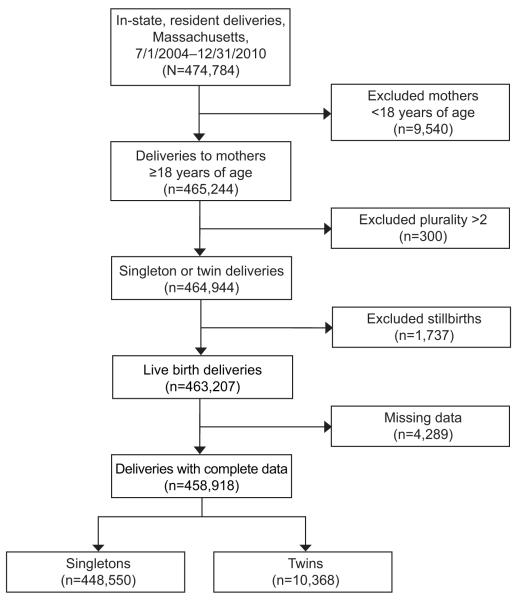
Results: The prevalence of severe maternal morbidity among this population (n=458,918) was 1.16%. The overall, crude prevalences of severe maternal morbidity among fertile, subfertile, and ART deliveries were 1.09%, 1.44%, and 3.14%, respectively. The most common indicator of severe maternal morbidity was blood transfusion. In multivariable analyses, among singletons, ART was associated with increased odds of severe maternal morbidity compared with both fertile (vaginal: adjusted odds ratio [OR] 2.27, 95% confidence interval [CI] 1.78-2.88; cesarean: adjusted OR 1.67, 95% CI 1.40-1.98, respectively) and subfertile (vaginal: adjusted OR 1.97, 95% CI 1.30-3.00; cesarean: adjusted OR 1.75, 95% CI 1.30-2.35, respectively) deliveries. Among twins, only cesarean ART deliveries had significantly greater severe maternal morbidity compared with cesarean fertile deliveries (adjusted OR 1.48, 95% CI 1.14-1.93).
Conclusion: Women who conceive through ART may have elevated risk of severe maternal morbidity at delivery, largely indicated by blood transfusion, even when compared with a subfertile population. Further research should elucidate mechanisms underlying this risk.
Figures
References
-
- Centers for Disease Control and Prevention. Division of Reproductive Health, National Center for Chronic Disease Prevention and Health Promotion [Accessed July 14, 2015];Pregnancy Mortality Surveillance System. 2014 http://www.cdc gov/reproductivehealth/maternalinfanthealth/pmss html [serial online]
-
- Callaghan WM, Creanga AA, Kuklina EV. Severe maternal morbidity among delivery and postpartum hospitalizations in the United States. Obstet Gynecol. 2012;120:1029–1036. - PubMed
-
- Sunderam S, Kissin DM, Crawford SB, Folger SG, Jamieson DJ, Barfield WD. Assisted reproductive technology surveillance--United States, 2011. MMWR Surveill Summ. 2014;63:1–28. - PubMed
-
- Wright VC, Schieve LA, Reynolds MA, Jeng G, Kissin D. Assisted reproductive technology surveillance--United States, 2001. MMWR Surveill Summ. 2004;53:1–20. - PubMed
-
- Chandra A, Copen CE, Stephen EH. Infertility service use in the United States: Data from the National Survey of Family Growth, 1982–2010. National Center for Health Statistics; Hyattsville, MD: 2014. National health statistics reports; no 73. 2014. - PubMed
Publication types
MeSH terms
Grants and funding
LinkOut - more resources
Full Text Sources
Other Literature Sources
Medical
