


Exploratory study of serum ubiquitin carboxyl-terminal esterase L1 and glial fibrillary acidic protein for outcome prognostication after pediatric cardiac arrest
- PMID: 26855294
- PMCID: PMC4792689
- DOI: 10.1016/j.resuscitation.2016.01.024
Exploratory study of serum ubiquitin carboxyl-terminal esterase L1 and glial fibrillary acidic protein for outcome prognostication after pediatric cardiac arrest
Abstract
Introduction: Brain injury is the leading cause of morbidity and death following pediatric cardiac arrest. Serum biomarkers of brain injury may assist in outcome prognostication. The objectives of this study were to evaluate the properties of serum ubiquitin carboxyl-terminal esterase-L1 (UCH-L1) and glial fibrillary acidic protein (GFAP) to classify outcome in pediatric cardiac arrest.
Methods: Single center prospective study. Serum biomarkers were measured at 2 time points during the initial 72 h in children after cardiac arrest (n=19) and once in healthy children (controls, n=43). We recorded demographics and details of the cardiac arrest and resuscitation. We determined the associations between serum biomarker concentrations and Pediatric Cerebral Performance Category (PCPC) at 6 months (favorable (PCPC 1-3) or unfavorable (PCPC 4-6)).
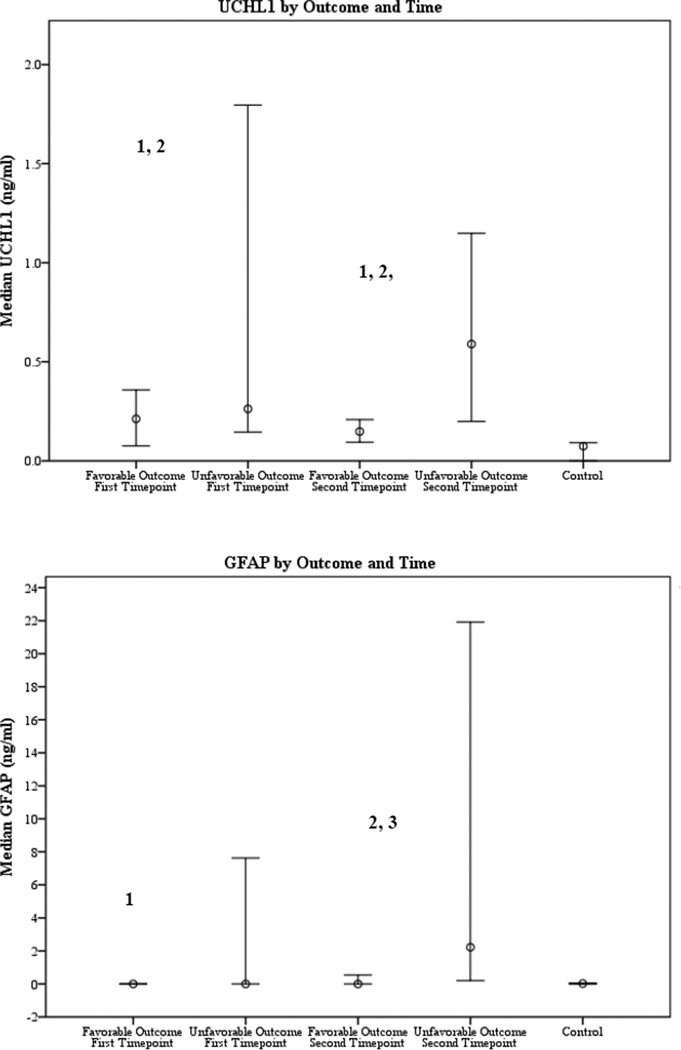
Results: The initial assessment (time point 1) occurred at a median (IQR) of 10.5 (5.5-17.0)h and the second assessment (time point 2) at 59.0 (54.5-65.0)h post-cardiac arrest. Serum UCH-L1 was higher among children following cardiac arrest than among controls at both time points (p<0.05). Serum GFAP in subjects with unfavorable outcome was higher at time point 2 than in controls (p<0.05). Serum UCH-L1 at time point 1 (AUC 0.782) and both UCH-L1 and GFAP at time point 2 had good classification accuracy for outcome (AUC 0.822 and 0.796), p<0.05 for all.
Conclusion: Preliminary data suggest that serum UCH-L1 and GFAP may be of use to prognosticate outcome after pediatric cardiac arrest at clinically-relevant time points and should be validated prospectively.
Keywords: Biomarker; Brain injury; Cardiac arrest; Outcomes; Pediatric.
Copyright © 2016 Elsevier Ireland Ltd. All rights reserved.
Conflict of interest statement
The other co-authors have nothing to disclose.
Figures
References
-
- Young KD, Gausche-Hill M, McClung CD, Lewis RJ. A prospective, population-based study of the epidemiology and outcome of out-of-hospital pediatric cardiopulmonary arrest. Pediatrics. 2004;114:157–164. - PubMed
-
- Bedell GM. Functional outcomes of school-age children with acquired brain injuries at discharge from inpatient rehabilitation. Brain Inj. 2008;22:313–324. - PubMed
-
- Lieh-Lai MW, Theodorou AA, Sarnaik AP, Meert KL, Moylan PM, Canady AI. Limitations of the Glasgow Coma Scale in predicting outcome in children with traumatic brain injury. J Pediatr. 1992;120:195–199. - PubMed
-
- Abend NS, Licht DJ. Predicting outcome in children with hypoxic ischemic encephalopathy. Pediatr Crit Care Med. 2008;9:32–39. - PubMed
Publication types
MeSH terms
Substances
Grants and funding
LinkOut - more resources
Full Text Sources
Other Literature Sources
Medical
Miscellaneous
