


Intra-articular Fractures of the Sigmoid Notch of the Distal Radius: Analysis of Progression to Distal Radial Ulnar Joint Arthritis and Impact on Upper Extremity Function in Surgically Treated Fractures
- PMID: 26855837
- PMCID: PMC4742258
- DOI: 10.1055/s-0035-1570742
Intra-articular Fractures of the Sigmoid Notch of the Distal Radius: Analysis of Progression to Distal Radial Ulnar Joint Arthritis and Impact on Upper Extremity Function in Surgically Treated Fractures
Abstract
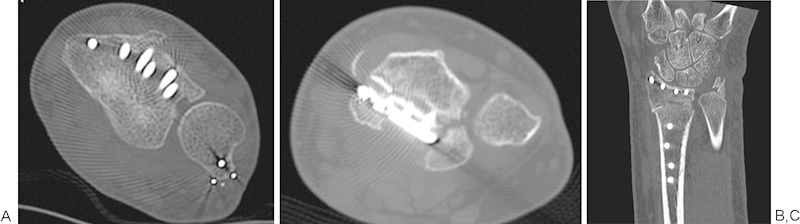
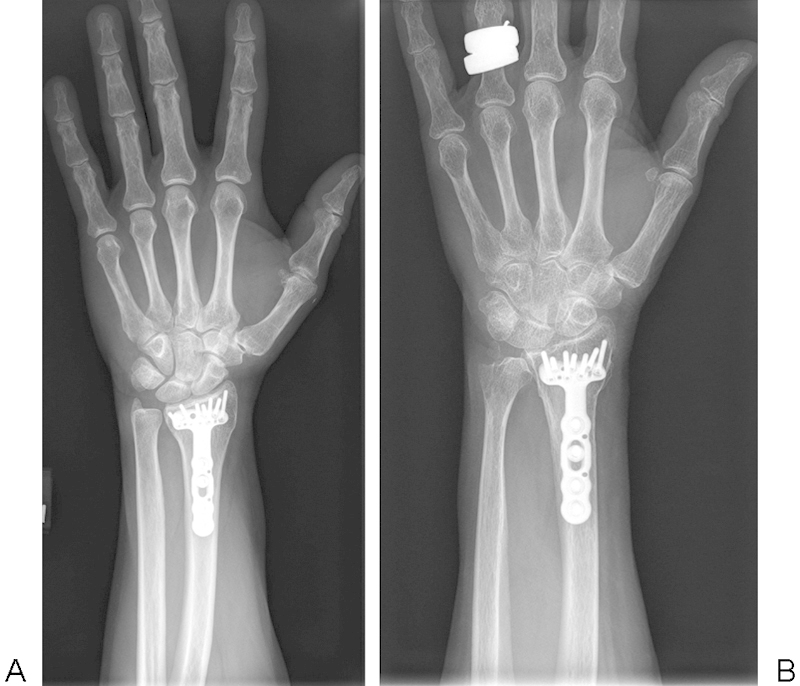
Background Studies have established an increased risk of radiocarpal joint posttraumatic arthritis in patients with displaced intra-articular fractures of the distal radius, although this phenomenon has yet to be evaluated in the distal radioulnar joint (DRUJ). Purpose We hypothesized that patients with displaced intra-articular fractures of the sigmoid notch would have a higher prevalence of DRUJ arthritis and greater upper extremity dysfunction after operative treatment of distal radius fractures compared with fractures without sigmoid notch involvement. We also hypothesized that the degree of sigmoid notch incongruity would be correlated with the grade of DRUJ arthritis and the severity of upper extremity dysfunction. Patients and Methods A retrospective review was conducted on surgically treated patients with distal radius fractures with pre- and/or postoperative computed tomography (CT) scans. Patients were divided into groups based on presence or absence of fracture extension into the sigmoid notch. Within the sigmoid notch group, postoperative CT scans were used to measure sigmoid notch fracture step-off and diastasis (mm), as well as volar or dorsal DRUJ subluxation (%). Patients were administered Disabilities of the Arm, Shoulder, and Hand (DASH) questionnaires and radiographs were obtained to grade DRUJ arthritis using the Kellgren-Lawrence (KL) radiographic criteria. Results Thirty-three patients were included (19 with sigmoid notch involvement and 14 without) with an average radiographic follow-up of 6.3 years (range: 3.5-10.1 years). DASH scores were available for all patients, and radiographic follow-up was available in 24 patients (73%). A trend toward higher grade of DRUJ arthritis and poorer average DASH was found in those with sigmoid notch involvement, but was not statistically different. In the sigmoid notch group there were poorer DASH scores in patients with coronal step-off > 1.0-mm (p < 0.05). There were no significant correlations between sigmoid notch step-off, diastasis or DRUJ subluxation and either KL grade of arthritis or DASH scores. Conclusion Fractures involving the sigmoid notch did not appear to have a greater prevalence of DRUJ posttraumatic arthritis in operatively treated patients at greater than 6 years of follow-up. Postoperative sigmoid notch step-off, diastasis or DRUJ subluxation had a minimal effect on upper extremity function, but fractures with a coronal step-off of > 1.0-mm exhibited higher levels of upper extremity dysfunction. Level of Evidence Prognostic, Level III-Case control.
Keywords: distal radial ulnar joint; intra-articular distal radius; sigmoid notch.
Conflict of interest statement
Figures

References
-
- Baron J A, Karagas M, Barrett J. et al.Basic epidemiology of fractures of the upper and lower limb among Americans over 65 years of age. Epidemiology. 1996;7(6):612–618. - PubMed
-
- Knirk J L, Jupiter J B. Intra-articular fractures of the distal end of the radius in young adults. J Bone Joint Surg Am. 1986;68(5):647–659. - PubMed
-
- Kopylov P, Johnell O, Redlund-Johnell I, Bengner U. Fractures of the distal end of the radius in young adults: a 30-year follow-up. J Hand Surg [Br] 1993;18(1):45–49. - PubMed
-
- Forward D P, Davis T R, Sithole J S. Do young patients with malunited fractures of the distal radius inevitably develop symptomatic post-traumatic osteoarthritis? J Bone Joint Surg Br. 2008;90(5):629–637. - PubMed
LinkOut - more resources
Full Text Sources
Other Literature Sources
Medical
