Real-life experience with personally familiar faces enhances discrimination based on global information
- PMID: 26855852
- PMCID: PMC4741065
- DOI: 10.7717/peerj.1465
Real-life experience with personally familiar faces enhances discrimination based on global information
Abstract
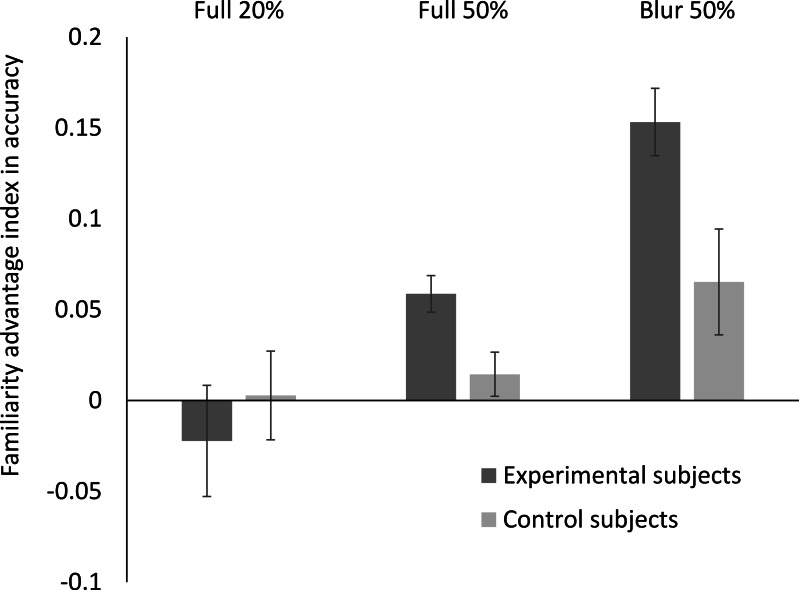
Despite the agreement that experience with faces leads to more efficient processing, the underlying mechanisms remain largely unknown. Building on empirical evidence from unfamiliar face processing in healthy populations and neuropsychological patients, the present experiment tested the hypothesis that personal familiarity is associated with superior discrimination when identity information is derived based on global, as opposed to local facial information. Diagnosticity and availability of local and global information was manipulated through varied physical similarity and spatial resolution of morph faces created from personally familiar or unfamiliar faces. We found that discrimination of subtle changes between highly similar morph faces was unaffected by familiarity. Contrariwise, relatively more pronounced physical (i.e., identity) differences were more efficiently discriminated for personally familiar faces, indicating more efficient processing of global, as opposed to local facial information through real-life experience.
Keywords: Face processing; Global information integration; Holistic processing; Personal familiarity; Real-life exposure.
Conflict of interest statement
The authors declare that there are no competing interests.
Figures

References
-
- Bahrick HP, Bahrick PO, Wittingler RP. Fifty years of memory for names and faces: a cross-sectional approach. Journal of Experimental Psychology: General. 1975;104:54–75. doi: 10.1037/0096-3445.104.1.54. - DOI
LinkOut - more resources
Full Text Sources
Other Literature Sources