Lowest Oxyhemoglobin Saturation May Be an Independent Factor Influencing Auditory Function in Severe Obstructive Sleep Apnea
- PMID: 26857050
- PMCID: PMC4865550
- DOI: 10.5664/jcsm.5786
Lowest Oxyhemoglobin Saturation May Be an Independent Factor Influencing Auditory Function in Severe Obstructive Sleep Apnea
Abstract
Study objectives: The aims of this study were to determine if a correlation exists between the level of hypoxia induced by severe obstructive sleep apnea syndrome (OSAS) and the level of auditory dysfunction when verifying such a relationship using polysomnography (PSG).
Methods: A retrospective review of 41 patients with severe OSAS was performed. Independent risk factors for hearing impairment included parameters of PSG, which were analyzed in two hearing groups at a level ≥ 40 decibels (dB).
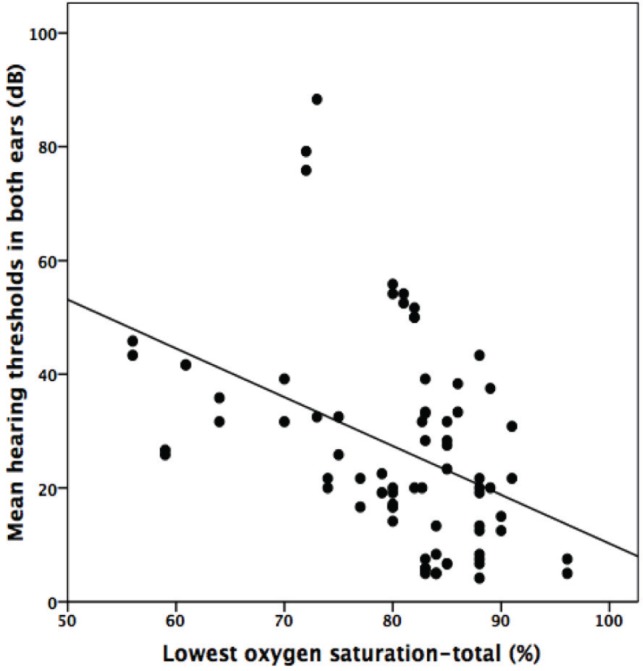
Results: Oxyhemoglobin saturation, especially the lowest oxyhemoglobin saturation level, showed lower thresholds in the hearing impairment group than in the control group (p = 0.039 at NREM stage; p = 0.029 at REM stage; p = 0.001 at total sleep stage). After adjusting for other risk factors, the sole variable that remained significant was lowest oxyhemoglobin saturation (total; p = 0.046). In the correlation analysis, a decreasing lowest oxyhemoglobin saturation (from all subjects, n = 41) correlated with a greater mean hearing threshold (R(2) = 0.297; p < 0.001).
Conclusion: Our results indicated that lowest oxyhemoglobin saturation in PSG is the only variable correlated with the hearing threshold. This finding could be predictive of possible hearing alternation in patients with severe OSAS.
Commentary: A commentary on this article appears in this issue on page 641.
Keywords: obstructive sleep apnea; oxyhemoglobin saturation; polysomnography; sensorineural hearing loss.
© 2016 American Academy of Sleep Medicine.
Figures
Comment in
-
Can You Hear Me Now?J Clin Sleep Med. 2016 May 15;12(5):641-2. doi: 10.5664/jcsm.5780. J Clin Sleep Med. 2016. PMID: 27092694 Free PMC article. No abstract available.
References
-
- American Thoracic Society. Standards and indications for cardiopulmonary sleep studies in children. Am J Respir Crit Care Med. 1996;153:866–78. - PubMed
-
- Fletcher EC. The relationship between systemic hypertension and obstructive sleep apnea: facts and theory. Am J Med. 1995;98:118–28. - PubMed
-
- Hui DS, Wong TY, Ko FW, et al. Prevalence of sleep disturbances in Chinese patients with end-stage renal failure on continuous ambulatory peritoneal dialysis. Am J Kidney Dis. 2000;36:783–8. - PubMed
-
- Javaheri S, Parker TJ, Liming JD, et al. Sleep apnea in 81 ambulatory male patients with stable heart failure: types and their prevalences, consequences and presentations. Circulation. 1998;97:2154–9. - PubMed
MeSH terms
Substances
LinkOut - more resources
Full Text Sources
Other Literature Sources
Medical
Miscellaneous