. 2016 Apr 1;76(7):1714-23.
doi: 10.1158/0008-5472.CAN-15-0338. Epub 2016 Feb 8.

Genomic Landscape of Somatic Alterations in Esophageal Squamous Cell Carcinoma and Gastric Cancer

Affiliations

Genomic Landscape of Somatic Alterations in Esophageal Squamous Cell Carcinoma and Gastric Cancer

Nan Hu et al. Cancer Res. .

Abstract

Gastric cancer and esophageal cancer are the second and sixth leading causes of cancer-related death worldwide. Multiple genomic alterations underlying gastric cancer and esophageal squamous cell carcinoma (ESCC) have been identified, but the full spectrum of genomic structural variations and mutations have yet to be uncovered. Here, we report the results of whole-genome sequencing of 30 samples comprising tumor and blood from 15 patients, four of whom presented with ESCC, seven with gastric cardia adenocarcinoma (GCA), and four with gastric noncardia adenocarcinoma. Analyses revealed that an A>C mutation was common in GCA, and in addition to the preferential nucleotide sequence of A located 5 prime to the mutation as noted in previous studies, we found enrichment of T in the 5 prime base. The A>C mutations in GCA suggested that oxidation of guanine may be a potential mechanism underlying cancer mutagenesis. Furthermore, we identified genes with mutations in gastric cancer and ESCC, including well-known cancer genes, TP53, JAK3, BRCA2, FGF2, FBXW7, MSH3, PTCH, NF1, ERBB2, and CHEK2, and potentially novel cancer-associated genes, KISS1R, AMH, MNX1, WNK2, and PRKRIR Finally, we identified recurrent chromosome alterations in at least 30% of tumors in genes, including MACROD2, FHIT, and PARK2 that were often intragenic deletions. These structural alterations were validated using the The Cancer Genome Atlas dataset. Our studies provide new insights into understanding the genomic landscape, genome instability, and mutation profile underlying gastric cancer and ESCC development. Cancer Res; 76(7); 1714-23. ©2016 AACR.


Conflict of interest statement

Conflict of interest statement: The authors disclose no potential conflicts of interest.

Figures

Figure 1
Figure 1
Circos plots of somatic single nucleotide variants, copy number alterations, and structural variations in the 15 cancer genomes. The inner ring displays SVs: black for intrachromosomal SVs and red for interchromosomal SVs. The 2nd ring next to SVs is CNA shown in grey. The 3rd ring is SNV shown in green. The outside ring is the chromosome ideogram. The sample description can be found in Supplementary Table 1.
Figure 2
Figure 2
Summary of somatic mutations and mutation spectrum in GNCA, GCA, and ESCC genomes and non-negative matrix factorization (NMF) analysis of SNV substitution matrix. Somatic SNV are summarized in Figure 2a–b. The numbers of somatic mutations per million bases in intergenic, intronic, and exonic regions of GCA, GNCA, and ESCC genomes are illustrated with bar graphs. Here somatic mutations include single nucleotide variations and small indels. (a) The graph shows mutations in intergenic, intronic, and exonic regions whereas. (b) The graphs shows mutations of various types of amino-acid changes. SNV substitution patterns are summarized in Figure 2c–d. (c) The graph shows the numbers of somatic mutations for the six types of base substitutions are summarized on the left. We also consider the context of 5 prime base and 3 prime base; there are 96 possible combination (4 times 6 times 4). (d) The heatmap shows the results for the 15 tumors.
Figure 3
Figure 3
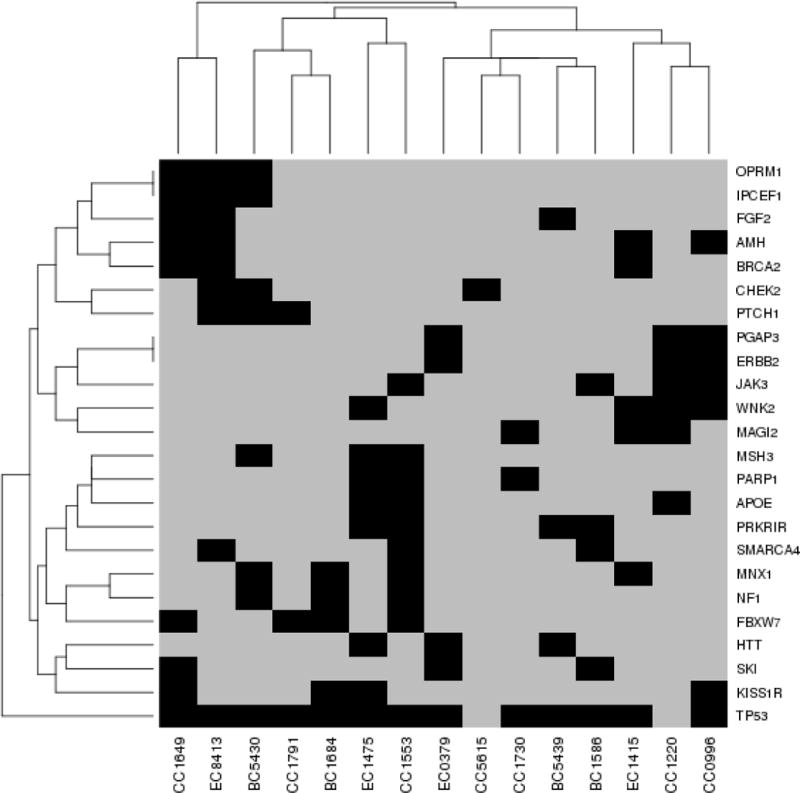
Summary of potential cancer driver mutations. The potential driver mutations were identified using Ingenuity Variant Analysis (IVA). We identified 24 genes that were frequently mutated in ESCC and gastric cancer. Mutations and affected tumors are shown in the heatmap.
Figure 4
Figure 4
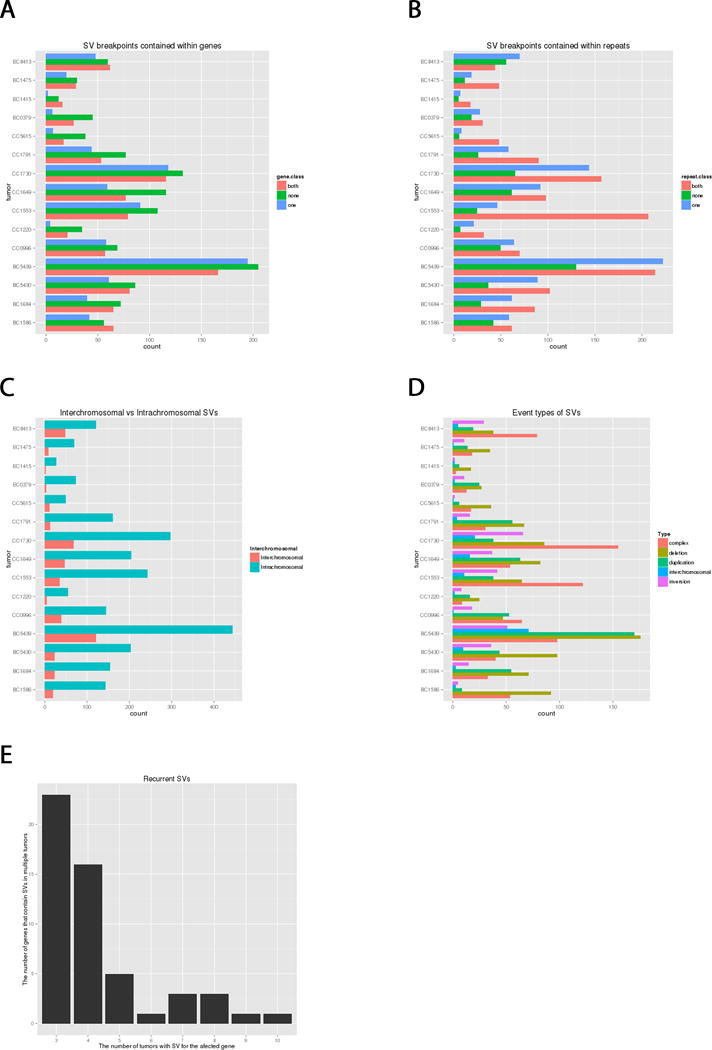
Characterization of somatic SVs in gastric cancer and ESCC genomes. (a) Bar graph of SVs with respect to whether breakpoints are located with genes or not. The count on x-axis refers to the number of SVs. (b) Bar graph of SVs with respect to whether breakpoints are located with repeats or not. (c) Bar graph of interchromosomal versus intrachromosomal SVs. (d) Bar graph of SVs classified by the processes that generated these SVs. (e) Bar graph of recurrent SVs. Sample count refers to the number of tumors affected by the SVs, and gene count refers to the number of genes that showed recurrent SVs for a given number of sample count.
Figure 5
Figure 5
IGV views of structural changes of recurrent SVs. IGV views for MACROD2, FHIT, and PARK2. Blue rectangles are exons. Red rectangles are deleted regions, and the number below the box refers to SV id. Tumors are labeled on the left. (a) MACROD2; (b) FHIT; (c) PARK2

References

    1. Ferlay J, Shin HR, Bray F, Forman D, Mathers C, Parkin DM. Estimates of worldwide burden of cancer in 2008: GLOBOCAN 2008. Int J Cancer. 2010;127(12):2893–917. doi: 10.1002/ijc.25516. Epub 2011/02/26. - DOI - PubMed
    1. Ke L. Mortality and incidence trends from esophagus cancer in selected geographic areas of China circa 1970–90. Int J Cancer. 2002;102(3):271–4. doi: 10.1002/ijc.10706. Epub 2002/10/25. - DOI - PubMed
    1. Li JY. Epidemiology of esophageal cancer in China. Natl Cancer Inst Monogr. 1982;62:113–20. Epub 1982/01/01. - PubMed
    1. Liu SF, Shen Q, Dawsey SM, Wang GQ, Nieberg RK, Wang ZY, et al. Esophageal balloon cytology and subsequent risk of esophageal and gastric-cardia cancer in a high-risk Chinese population. Int J Cancer. 1994;57(6):775–80. Epub 1994/06/15. - PubMed
    1. Abnet CC, Freedman ND, Hu N, Wang Z, Yu K, Shu XO, et al. A shared susceptibility locus in PLCE1 at 10q23 for gastric adenocarcinoma and esophageal squamous cell carcinoma. Nat Genet. 2010;42(9):764–7. Epub 2010/08/24. doi: 10.1038/ng.649 ng.649 [pii] - PMC - PubMed

Publication types