


Visualizing the origins of selfish de novo mutations in individual seminiferous tubules of human testes
- PMID: 26858415
- PMCID: PMC4780627
- DOI: 10.1073/pnas.1521325113
Visualizing the origins of selfish de novo mutations in individual seminiferous tubules of human testes
Abstract
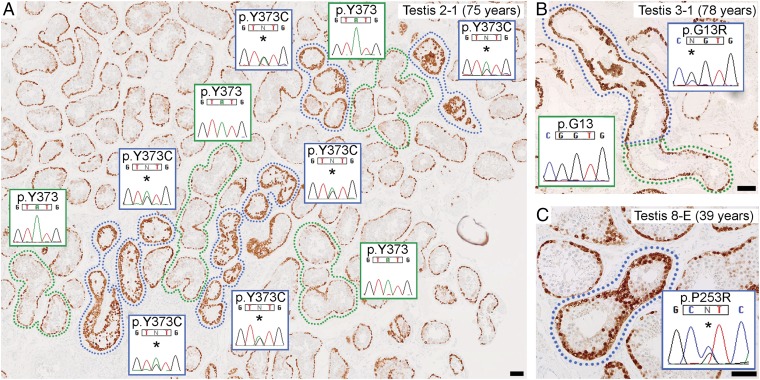
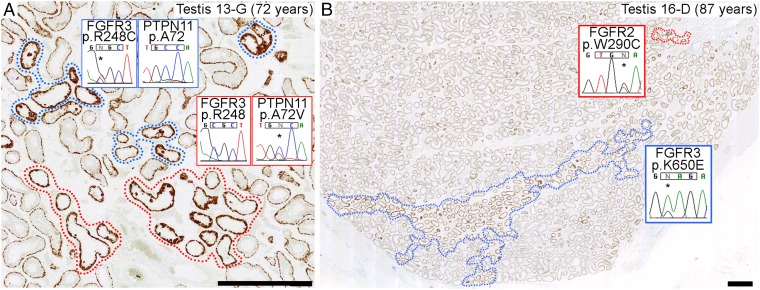
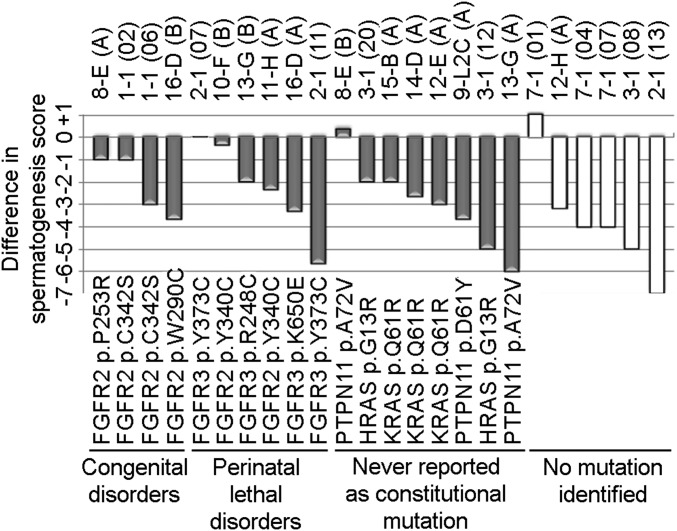
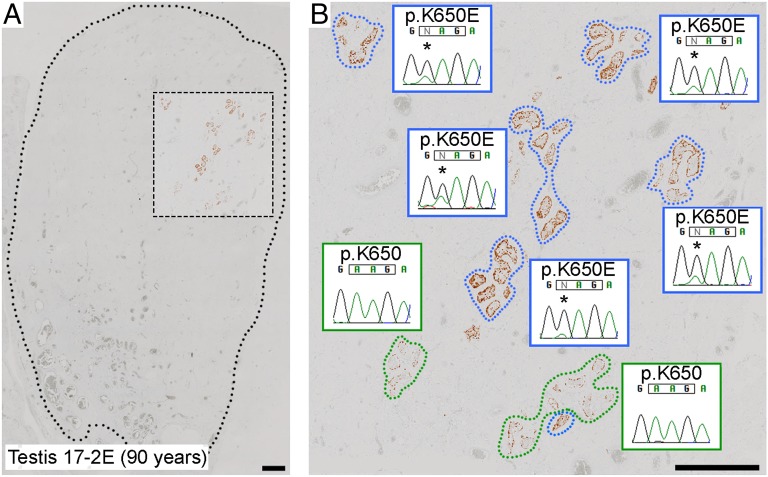
De novo point mutations arise predominantly in the male germline and increase in frequency with age, but it has not previously been possible to locate specific, identifiable mutations directly within the seminiferous tubules of human testes. Using microdissection of tubules exhibiting altered expression of the spermatogonial markers MAGEA4, FGFR3, and phospho-AKT, whole genome amplification, and DNA sequencing, we establish an in situ strategy for discovery and analysis of pathogenic de novo mutations. In 14 testes from men aged 39-90 y, we identified 11 distinct gain-of-function mutations in five genes (fibroblast growth factor receptors FGFR2 and FGFR3, tyrosine phosphatase PTPN11, and RAS oncogene homologs HRAS and KRAS) from 16 of 22 tubules analyzed; all mutations have known associations with severe diseases, ranging from congenital or perinatal lethal disorders to somatically acquired cancers. These results support proposed selfish selection of spermatogonial mutations affecting growth factor receptor-RAS signaling, highlight its prevalence in older men, and enable direct visualization of the microscopic anatomy of elongated mutant clones.
Keywords: germline; mutation; selfish selection; seminiferous tubule; testis.
Conflict of interest statement
The authors declare no conflict of interest.
Figures
Comment in
-
Genetics: Selfish spermatogonia.Nat Rev Urol. 2016 Apr;13(4):181. doi: 10.1038/nrurol.2016.37. Epub 2016 Feb 23. Nat Rev Urol. 2016. PMID: 26902338 No abstract available.
References
Publication types
MeSH terms
Grants and funding
LinkOut - more resources
Full Text Sources
Other Literature Sources
Research Materials
Miscellaneous
