


Individual and community-level factors associated with introduction of prelacteal feeding in Ethiopia
- PMID: 26858835
- PMCID: PMC4745177
- DOI: 10.1186/s13690-016-0117-0
Individual and community-level factors associated with introduction of prelacteal feeding in Ethiopia
Abstract
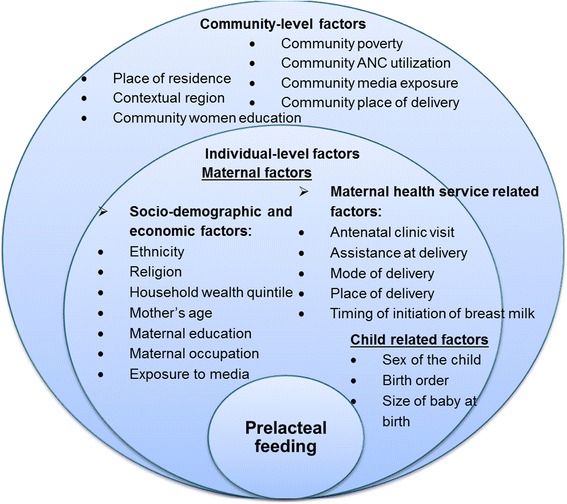
Background: Ethiopia is a country with low optimal breast feeding practice, and prelacteal feeding is still a norm. Introduction of prelacteal feeding is a known barrier for optimal breast feeding practices. However, knowledge on determinants of introduction of prelacteal feeding is minimal. This study aimed to identify the effects of individual and community-level factors in the introduction of prelacteal feeding in Ethiopia.
Methods: Data for this study was extracted from the nationally representative 2011 Ethiopia Demographic and Health Survey (EDHS) and focused on a sample from child data, with a sample from 576 clusters of 7692 children who were last-born in the past five years preceding the survey. The data was collected using two-stage cluster design, in which enumeration areas forming the first stage and households making the second stage. A two-level mixed effect multivariable logistic regression model was fitted to determine the individual and community-level factors associated with introduction of prelacteal feeding.
Results: From the total sample of children 28.92 % were fed prelacteals. Butter (n = 1143), plain water (n = 395) and milk-other than breast milk (n = 323) were commonly used prelacteals. In multivariable two-level mixed effect model; caesarean mode of delivery (Adjusted odds ratio (AOR) = 1.87; 95 % CI 1.28, 2.73), and late initiation of breastfeeding (AOR = 5.32; 95 % CI 4.65, 6.09) were both positively associated with the odds of giving prelacteals. Higher economic status 28 % (AOR = 0.72; 95 % CI 0.54, 0.98), giving birth at hand of non-health personnel birth assistance (AOR = 0.68; 95 % CI 0.54, 0.87), large birth size of child (AOR = 0.80; 95 % CI 0.68, 0.95) and high community antenatal care use (AOR = 0.58; 95 % CI 0.38, 0.87) were negatively associated with the odds of giving prelacteals. Significant variation in prelacteal feeding practice was also seen among ethnic and religious groups, and across regions.
Conclusions: The prevalence of prelacteal feeding was high that remained a challenge for optimal breastfeeding in Ethiopia. Not only individual-level factors, but also community-level factors contribute to prelacteal feeding practice. Increasing access to health education through increasing maternal health care service coverage and community involvement is crucial.
Keywords: Ethiopia; Multilevel factors; Optimal breastfeeding; Prelacteal feeding.
Figures
References
-
- FMOH . National strategy on infant and young child feeding. Edited by Family health. FMOH: Addis Ababa, Ethiopia; 2004.
-
- WHO. Infant and young child feeding: Model chapter for textbooks for medical students and allied health professionals: Geneva, Switzerland: WHO; 2009. - PubMed
-
- U.S.Department of Health and Human Services . The surgeon general’s call to action to support breastfeeding edited by U.S. Department of health and human services. Washington, DC: Office of the Surgeon General; 2011.
-
- WHO . Fulfilling the health agenda for women and children: the 2014 report. Geneva, Switzerland: UNICEF and WHO; 2014.
-
- Central Statistical Agency [Ethiopia] and ICF International. Ethiopia demographic and health survey 2011. Addis Ababa, Ethiopia and Calverton,Maryland, USA; 2012.
LinkOut - more resources
Full Text Sources
Other Literature Sources
Miscellaneous
