


Synergistic Effects of Calcineurin Inhibitors and Steroids on Steroid Sensitivity of Peripheral Blood Mononuclear Cells
- PMID: 26858893
- PMCID: PMC4733836
- DOI: 10.3727/215517914X681802
Synergistic Effects of Calcineurin Inhibitors and Steroids on Steroid Sensitivity of Peripheral Blood Mononuclear Cells
Abstract
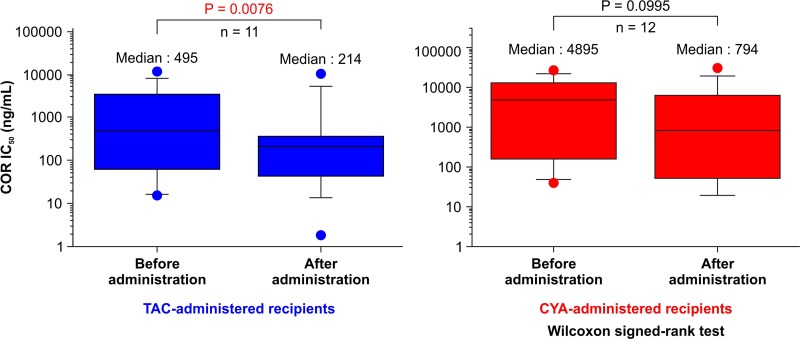
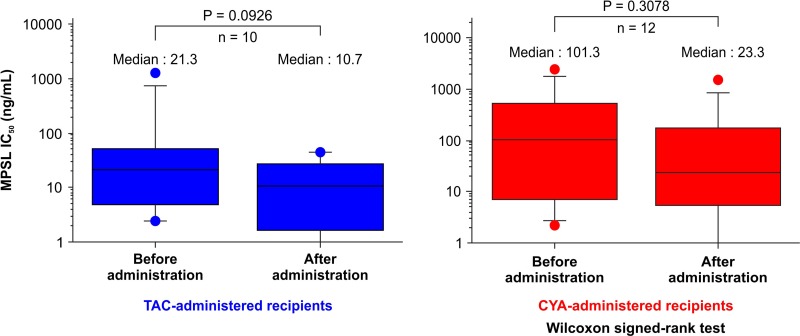
The steroid receptor (SR) complex contains FKBP51 and FKBP52, which bind to tacrolimus (TAC) and cyclophilin 40, which, in turn, bind to cyclosporine (CYA); these influence the intranuclear mobility of steroid-SR complexes. Pharmacodynamic interactions are thought to exist between steroids and calcineurin inhibitors (CNIs) on the SR complex. We examined the effect of CNIs on steroid sensitivity. Methylprednisolone (MPSL) sensitivity was estimated as the concentration inhibiting mitosis in 50% (IC50) of peripheral blood mononuclear cells and as the area under the MPSL concentration-proliferation suppressive rate curves (CPS-AUC) in 30 healthy subjects. MPSL sensitivity was compared between the additive group (AG) as the MPSL sensitivity that was a result of addition of the proliferation suppressive rate of CNIs to that of MPSL and the mixed culture group (MCG) as MPSL sensitivity of mixed culture with both MPSL and CNIs in identical patients. IC50 values of MPSL and cortisol sensitivity were examined before and 2 months after CNI administration in 23 renal transplant recipients. IC50 and CPS-AUC values of MPSL were lower in the MCG than in the AG with administration of TAC and CYA. The CPS-AUC ratio of MCG and AG was lower in the TAC group. IC50 values of MPSL and cortisol tended to be lower after administration of TAC and CYA, and a significant difference was observed in the IC50 of cortisol after TAC administration. Steroid sensitivity increased with both TAC and CYA. Furthermore, TAC had a greater effect on increasing sensitivity. Thus, concomitant administration of CNIs and steroids can increase steroid sensitivity.
Keywords: Calcineurin inhibitors (CNIs); Cyclosporine (CYA); Pharmacodynamic interaction; Steroid sensitivity; Tacrolimus (TAC).
Figures
References
-
- Banerjee A.; Periyasamy S.; Wolf I. M.; Hinds T. D. Jr.; Yong W.; Shou W.; Sanchez E. R. Control of glucocorticoid and progesterone receptor subcellular localization by the ligand-binding domain is mediated by distinct interactions with tetratricopeptide repeat proteins. Biochemistry 47(39):10471–10480; 2008. - PMC - PubMed
-
- Davies T. H.; Ning Y. M.; Sánchez E. R. Differential control of glucocorticoid receptor hormone-binding function by tetratricopeptide repeat (TPR) proteins and the immunosuppressive ligand FK506. Biochemistry 44:2030–2038; 2005. - PubMed
-
- Denny W. B.; Prapapanich V.; Smith D. F.; Scammell J. G. Structure-function analysis of squirrel monkey FK506-binding protein 51, a potent inhibitor of glucocorticoid receptor activity. Endocrinology 146:3194–3201; 2005. - PubMed
-
- Denny W. B.; Valentine D. L.; Reynolds P. D.; Smith D. F.; Scammell J. G. Squirrel monkey immunophilin FKBP51 is a potent inhibitor of glucocorticoid receptor binding. Endocrinology 14:4107–4113; 2000. - PubMed
-
- Fretz H.; Albers M. W.; Galat A.; Standaert R. F.; Lane W. S.; Burakoff S. T.; Bierer B. E.; Schreiber S. L. Rapamycin and FK506 binding proteins (immunophilins). J. Am. Chem. Soc. 113:1409–1411; 1991.
LinkOut - more resources
Full Text Sources
Other Literature Sources
Research Materials
Miscellaneous
