


Striatal magnetic resonance spectroscopy abnormalities in young adult SAPAP3 knockout mice
- PMID: 26858992
- PMCID: PMC4742338
- DOI: 10.1016/j.bpsc.2015.10.001
Striatal magnetic resonance spectroscopy abnormalities in young adult SAPAP3 knockout mice
Abstract
Background: Obsessive compulsive disorder (OCD) is a debilitating condition with lifetime prevalence of 1-3%. OCD typically arises in youth but delays in diagnosis impede optimal treatment and developmental studies of the disorder. Research using genetically modified rodents may provide models of etiology that enable earlier detection and intervention. The SAPAP3 knockout (KO) transgenic mouse was developed as an animal model of OCD and related disorders (OCRD). KO mice exhibit compulsive self-grooming behavior analogous to behaviors found in people with OCRD. Striatal hyperactivity has been reported in these mice and in humans with OCD.
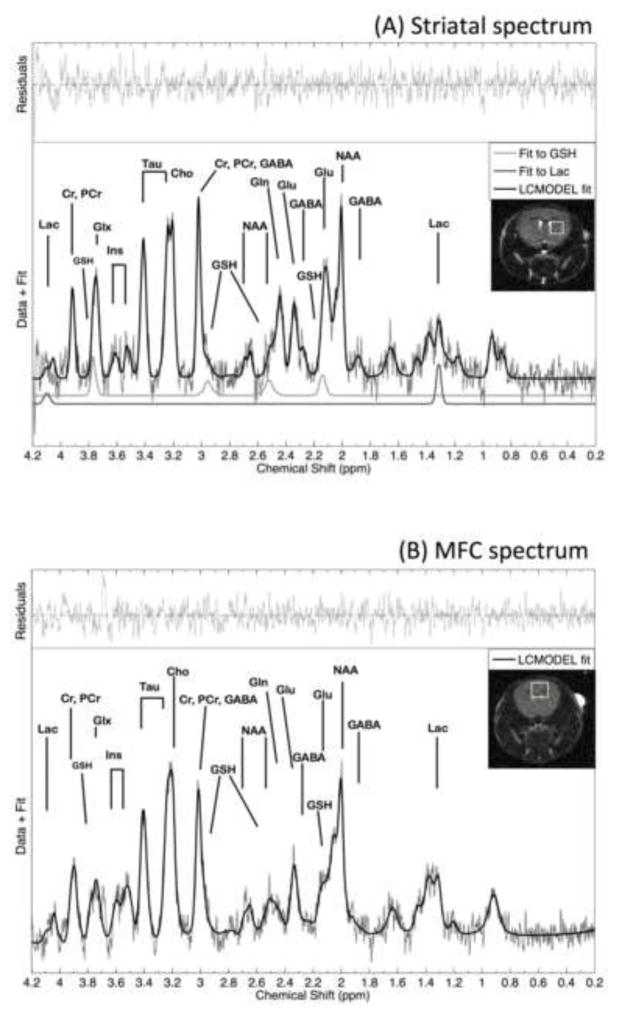
Methods: Striatal and medial frontal cortex 9.4 Tesla proton spectra were acquired from young adult SAPAP3 KO and wild-type control mice to determine whether KO mice have metabolic and neurochemical abnormalities.
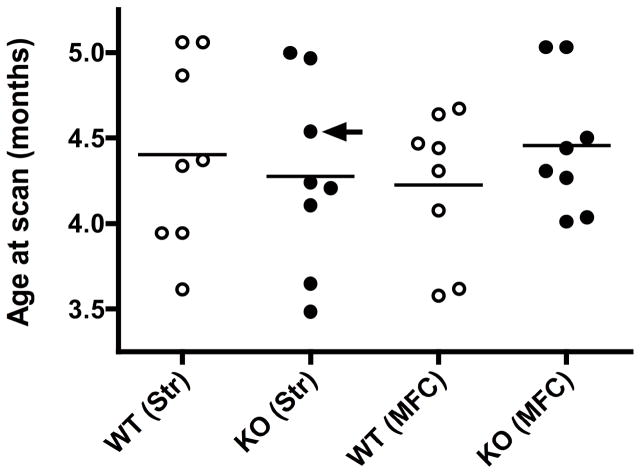
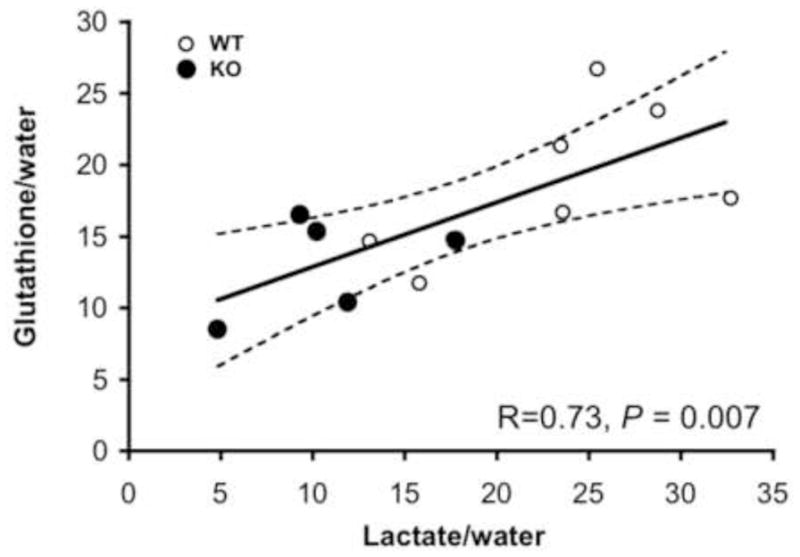
Results: Young adult KO mice had lower striatal lactate (P=0.006) and glutathione (P=0.039) levels. Among all mice, striatal lactate and glutathione levels were associated (R=0.73, P=0.007). We found no group differences in medial frontal cortex metabolites. At the age range studied, only 1 of 8 KO mice had skin lesions indicative of severe compulsive grooming.
Conclusion: Young adult SAPAP3 KO mice have striatal but not medial frontal cortex MRS abnormalities that may reflect striatal hypermetabolism accompanied by oxidative stress. These abnormalities typically preceded the onset of severe compulsive grooming. Our findings are consistent with striatal hypermetabolism in OCD. Together, these results suggest that striatal MRS measures of lactate or glutathione might be useful biomarkers for early detection of risk for developing compulsive behavior disorders.
Keywords: Magnetic resonance spectroscopy; Obsessive compulsive disorder; Oxidative stress; SAPAP3 protein; Striatal dysfunction; Translational model.
Figures
References
-
- Stengler K, Olbrich S, Heider D, Dietrich S, Riedel-Heller S, Jahn I. Mental health treatment seeking among patients with OCD: impact of age of onset. Soc Psychiatry Psychiatr Epidemiol. 2013;48:813–819. - PubMed
-
- American Psychiatric Association. Diagnostic and Statistical Manual of Mental Disorders: DSM-5. Washington, D.C: American Psychiatric Press; 2013.
-
- Güldenpfennig M, de Wolmarans W, du Preez JL, Stein DJ, Harvey BH. Cortico-striatal oxidative status, dopamine turnover and relation with stereotypy in the deer mouse. Physiol Behav. 2011;103:404–11. - PubMed
Grants and funding
LinkOut - more resources
Full Text Sources
Other Literature Sources
Research Materials